

Box 19.3 A System for Recording the Outcomes of Weed Biological
Control
Since the early 1990s, ‘complete’, ‘substantial’, or ‘negligible’ have been
accepted descriptions of achievements in weed biological control at the plant
population level (i.e. outcomes). These terms are too coarse and therefore can
be misleading. For example, a biological control programme might result in
the near-elimination (‘complete’ control), of the target weed in one area or
situation, but in ‘negligible’ control elsewhere, an outcome that would ‘average out’ as ‘substantial’ control. This is clearly unsatisfactory. Recently a more
elaborate and robust system has been developed for recording outcomes that
considers four different ‘invasion parameters’: density, area, biomass and
number of propagules (seeds), for different regions and habitats (Hoffmann
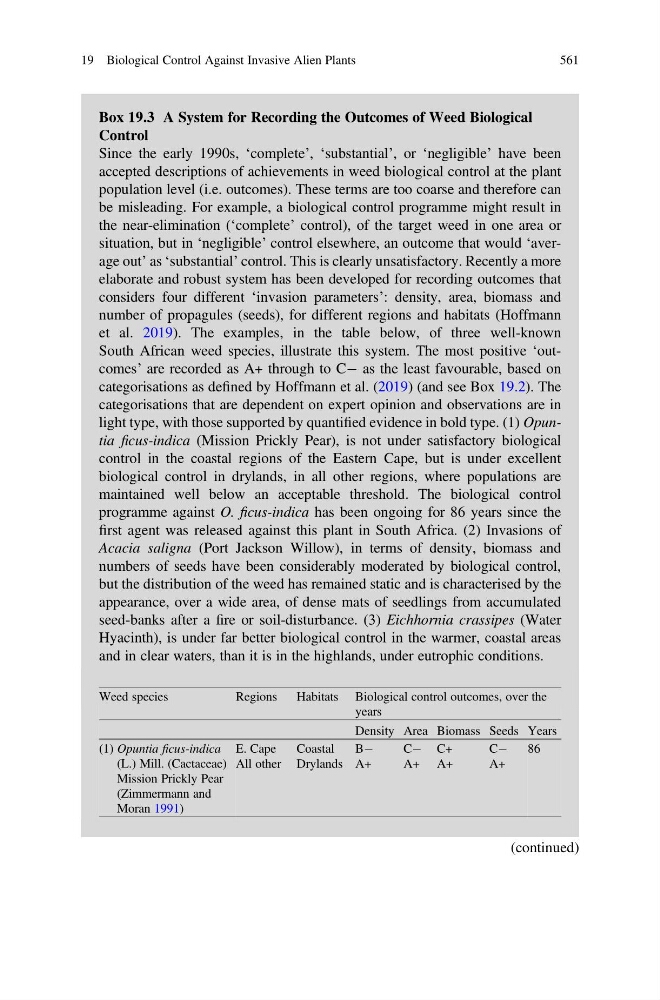
et al. 2019). The examples, in the table below, of three well-known
South African weed species, illustrate this system. The most positive ‘outcomes’ are recorded as A+ through to CÀ as the least favourable, based on
categorisations as defined by Hoffmann et al. (2019) (and see Box 19.2). The
categorisations that are dependent on expert opinion and observations are in
light type, with those supported by quantified evidence in bold type. (1) Opuntia ficus-indica (Mission Prickly Pear), is not under satisfactory biological
control in the coastal regions of the Eastern Cape, but is under excellent
biological control in drylands, in all other regions, where populations are
maintained well below an acceptable threshold. The biological control
programme against O. ficus-indica has been ongoing for 86 years since the
first agent was released against this plant in South Africa. (2) Invasions of
Acacia saligna (Port Jackson Willow), in terms of density, biomass and
numbers of seeds have been considerably moderated by biological control,
but the distribution of the weed has remained static and is characterised by the
appearance, over a wide area, of dense mats of seedlings from accumulated
seed-banks after a fire or soil-disturbance. (3) Eichhornia crassipes (Water
Hyacinth), is under far better biological control in the warmer, coastal areas
and in clear waters, than it is in the highlands, under eutrophic conditions.
Weed species
Regions
Habitats Biological control outcomes, over the
years
Density Area Biomass Seeds Years
(1) Opuntia ficus-indica
(L.) Mill. (Cactaceae)
Mission Prickly Pear
(Zimmermann and
Moran 1991)
E. Cape
Coastal
BÀ
CÀ C+
CÀ
86
All other Drylands A+
A+ A+
A+
(continued)
19 Biological Control Against Invasive Alien Plants
561