

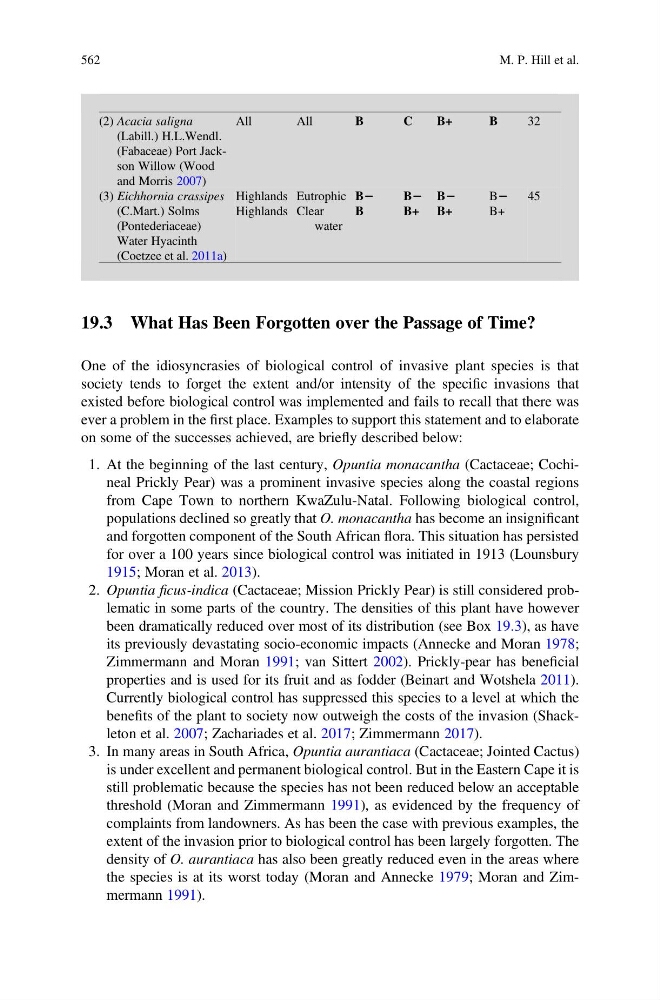
(2) Acacia saligna
(Labill.) H.L.Wendl.
(Fabaceae) Port Jackson Willow (Wood
and Morris 2007)
All
All
B
C
B+
B
32
(3) Eichhornia crassipes
(C.Mart.) Solms
(Pontederiaceae)
Water Hyacinth
(Coetzee et al. 2011a)
Highlands Eutrophic B2
B2 B2
B2
45
Highlands Clear
water
B
B + B +
B+
19.3 What Has Been Forgotten over the Passage of Time?
One of the idiosyncrasies of biological control of invasive plant species is that
society tends to forget the extent and/or intensity of the specific invasions that
existed before biological control was implemented and fails to recall that there was
ever a problem in the first place. Examples to support this statement and to elaborate
on some of the successes achieved, are briefly described below:
1. At the beginning of the last century, Opuntia monacantha (Cactaceae; Cochineal Prickly Pear) was a prominent invasive species along the coastal regions
from Cape Town to northern KwaZulu-Natal. Following biological control,
populations declined so greatly that O. monacantha has become an insignificant
and forgotten component of the South African flora. This situation has persisted
for over a 100 years since biological control was initiated in 1913 (Lounsbury
1915; Moran et al. 2013).
2. Opuntia ficus-indica (Cactaceae; Mission Prickly Pear) is still considered problematic in some parts of the country. The densities of this plant have however
been dramatically reduced over most of its distribution (see Box 19.3), as have
its previously devastating socio-economic impacts (Annecke and Moran 1978;
Zimmermann and Moran 1991; van Sittert 2002). Prickly-pear has beneficial
properties and is used for its fruit and as fodder (Beinart and Wotshela 2011).
Currently biological control has suppressed this species to a level at which the
benefits of the plant to society now outweigh the costs of the invasion (Shackleton et al. 2007; Zachariades et al. 2017; Zimmermann 2017).
3. In many areas in South Africa, Opuntia aurantiaca (Cactaceae; Jointed Cactus)
is under excellent and permanent biological control. But in the Eastern Cape it is
still problematic because the species has not been reduced below an acceptable
threshold (Moran and Zimmermann 1991), as evidenced by the frequency of
complaints from landowners. As has been the case with previous examples, the
extent of the invasion prior to biological control has been largely forgotten. The
density of O. aurantiaca has also been greatly reduced even in the areas where
the species is at its worst today (Moran and Annecke 1979; Moran and Zimmermann 1991).
562
M. P. Hill et al.