

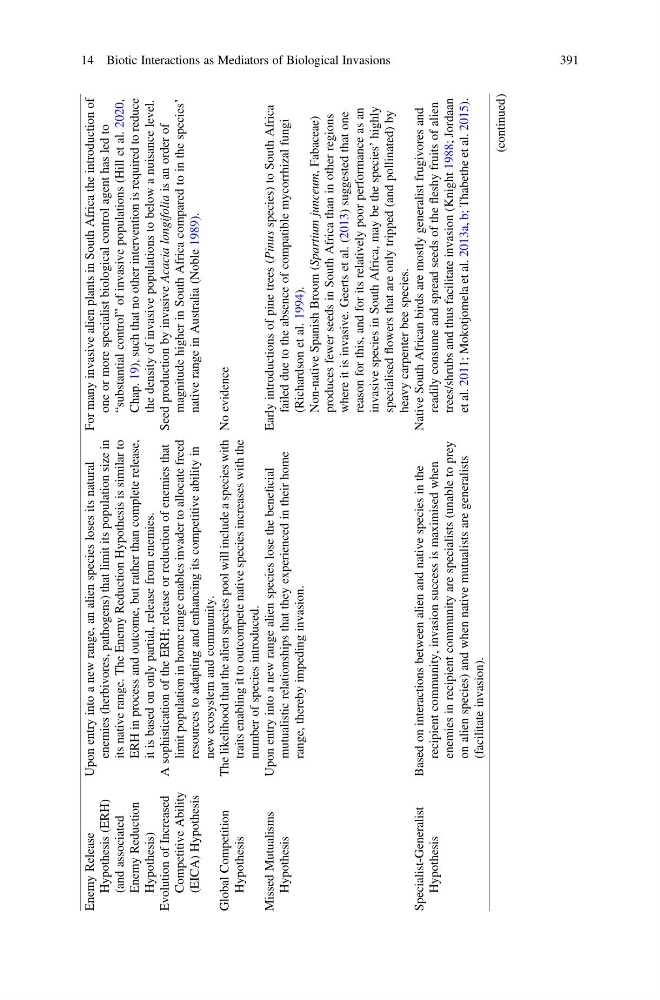
Enemy Release
Hypothesis (ERH)
(and associated
Enemy Reduction
Hypothesis)
Upon entry into a new range, an alien species loses its natural
enemies (herbivores, pathogens) that limit its population size in
its native range. The Enemy Reduction Hypothesis is similar to
ERH in process and outcome, but rather than complete release,
it is based on only partial, release from enemies.
For many invasive alien plants in South Africa the introduction of
one or more specialist biological control agent has led to
“substantial control” of invasive populations (Hill et al. 2020,
Chap. 19), such that no other intervention is required to reduce
the density of invasive populations to below a nuisance level.
Evolution of Increased
Competitive Ability
(EICA) Hypothesis
A sophistication of the ERH; release or reduction of enemies that
limit population in home range enables invader to allocate freed
resources to adapting and enhancing its competitive ability in
new ecosystem and community.
Seed production by invasive Acacia longifolia
is an order of
magnitude higher in South Africa compared to in the species’
native range in Australia (Noble 1989).
Global Competition
Hypothesis
The likelihood that the alien species pool will include a species with
traits enabling it to outcompete native species increases with the
number of species introduced.
No evidence
Missed Mutualisms
Hypothesis
Upon entry into a new range alien species lose the beneficial
mutualistic relationships that they experienced in their home
range, thereby impeding invasion.
Early introductions of pine trees (Pinus species) to South Africa
failed due to the absence of compatible mycorrhizal fungi
(Richardson et al. 1994).
Non-native Spanish Broom (Spartium junceum,
Fabaceae)
produces fewer seeds in South Africa than in other regions
where it is invasive. Geerts et al. (2013) suggested that one
reason for this, and for its relatively poor performance as an
invasive species in South Africa, may be the species’ highly
specialised
flowers that are only tripped (and pollinated) by
heavy carpenter bee species.
Specialist-Generalist
Hypothesis
Based on interactions between alien and native species in the
recipient community, invasion success is maximised when
enemies in recipient community are specialists (unable to prey
on alien species) and when native mutualists are generalists
(facilitate invasion).
Native South African birds are mostly generalist frugivores and
readily consume and spread seeds of the
fleshy fruits of alien
trees/shrubs and thus facilitate invasion (Knight 1988; Jordaan
et al. 2011; Mokotjomela et al. 2013a, b; Thabethe et al. 2015).
(continued)
14 Biotic Interactions as Mediators of Biological Invasions
391
Hypothesis (ERH)
(and associated
Enemy Reduction
Hypothesis)
Upon entry into a new range, an alien species loses its natural
enemies (herbivores, pathogens) that limit its population size in
its native range. The Enemy Reduction Hypothesis is similar to
ERH in process and outcome, but rather than complete release,
it is based on only partial, release from enemies.
For many invasive alien plants in South Africa the introduction of
one or more specialist biological control agent has led to
“substantial control” of invasive populations (Hill et al. 2020,
Chap. 19), such that no other intervention is required to reduce
the density of invasive populations to below a nuisance level.
Evolution of Increased
Competitive Ability
(EICA) Hypothesis
A sophistication of the ERH; release or reduction of enemies that
limit population in home range enables invader to allocate freed
resources to adapting and enhancing its competitive ability in
new ecosystem and community.
Seed production by invasive Acacia longifolia
is an order of
magnitude higher in South Africa compared to in the species’
native range in Australia (Noble 1989).
Global Competition
Hypothesis
The likelihood that the alien species pool will include a species with
traits enabling it to outcompete native species increases with the
number of species introduced.
No evidence
Missed Mutualisms
Hypothesis
Upon entry into a new range alien species lose the beneficial
mutualistic relationships that they experienced in their home
range, thereby impeding invasion.
Early introductions of pine trees (Pinus species) to South Africa
failed due to the absence of compatible mycorrhizal fungi
(Richardson et al. 1994).
Non-native Spanish Broom (Spartium junceum,
Fabaceae)
produces fewer seeds in South Africa than in other regions
where it is invasive. Geerts et al. (2013) suggested that one
reason for this, and for its relatively poor performance as an
invasive species in South Africa, may be the species’ highly
specialised
flowers that are only tripped (and pollinated) by
heavy carpenter bee species.
Specialist-Generalist
Hypothesis
Based on interactions between alien and native species in the
recipient community, invasion success is maximised when
enemies in recipient community are specialists (unable to prey
on alien species) and when native mutualists are generalists
(facilitate invasion).
Native South African birds are mostly generalist frugivores and
readily consume and spread seeds of the
fleshy fruits of alien
trees/shrubs and thus facilitate invasion (Knight 1988; Jordaan
et al. 2011; Mokotjomela et al. 2013a, b; Thabethe et al. 2015).
(continued)
14 Biotic Interactions as Mediators of Biological Invasions
391