

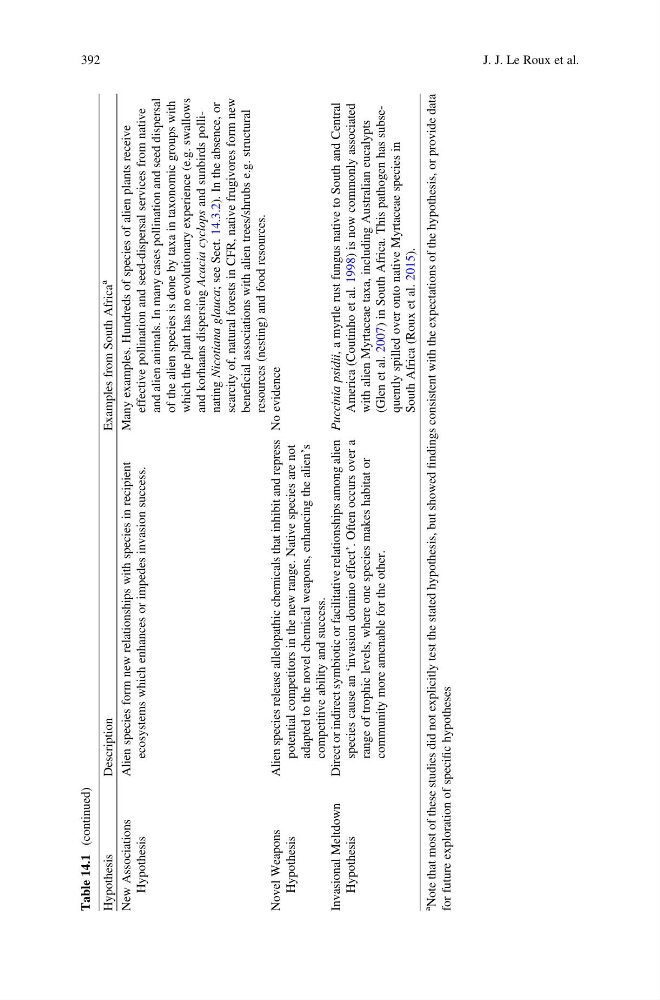
Table 14.1
(continued)
Hypothesis
Description
Examples from South Africa
a
New Associations
Hypothesis
Alien species form new relationships with species in recipient
ecosystems which enhances or impedes invasion success.
Many examples. Hundreds of species of alien plants receive
effective pollination and seed-dispersal services from native
and alien animals. In many cases pollination and seed dispersal
of the alien species is done by taxa in taxonomic groups with
which the plant has no evolutionary experience (e.g. swallows
and korhaans dispersing Acacia cyclops
and sunbirds pollinating Nicotiana glauca;
see Sect. 14.3.2). In the absence, or
scarcity of, natural forests in CFR, native frugivores form new
beneficial associations with alien trees/shrubs e.g. structural
resources (nesting) and food resources.
Novel Weapons
Hypothesis
Alien species release allelopathic chemicals that inhibit and repress
potential competitors in the new range. Native species are not
adapted to the novel chemical weapons, enhancing the alien’s
competitive ability and success.
No evidence
Invasional Meltdown
Hypothesis
Direct or indirect symbiotic or facilitative relationships among alien
species cause an
‘invasion domino effect’. Often occurs over a
range of trophic levels, where one species makes habitat or
community more amenable for the other.
Puccinia psidii,
a myrtle rust fungus native to South and Central
America (Coutinho et al. 1998) is now commonly associated
with alien Myrtaceae taxa, including Australian eucalypts
(Glen et al. 2007) in South Africa. This pathogen has subsequently spilled over onto native Myrtaceae species in
South Africa (Roux et al. 2015).
a
Note that most of these studies did not explicitly test the stated hypothesis, but showed
findings consistent with the expectations of the hypothesis, or provide data
for future exploration of specific hypotheses
392
J. J. Le Roux et al.
(continued)
Hypothesis
Description
Examples from South Africa
a
New Associations
Hypothesis
Alien species form new relationships with species in recipient
ecosystems which enhances or impedes invasion success.
Many examples. Hundreds of species of alien plants receive
effective pollination and seed-dispersal services from native
and alien animals. In many cases pollination and seed dispersal
of the alien species is done by taxa in taxonomic groups with
which the plant has no evolutionary experience (e.g. swallows
and korhaans dispersing Acacia cyclops
and sunbirds pollinating Nicotiana glauca;
see Sect. 14.3.2). In the absence, or
scarcity of, natural forests in CFR, native frugivores form new
beneficial associations with alien trees/shrubs e.g. structural
resources (nesting) and food resources.
Novel Weapons
Hypothesis
Alien species release allelopathic chemicals that inhibit and repress
potential competitors in the new range. Native species are not
adapted to the novel chemical weapons, enhancing the alien’s
competitive ability and success.
No evidence
Invasional Meltdown
Hypothesis
Direct or indirect symbiotic or facilitative relationships among alien
species cause an
‘invasion domino effect’. Often occurs over a
range of trophic levels, where one species makes habitat or
community more amenable for the other.
Puccinia psidii,
a myrtle rust fungus native to South and Central
America (Coutinho et al. 1998) is now commonly associated
with alien Myrtaceae taxa, including Australian eucalypts
(Glen et al. 2007) in South Africa. This pathogen has subsequently spilled over onto native Myrtaceae species in
South Africa (Roux et al. 2015).
a
Note that most of these studies did not explicitly test the stated hypothesis, but showed
findings consistent with the expectations of the hypothesis, or provide data
for future exploration of specific hypotheses
392
J. J. Le Roux et al.