

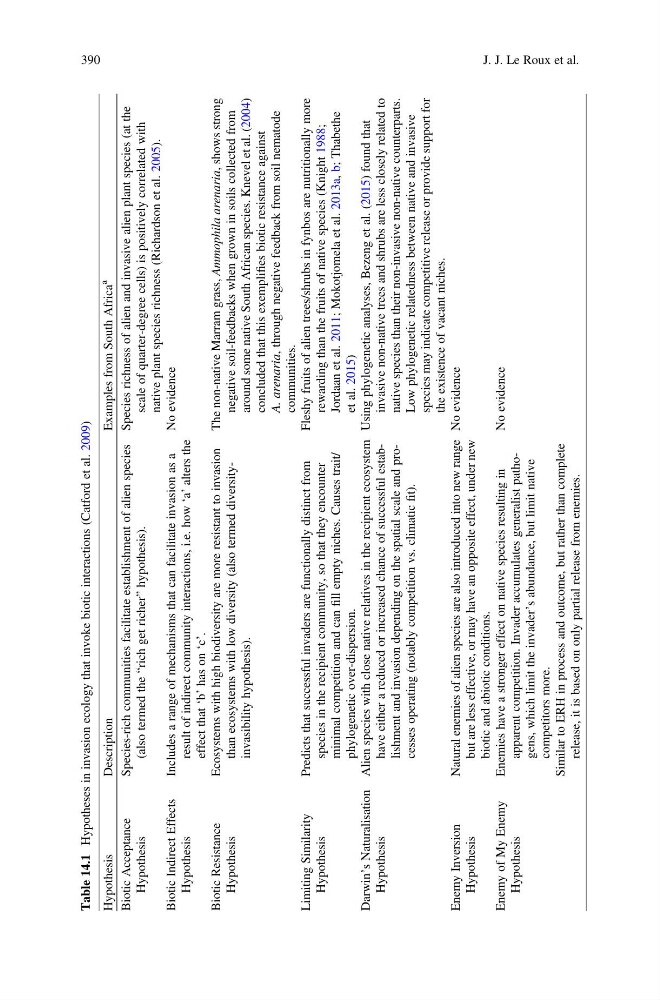
Table 14.1
Hypotheses in invasion ecology that invoke biotic interactions (Catford et al. 2009)
Hypothesis
Description
Examples from South Africa
a
Biotic Acceptance
Hypothesis
Species-rich communities facilitate establishment of alien species
(also termed the
“rich get richer” hypothesis).
Species richness of alien and invasive alien plant species (at the
scale of quarter-degree cells) is positively correlated with
native plant species richness (Richardson et al. 2005).
Biotic Indirect Effects
Hypothesis
Includes a range of mechanisms that can facilitate invasion as a
result of indirect community interactions, i.e. how
‘a’ alters the
effect that
‘b’ has on
‘c’.
No evidence
Biotic Resistance
Hypothesis
Ecosystems with high biodiversity are more resistant to invasion
than ecosystems with low diversity (also termed diversityinvasibility hypothesis).
The non-native Marram grass, Ammophila arenaria,
shows strong
negative soil-feedbacks when grown in soils collected from
around some native South African species. Knevel et al. (2004)
concluded that this exemplifies biotic resistance against
A. arenaria,
through negative feedback from soil nematode
communities.
Limiting Similarity
Hypothesis
Predicts that successful invaders are functionally distinct from
species in the recipient community, so that they encounter
minimal competition and can
fill empty niches. Causes trait/
phylogenetic over-dispersion.
Fleshy fruits of alien trees/shrubs in fynbos are nutritionally more
rewarding than the fruits of native species (Knight 1988;
Jordaan et al. 2011; Mokotjomela et al. 2013a, b; Thabethe
et al. 2015)
Darwin’s Naturalisation
Hypothesis
Alien species with close native relatives in the recipient ecosystem
have either a reduced or increased chance of successful establishment and invasion depending on the spatial scale and processes operating (notably competition vs. climatic
fit).
Using phylogenetic analyses, Bezeng et al. (2015) found that
invasive non-native trees and shrubs are less closely related to
native species than their non-invasive non-native counterparts.
Low phylogenetic relatedness between native and invasive
species may indicate competitive release or provide support for
the existence of vacant niches.
Enemy Inversion
Hypothesis
Natural enemies of alien species are also introduced into new range
but are less effective, or may have an opposite effect, under new
biotic and abiotic conditions.
No evidence
Enemy of My Enemy
Hypothesis
Enemies have a stronger effect on native species resulting in
apparent competition. Invader accumulates generalist pathogens, which limit the invader’s abundance, but limit native
competitors more.
Similar to ERH in process and outcome, but rather than complete
release, it is based on only partial release from enemies.
No evidence
390
J. J. Le Roux et al.
Hypotheses in invasion ecology that invoke biotic interactions (Catford et al. 2009)
Hypothesis
Description
Examples from South Africa
a
Biotic Acceptance
Hypothesis
Species-rich communities facilitate establishment of alien species
(also termed the
“rich get richer” hypothesis).
Species richness of alien and invasive alien plant species (at the
scale of quarter-degree cells) is positively correlated with
native plant species richness (Richardson et al. 2005).
Biotic Indirect Effects
Hypothesis
Includes a range of mechanisms that can facilitate invasion as a
result of indirect community interactions, i.e. how
‘a’ alters the
effect that
‘b’ has on
‘c’.
No evidence
Biotic Resistance
Hypothesis
Ecosystems with high biodiversity are more resistant to invasion
than ecosystems with low diversity (also termed diversityinvasibility hypothesis).
The non-native Marram grass, Ammophila arenaria,
shows strong
negative soil-feedbacks when grown in soils collected from
around some native South African species. Knevel et al. (2004)
concluded that this exemplifies biotic resistance against
A. arenaria,
through negative feedback from soil nematode
communities.
Limiting Similarity
Hypothesis
Predicts that successful invaders are functionally distinct from
species in the recipient community, so that they encounter
minimal competition and can
fill empty niches. Causes trait/
phylogenetic over-dispersion.
Fleshy fruits of alien trees/shrubs in fynbos are nutritionally more
rewarding than the fruits of native species (Knight 1988;
Jordaan et al. 2011; Mokotjomela et al. 2013a, b; Thabethe
et al. 2015)
Darwin’s Naturalisation
Hypothesis
Alien species with close native relatives in the recipient ecosystem
have either a reduced or increased chance of successful establishment and invasion depending on the spatial scale and processes operating (notably competition vs. climatic
fit).
Using phylogenetic analyses, Bezeng et al. (2015) found that
invasive non-native trees and shrubs are less closely related to
native species than their non-invasive non-native counterparts.
Low phylogenetic relatedness between native and invasive
species may indicate competitive release or provide support for
the existence of vacant niches.
Enemy Inversion
Hypothesis
Natural enemies of alien species are also introduced into new range
but are less effective, or may have an opposite effect, under new
biotic and abiotic conditions.
No evidence
Enemy of My Enemy
Hypothesis
Enemies have a stronger effect on native species resulting in
apparent competition. Invader accumulates generalist pathogens, which limit the invader’s abundance, but limit native
competitors more.
Similar to ERH in process and outcome, but rather than complete
release, it is based on only partial release from enemies.
No evidence
390
J. J. Le Roux et al.