

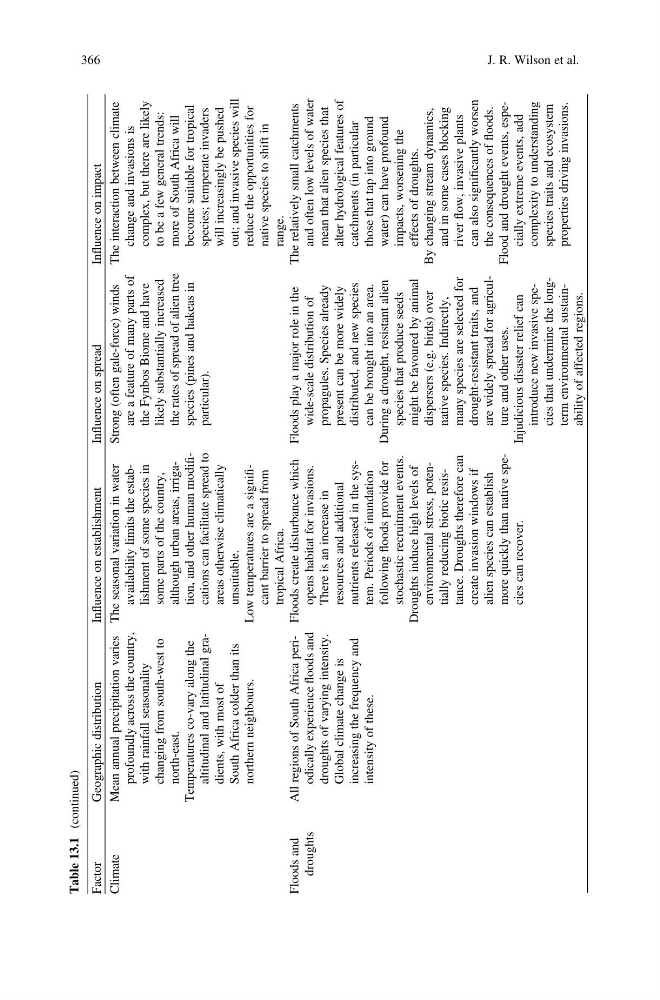
Table 13.1
(continued)
Factor
Geographic distribution
Influence on establishment
Influence on spread
Influence on impact
Climate
Mean annual precipitation varies
profoundly across the country,
with rainfall seasonality
changing from south-west to
north-east.
Temperatures co-vary along the
altitudinal and latitudinal gradients, with most of
South Africa colder than its
northern neighbours.
The seasonal variation in water
availability limits the establishment of some species in
some parts of the country,
although urban areas, irrigation, and other human modifications can facilitate spread to
areas otherwise climatically
unsuitable.
Low temperatures are a significant barrier to spread from
tropical Africa.
Strong (often gale-force) winds
are a feature of many parts of
the Fynbos Biome and have
likely substantially increased
the rates of spread of alien tree
species (pines and hakeas in
particular).
The interaction between climate
change and invasions is
complex, but there are likely
to be a few general trends:
more of South Africa will
become suitable for tropical
species; temperate invaders
will increasingly be pushed
out; and invasive species will
reduce the opportunities for
native species to shift in
range.
Floods and
droughts
All regions of South Africa periodically experience
floods and
droughts of varying intensity.
Global climate change is
increasing the frequency and
intensity of these.
Floods create disturbance which
opens habitat for invasions.
There is an increase in
resources and additional
nutrients released in the system. Periods of inundation
following
floods provide for
stochastic recruitment events.
Droughts induce high levels of
environmental stress, potentially reducing biotic resistance. Droughts therefore can
create invasion windows if
alien species can establish
more quickly than native species can recover.
Floods play a major role in the
wide-scale distribution of
propagules. Species already
present can be more widely
distributed, and new species
can be brought into an area.
During a drought, resistant alien
species that produce seeds
might be favoured by animal
dispersers (e.g. birds) over
native species. Indirectly,
many species are selected for
drought-resistant traits, and
are widely spread for agriculture and other uses.
Injudicious disaster relief can
introduce new invasive species that undermine the longterm environmental sustainability of affected regions.
The relatively small catchments
and often low levels of water
mean that alien species that
alter hydrological features of
catchments (in particular
those that tap into ground
water) can have profound
impacts, worsening the
effects of droughts.
By changing stream dynamics,
and in some cases blocking
river
flow, invasive plants
can also significantly worsen
the consequences of
floods.
Flood and drought events, especially extreme events, add
complexity to understanding
species traits and ecosystem
properties driving invasions.
366
J. R. Wilson et al.
(continued)
Factor
Geographic distribution
Influence on establishment
Influence on spread
Influence on impact
Climate
Mean annual precipitation varies
profoundly across the country,
with rainfall seasonality
changing from south-west to
north-east.
Temperatures co-vary along the
altitudinal and latitudinal gradients, with most of
South Africa colder than its
northern neighbours.
The seasonal variation in water
availability limits the establishment of some species in
some parts of the country,
although urban areas, irrigation, and other human modifications can facilitate spread to
areas otherwise climatically
unsuitable.
Low temperatures are a significant barrier to spread from
tropical Africa.
Strong (often gale-force) winds
are a feature of many parts of
the Fynbos Biome and have
likely substantially increased
the rates of spread of alien tree
species (pines and hakeas in
particular).
The interaction between climate
change and invasions is
complex, but there are likely
to be a few general trends:
more of South Africa will
become suitable for tropical
species; temperate invaders
will increasingly be pushed
out; and invasive species will
reduce the opportunities for
native species to shift in
range.
Floods and
droughts
All regions of South Africa periodically experience
floods and
droughts of varying intensity.
Global climate change is
increasing the frequency and
intensity of these.
Floods create disturbance which
opens habitat for invasions.
There is an increase in
resources and additional
nutrients released in the system. Periods of inundation
following
floods provide for
stochastic recruitment events.
Droughts induce high levels of
environmental stress, potentially reducing biotic resistance. Droughts therefore can
create invasion windows if
alien species can establish
more quickly than native species can recover.
Floods play a major role in the
wide-scale distribution of
propagules. Species already
present can be more widely
distributed, and new species
can be brought into an area.
During a drought, resistant alien
species that produce seeds
might be favoured by animal
dispersers (e.g. birds) over
native species. Indirectly,
many species are selected for
drought-resistant traits, and
are widely spread for agriculture and other uses.
Injudicious disaster relief can
introduce new invasive species that undermine the longterm environmental sustainability of affected regions.
The relatively small catchments
and often low levels of water
mean that alien species that
alter hydrological features of
catchments (in particular
those that tap into ground
water) can have profound
impacts, worsening the
effects of droughts.
By changing stream dynamics,
and in some cases blocking
river
flow, invasive plants
can also significantly worsen
the consequences of
floods.
Flood and drought events, especially extreme events, add
complexity to understanding
species traits and ecosystem
properties driving invasions.
366
J. R. Wilson et al.