

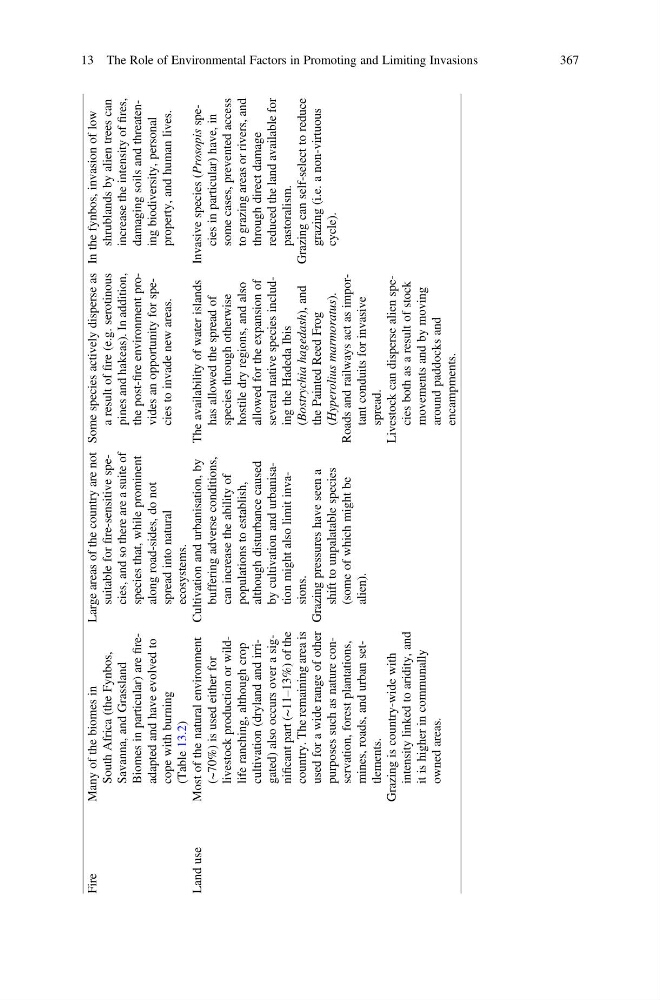
Fire
Many of the biomes in
South Africa (the Fynbos,
Savanna, and Grassland
Biomes in particular) are
fireadapted and have evolved to
cope with burning
(Table 13.2)
Large areas of the country are not
suitable for
fire-sensitive species, and so there are a suite of
species that, while prominent
along road-sides, do not
spread into natural
ecosystems.
Some species actively disperse as
a result of
fire (e.g. serotinous
pines and hakeas). In addition,
the post-fire environment provides an opportunity for species to invade new areas.
In the fynbos, invasion of low
shrublands by alien trees can
increase the intensity of
fires,
damaging soils and threatening biodiversity, personal
property, and human lives.
Land use
Most of the natural environment
(~70%) is used either for
livestock production or wildlife ranching, although crop
cultivation (dryland and irrigated) also occurs over a significant part (~11–13%) of the
country. The remaining area is
used for a wide range of other
purposes such as nature conservation, forest plantations,
mines, roads, and urban settlements.
Grazing is country-wide with
intensity linked to aridity, and
it is higher in communally
owned areas.
Cultivation and urbanisation, by
buffering adverse conditions,
can increase the ability of
populations to establish,
although disturbance caused
by cultivation and urbanisation might also limit invasions.
Grazing pressures have seen a
shift to unpalatable species
(some of which might be
alien).
The availability of water islands
has allowed the spread of
species through otherwise
hostile dry regions, and also
allowed for the expansion of
several native species including the Hadeda Ibis
(Bostrychia hagedash),
and
the Painted Reed Frog
(Hyperolius marmoratus).
Roads and railways act as important conduits for invasive
spread.
Livestock can disperse alien species both as a result of stock
movements and by moving
around paddocks and
encampments.
Invasive species (Prosopis species in particular) have, in
some cases, prevented access
to grazing areas or rivers, and
through direct damage
reduced the land available for
pastoralism.
Grazing can self-select to reduce
grazing (i.e. a non-virtuous
cycle).
13 The Role of Environmental Factors in Promoting and Limiting Invasions
367
Many of the biomes in
South Africa (the Fynbos,
Savanna, and Grassland
Biomes in particular) are
fireadapted and have evolved to
cope with burning
(Table 13.2)
Large areas of the country are not
suitable for
fire-sensitive species, and so there are a suite of
species that, while prominent
along road-sides, do not
spread into natural
ecosystems.
Some species actively disperse as
a result of
fire (e.g. serotinous
pines and hakeas). In addition,
the post-fire environment provides an opportunity for species to invade new areas.
In the fynbos, invasion of low
shrublands by alien trees can
increase the intensity of
fires,
damaging soils and threatening biodiversity, personal
property, and human lives.
Land use
Most of the natural environment
(~70%) is used either for
livestock production or wildlife ranching, although crop
cultivation (dryland and irrigated) also occurs over a significant part (~11–13%) of the
country. The remaining area is
used for a wide range of other
purposes such as nature conservation, forest plantations,
mines, roads, and urban settlements.
Grazing is country-wide with
intensity linked to aridity, and
it is higher in communally
owned areas.
Cultivation and urbanisation, by
buffering adverse conditions,
can increase the ability of
populations to establish,
although disturbance caused
by cultivation and urbanisation might also limit invasions.
Grazing pressures have seen a
shift to unpalatable species
(some of which might be
alien).
The availability of water islands
has allowed the spread of
species through otherwise
hostile dry regions, and also
allowed for the expansion of
several native species including the Hadeda Ibis
(Bostrychia hagedash),
and
the Painted Reed Frog
(Hyperolius marmoratus).
Roads and railways act as important conduits for invasive
spread.
Livestock can disperse alien species both as a result of stock
movements and by moving
around paddocks and
encampments.
Invasive species (Prosopis species in particular) have, in
some cases, prevented access
to grazing areas or rivers, and
through direct damage
reduced the land available for
pastoralism.
Grazing can self-select to reduce
grazing (i.e. a non-virtuous
cycle).
13 The Role of Environmental Factors in Promoting and Limiting Invasions
367