

near Port Elizabeth was built in the 2000s (Mitchell 2014c)]. Today, people, goods
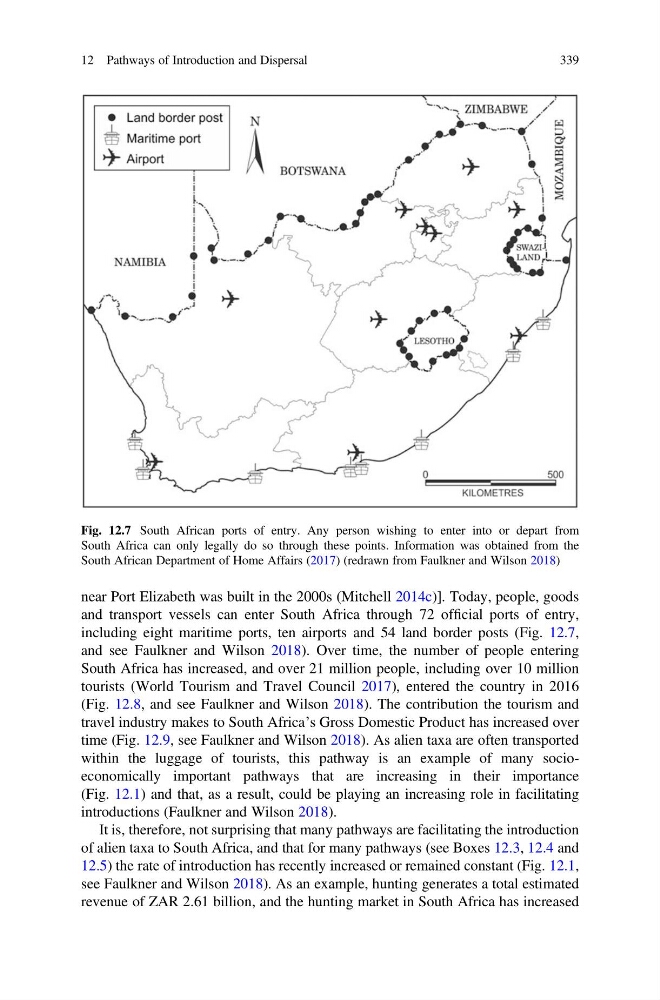
and transport vessels can enter South Africa through 72 official ports of entry,
including eight maritime ports, ten airports and 54 land border posts (Fig. 12.7,
and see Faulkner and Wilson 2018). Over time, the number of people entering
South Africa has increased, and over 21 million people, including over 10 million
tourists (World Tourism and Travel Council 2017), entered the country in 2016
(Fig. 12.8, and see Faulkner and Wilson 2018). The contribution the tourism and
travel industry makes to South Africa’s Gross Domestic Product has increased over
time (Fig. 12.9, see Faulkner and Wilson 2018). As alien taxa are often transported
within the luggage of tourists, this pathway is an example of many socioeconomically important pathways that are increasing in their importance
(Fig. 12.1) and that, as a result, could be playing an increasing role in facilitating
introductions (Faulkner and Wilson 2018).
It is, therefore, not surprising that many pathways are facilitating the introduction
of alien taxa to South Africa, and that for many pathways (see Boxes 12.3, 12.4 and
12.5) the rate of introduction has recently increased or remained constant (Fig. 12.1,
see Faulkner and Wilson 2018). As an example, hunting generates a total estimated
revenue of ZAR 2.61 billion, and the hunting market in South Africa has increased
Fig. 12.7 South African ports of entry. Any person wishing to enter into or depart from
South Africa can only legally do so through these points. Information was obtained from the
South African Department of Home Affairs (2017) (redrawn from Faulkner and Wilson 2018)
12 Pathways of Introduction and Dispersal
339
and transport vessels can enter South Africa through 72 official ports of entry,
including eight maritime ports, ten airports and 54 land border posts (Fig. 12.7,
and see Faulkner and Wilson 2018). Over time, the number of people entering
South Africa has increased, and over 21 million people, including over 10 million
tourists (World Tourism and Travel Council 2017), entered the country in 2016
(Fig. 12.8, and see Faulkner and Wilson 2018). The contribution the tourism and
travel industry makes to South Africa’s Gross Domestic Product has increased over
time (Fig. 12.9, see Faulkner and Wilson 2018). As alien taxa are often transported
within the luggage of tourists, this pathway is an example of many socioeconomically important pathways that are increasing in their importance
(Fig. 12.1) and that, as a result, could be playing an increasing role in facilitating
introductions (Faulkner and Wilson 2018).
It is, therefore, not surprising that many pathways are facilitating the introduction
of alien taxa to South Africa, and that for many pathways (see Boxes 12.3, 12.4 and
12.5) the rate of introduction has recently increased or remained constant (Fig. 12.1,
see Faulkner and Wilson 2018). As an example, hunting generates a total estimated
revenue of ZAR 2.61 billion, and the hunting market in South Africa has increased
Fig. 12.7 South African ports of entry. Any person wishing to enter into or depart from
South Africa can only legally do so through these points. Information was obtained from the
South African Department of Home Affairs (2017) (redrawn from Faulkner and Wilson 2018)
12 Pathways of Introduction and Dispersal
339