

Box 12.5 (continued)
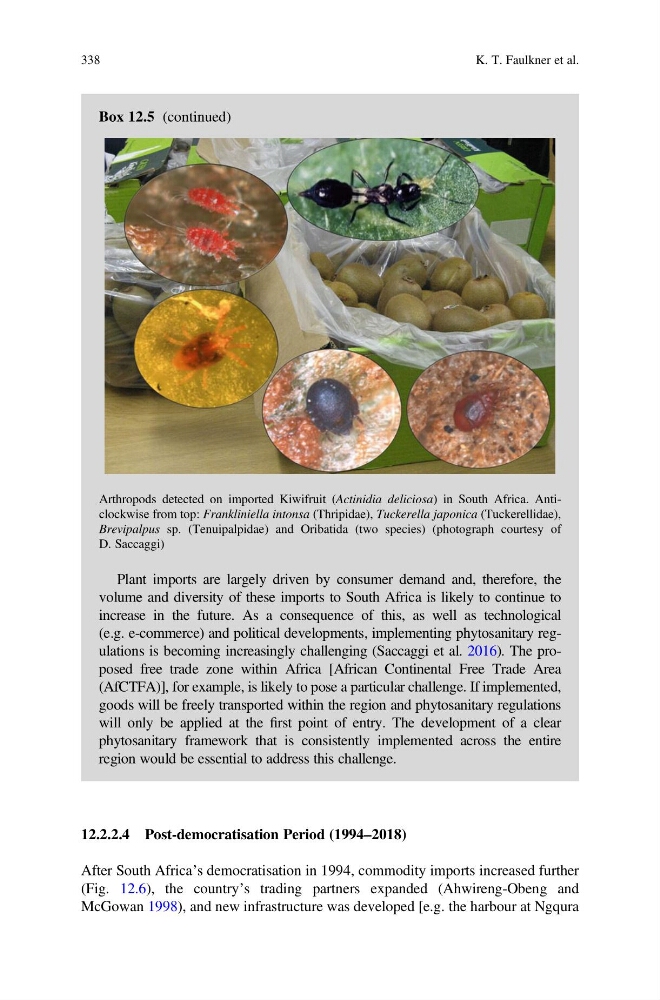
Arthropods detected on imported Kiwifruit (Actinidia deliciosa) in South Africa. Anticlockwise from top: Frankliniella intonsa (Thripidae), Tuckerella japonica (Tuckerellidae),
Brevipalpus sp. (Tenuipalpidae) and Oribatida (two species) (photograph courtesy of
D. Saccaggi)
Plant imports are largely driven by consumer demand and, therefore, the
volume and diversity of these imports to South Africa is likely to continue to
increase in the future. As a consequence of this, as well as technological
(e.g. e-commerce) and political developments, implementing phytosanitary regulations is becoming increasingly challenging (Saccaggi et al. 2016). The proposed free trade zone within Africa [African Continental Free Trade Area
(AfCTFA)], for example, is likely to pose a particular challenge. If implemented,
goods will be freely transported within the region and phytosanitary regulations
will only be applied at the first point of entry. The development of a clear
phytosanitary framework that is consistently implemented across the entire
region would be essential to address this challenge.
12.2.2.4 Post-democratisation Period (1994–2018)
After South Africa’s democratisation in 1994, commodity imports increased further
(Fig. 12.6), the country’s trading partners expanded (Ahwireng-Obeng and
McGowan 1998), and new infrastructure was developed [e.g. the harbour at Ngqura
338
K. T. Faulkner et al.
Arthropods detected on imported Kiwifruit (Actinidia deliciosa) in South Africa. Anticlockwise from top: Frankliniella intonsa (Thripidae), Tuckerella japonica (Tuckerellidae),
Brevipalpus sp. (Tenuipalpidae) and Oribatida (two species) (photograph courtesy of
D. Saccaggi)
Plant imports are largely driven by consumer demand and, therefore, the
volume and diversity of these imports to South Africa is likely to continue to
increase in the future. As a consequence of this, as well as technological
(e.g. e-commerce) and political developments, implementing phytosanitary regulations is becoming increasingly challenging (Saccaggi et al. 2016). The proposed free trade zone within Africa [African Continental Free Trade Area
(AfCTFA)], for example, is likely to pose a particular challenge. If implemented,
goods will be freely transported within the region and phytosanitary regulations
will only be applied at the first point of entry. The development of a clear
phytosanitary framework that is consistently implemented across the entire
region would be essential to address this challenge.
12.2.2.4 Post-democratisation Period (1994–2018)
After South Africa’s democratisation in 1994, commodity imports increased further
(Fig. 12.6), the country’s trading partners expanded (Ahwireng-Obeng and
McGowan 1998), and new infrastructure was developed [e.g. the harbour at Ngqura
338
K. T. Faulkner et al.