

Box 12.5 (continued)
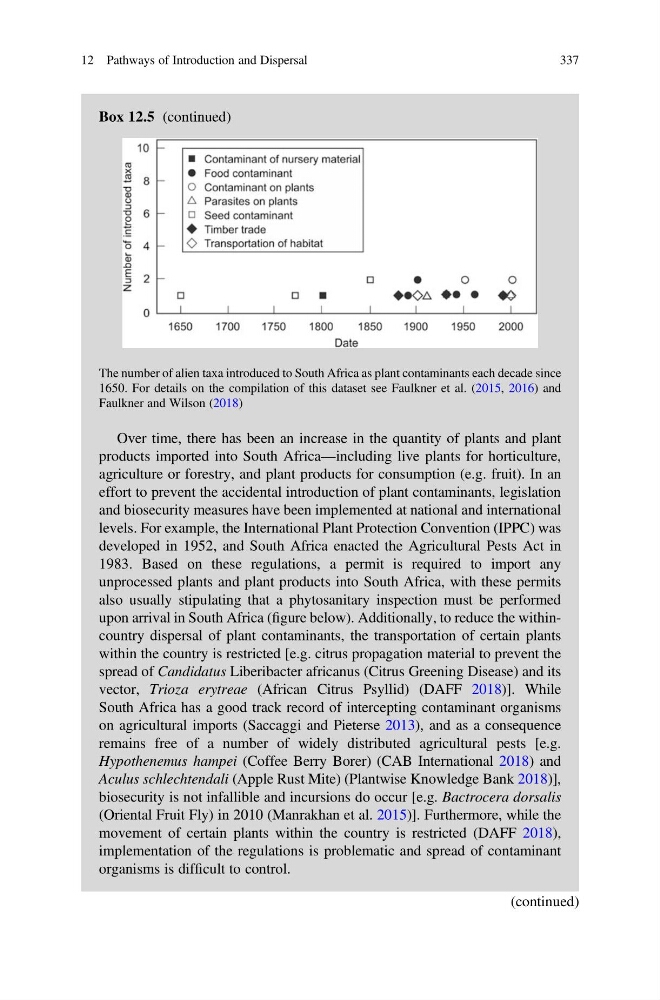
The number of alien taxa introduced to South Africa as plant contaminants each decade since
1650. For details on the compilation of this dataset see Faulkner et al. (2015, 2016) and
Faulkner and Wilson (2018)
Over time, there has been an increase in the quantity of plants and plant
products imported into South Africa—including live plants for horticulture,
agriculture or forestry, and plant products for consumption (e.g. fruit). In an
effort to prevent the accidental introduction of plant contaminants, legislation
and biosecurity measures have been implemented at national and international
levels. For example, the International Plant Protection Convention (IPPC) was
developed in 1952, and South Africa enacted the Agricultural Pests Act in
1983. Based on these regulations, a permit is required to import any
unprocessed plants and plant products into South Africa, with these permits
also usually stipulating that a phytosanitary inspection must be performed
upon arrival in South Africa (figure below). Additionally, to reduce the withincountry dispersal of plant contaminants, the transportation of certain plants
within the country is restricted [e.g. citrus propagation material to prevent the
spread of Candidatus Liberibacter africanus (Citrus Greening Disease) and its
vector, Trioza erytreae (African Citrus Psyllid) (DAFF 2018)]. While
South Africa has a good track record of intercepting contaminant organisms
on agricultural imports (Saccaggi and Pieterse 2013), and as a consequence
remains free of a number of widely distributed agricultural pests [e.g.
Hypothenemus hampei (Coffee Berry Borer) (CAB International 2018) and
Aculus schlechtendali (Apple Rust Mite) (Plantwise Knowledge Bank 2018)],
biosecurity is not infallible and incursions do occur [e.g. Bactrocera dorsalis
(Oriental Fruit Fly) in 2010 (Manrakhan et al. 2015)]. Furthermore, while the
movement of certain plants within the country is restricted (DAFF 2018),
implementation of the regulations is problematic and spread of contaminant
organisms is difficult to control.
(continued)
12 Pathways of Introduction and Dispersal
337
The number of alien taxa introduced to South Africa as plant contaminants each decade since
1650. For details on the compilation of this dataset see Faulkner et al. (2015, 2016) and
Faulkner and Wilson (2018)
Over time, there has been an increase in the quantity of plants and plant
products imported into South Africa—including live plants for horticulture,
agriculture or forestry, and plant products for consumption (e.g. fruit). In an
effort to prevent the accidental introduction of plant contaminants, legislation
and biosecurity measures have been implemented at national and international
levels. For example, the International Plant Protection Convention (IPPC) was
developed in 1952, and South Africa enacted the Agricultural Pests Act in
1983. Based on these regulations, a permit is required to import any
unprocessed plants and plant products into South Africa, with these permits
also usually stipulating that a phytosanitary inspection must be performed
upon arrival in South Africa (figure below). Additionally, to reduce the withincountry dispersal of plant contaminants, the transportation of certain plants
within the country is restricted [e.g. citrus propagation material to prevent the
spread of Candidatus Liberibacter africanus (Citrus Greening Disease) and its
vector, Trioza erytreae (African Citrus Psyllid) (DAFF 2018)]. While
South Africa has a good track record of intercepting contaminant organisms
on agricultural imports (Saccaggi and Pieterse 2013), and as a consequence
remains free of a number of widely distributed agricultural pests [e.g.
Hypothenemus hampei (Coffee Berry Borer) (CAB International 2018) and
Aculus schlechtendali (Apple Rust Mite) (Plantwise Knowledge Bank 2018)],
biosecurity is not infallible and incursions do occur [e.g. Bactrocera dorsalis
(Oriental Fruit Fly) in 2010 (Manrakhan et al. 2015)]. Furthermore, while the
movement of certain plants within the country is restricted (DAFF 2018),
implementation of the regulations is problematic and spread of contaminant
organisms is difficult to control.
(continued)
12 Pathways of Introduction and Dispersal
337