

Box 12.3 (continued)
in 1852 that the first marine alien species [the bryozoan Virididentula dentata
(previously known as Bugula dentata)] was recorded (Busk 1852). At the
time, wooden ships were in use and dry ballasts (e.g. rocks and sand) were
used for stability (Griffiths et al. 2009). As a consequence, the first marine
introductions included fouling organisms (e.g. bryozoans and barnacles),
wood-boring organisms [e.g. shipworms like Teredo navalis (Noble 1886)]
and intertidal species that were accidentally loaded with dry ballast. During
this time, Table Bay, Port Elizabeth and Durban harbours were the primary
ports (Mitchell 2014c) and these, along with the naval harbour at Simon’s
Town [where the shipworm Lyrodus pedicellatus was detected (Moll and
Roch 1931)], probably played an important role in early marine introductions.
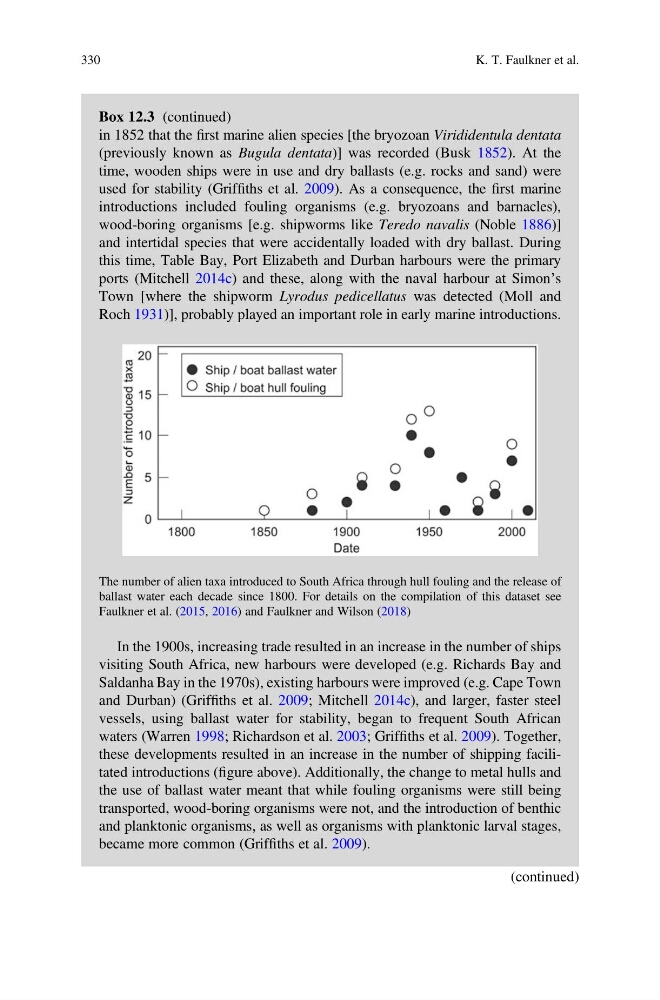
The number of alien taxa introduced to South Africa through hull fouling and the release of
ballast water each decade since 1800. For details on the compilation of this dataset see
Faulkner et al. (2015, 2016) and Faulkner and Wilson (2018)
In the 1900s, increasing trade resulted in an increase in the number of ships
visiting South Africa, new harbours were developed (e.g. Richards Bay and
Saldanha Bay in the 1970s), existing harbours were improved (e.g. Cape Town
and Durban) (Griffiths et al. 2009; Mitchell 2014c), and larger, faster steel
vessels, using ballast water for stability, began to frequent South African
waters (Warren 1998; Richardson et al. 2003; Griffiths et al. 2009). Together,
these developments resulted in an increase in the number of shipping facilitated introductions (figure above). Additionally, the change to metal hulls and
the use of ballast water meant that while fouling organisms were still being
transported, wood-boring organisms were not, and the introduction of benthic
and planktonic organisms, as well as organisms with planktonic larval stages,
became more common (Griffiths et al. 2009).
(continued)
330
K. T. Faulkner et al.
in 1852 that the first marine alien species [the bryozoan Virididentula dentata
(previously known as Bugula dentata)] was recorded (Busk 1852). At the
time, wooden ships were in use and dry ballasts (e.g. rocks and sand) were
used for stability (Griffiths et al. 2009). As a consequence, the first marine
introductions included fouling organisms (e.g. bryozoans and barnacles),
wood-boring organisms [e.g. shipworms like Teredo navalis (Noble 1886)]
and intertidal species that were accidentally loaded with dry ballast. During
this time, Table Bay, Port Elizabeth and Durban harbours were the primary
ports (Mitchell 2014c) and these, along with the naval harbour at Simon’s
Town [where the shipworm Lyrodus pedicellatus was detected (Moll and
Roch 1931)], probably played an important role in early marine introductions.
The number of alien taxa introduced to South Africa through hull fouling and the release of
ballast water each decade since 1800. For details on the compilation of this dataset see
Faulkner et al. (2015, 2016) and Faulkner and Wilson (2018)
In the 1900s, increasing trade resulted in an increase in the number of ships
visiting South Africa, new harbours were developed (e.g. Richards Bay and
Saldanha Bay in the 1970s), existing harbours were improved (e.g. Cape Town
and Durban) (Griffiths et al. 2009; Mitchell 2014c), and larger, faster steel
vessels, using ballast water for stability, began to frequent South African
waters (Warren 1998; Richardson et al. 2003; Griffiths et al. 2009). Together,
these developments resulted in an increase in the number of shipping facilitated introductions (figure above). Additionally, the change to metal hulls and
the use of ballast water meant that while fouling organisms were still being
transported, wood-boring organisms were not, and the introduction of benthic
and planktonic organisms, as well as organisms with planktonic larval stages,
became more common (Griffiths et al. 2009).
(continued)
330
K. T. Faulkner et al.