

Box 12.3 (continued)
Currently, South Africa has eight major maritime ports (Richards Bay,
Durban, East London, Ngqura, Port Elizabeth, Mossel Bay, Table Bay and
Saldanha Bay), which were visited in 2016 by more than 8000 ocean going
vessels (Transnet National Ports Authority 2017). Globally, efforts have been
made to prevent ballast water and biofouling introductions. Introductions
associated with ballast water are being addressed through the International
Convention for the Control and Management of Ships’ Ballast Water and
Sediments (BWM Convention), which was adopted in 2004 (IMO 2004), but
only entered into force in September 2017 (IMO 2017). While ships are often
coated with anti-fouling paint, currently no international agreement deals with
biofouling and many anti-fouled vessels can still transport alien taxa (Moser
et al. 2017). Although biofouling appears to be playing an important role in the
dispersal of marine alien taxa to (Griffiths et al. 2009; Mead et al. 2011; Peters
and Robinson 2017) and within South Africa [particularly on recreational
yachts (Peters and Robinson 2017; Peters et al. 2019)], there are currently
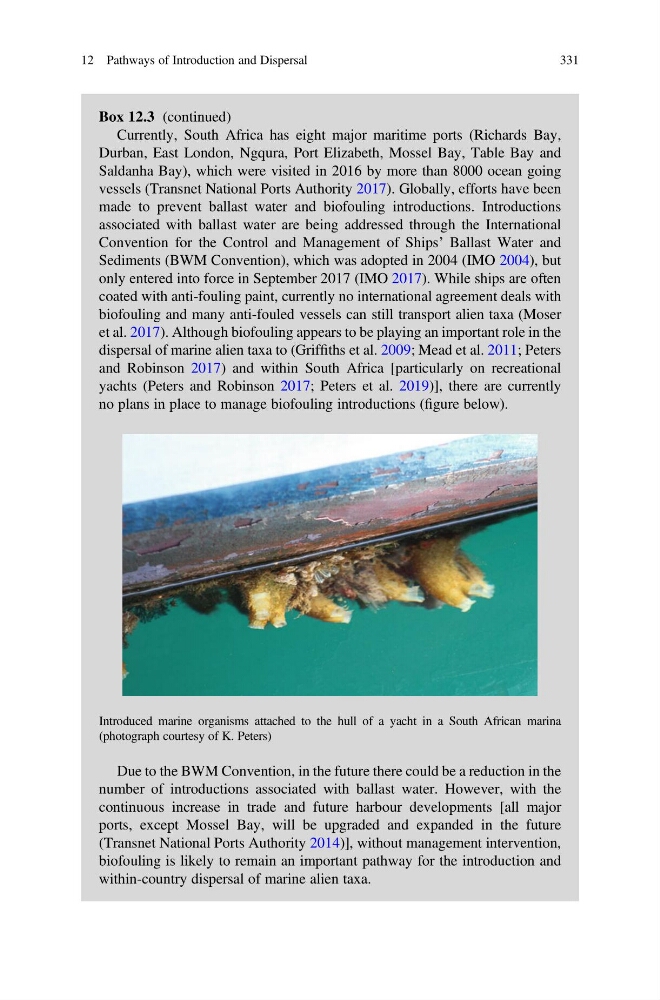
no plans in place to manage biofouling introductions (figure below).
Introduced marine organisms attached to the hull of a yacht in a South African marina
(photograph courtesy of K. Peters)
Due to the BWM Convention, in the future there could be a reduction in the
number of introductions associated with ballast water. However, with the
continuous increase in trade and future harbour developments [all major
ports, except Mossel Bay, will be upgraded and expanded in the future
(Transnet National Ports Authority 2014)], without management intervention,
biofouling is likely to remain an important pathway for the introduction and
within-country dispersal of marine alien taxa.
12 Pathways of Introduction and Dispersal
331
Currently, South Africa has eight major maritime ports (Richards Bay,
Durban, East London, Ngqura, Port Elizabeth, Mossel Bay, Table Bay and
Saldanha Bay), which were visited in 2016 by more than 8000 ocean going
vessels (Transnet National Ports Authority 2017). Globally, efforts have been
made to prevent ballast water and biofouling introductions. Introductions
associated with ballast water are being addressed through the International
Convention for the Control and Management of Ships’ Ballast Water and
Sediments (BWM Convention), which was adopted in 2004 (IMO 2004), but
only entered into force in September 2017 (IMO 2017). While ships are often
coated with anti-fouling paint, currently no international agreement deals with
biofouling and many anti-fouled vessels can still transport alien taxa (Moser
et al. 2017). Although biofouling appears to be playing an important role in the
dispersal of marine alien taxa to (Griffiths et al. 2009; Mead et al. 2011; Peters
and Robinson 2017) and within South Africa [particularly on recreational
yachts (Peters and Robinson 2017; Peters et al. 2019)], there are currently
no plans in place to manage biofouling introductions (figure below).
Introduced marine organisms attached to the hull of a yacht in a South African marina
(photograph courtesy of K. Peters)
Due to the BWM Convention, in the future there could be a reduction in the
number of introductions associated with ballast water. However, with the
continuous increase in trade and future harbour developments [all major
ports, except Mossel Bay, will be upgraded and expanded in the future
(Transnet National Ports Authority 2014)], without management intervention,
biofouling is likely to remain an important pathway for the introduction and
within-country dispersal of marine alien taxa.
12 Pathways of Introduction and Dispersal
331