

12.2.2 Changes Over Time to the Pathways of Introduction
and Dispersal
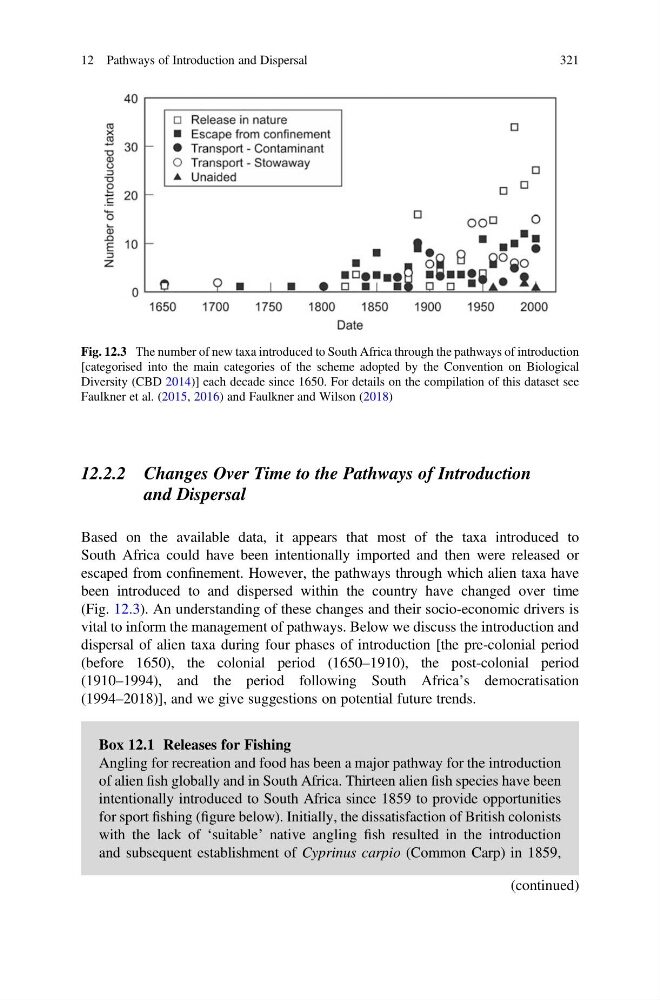
Based on the available data, it appears that most of the taxa introduced to
South Africa could have been intentionally imported and then were released or
escaped from confinement. However, the pathways through which alien taxa have
been introduced to and dispersed within the country have changed over time
(Fig. 12.3). An understanding of these changes and their socio-economic drivers is
vital to inform the management of pathways. Below we discuss the introduction and
dispersal of alien taxa during four phases of introduction [the pre-colonial period
(before 1650), the colonial period (1650–1910), the post-colonial period
(1910–1994), and the period following South Africa’s democratisation
(1994–2018)], and we give suggestions on potential future trends.
Box 12.1 Releases for Fishing
Angling for recreation and food has been a major pathway for the introduction
of alien fish globally and in South Africa. Thirteen alien fish species have been
intentionally introduced to South Africa since 1859 to provide opportunities
for sport fishing (figure below). Initially, the dissatisfaction of British colonists
with the lack of ‘suitable’ native angling fish resulted in the introduction
and subsequent establishment of Cyprinus carpio (Common Carp) in 1859,
(continued)
Fig. 12.3 The number of new taxa introduced to South Africa through the pathways of introduction
[categorised into the main categories of the scheme adopted by the Convention on Biological
Diversity (CBD 2014)] each decade since 1650. For details on the compilation of this dataset see
Faulkner et al. (2015, 2016) and Faulkner and Wilson (2018)
12 Pathways of Introduction and Dispersal
321
and Dispersal
Based on the available data, it appears that most of the taxa introduced to
South Africa could have been intentionally imported and then were released or
escaped from confinement. However, the pathways through which alien taxa have
been introduced to and dispersed within the country have changed over time
(Fig. 12.3). An understanding of these changes and their socio-economic drivers is
vital to inform the management of pathways. Below we discuss the introduction and
dispersal of alien taxa during four phases of introduction [the pre-colonial period
(before 1650), the colonial period (1650–1910), the post-colonial period
(1910–1994), and the period following South Africa’s democratisation
(1994–2018)], and we give suggestions on potential future trends.
Box 12.1 Releases for Fishing
Angling for recreation and food has been a major pathway for the introduction
of alien fish globally and in South Africa. Thirteen alien fish species have been
intentionally introduced to South Africa since 1859 to provide opportunities
for sport fishing (figure below). Initially, the dissatisfaction of British colonists
with the lack of ‘suitable’ native angling fish resulted in the introduction
and subsequent establishment of Cyprinus carpio (Common Carp) in 1859,
(continued)
Fig. 12.3 The number of new taxa introduced to South Africa through the pathways of introduction
[categorised into the main categories of the scheme adopted by the Convention on Biological
Diversity (CBD 2014)] each decade since 1650. For details on the compilation of this dataset see
Faulkner et al. (2015, 2016) and Faulkner and Wilson (2018)
12 Pathways of Introduction and Dispersal
321