

Box 12.1 (continued)
Salmo trutta (Brown Trout) in 1890, Salvelinus fontinalis (Brook Trout) in
1890, Oncorhynchus mykiss (Rainbow Trout) in 1894 and Salmo salar (Atlantic Salmon) in 1896 (Ellender and Weyl 2014). Later, other globally prized
sport fish species were also introduced, such as Micropterus salmoides (North
American Largemouth Bass) in 1928 and Micropterus dolomieu (Smallmouth
Bass) in 1937.
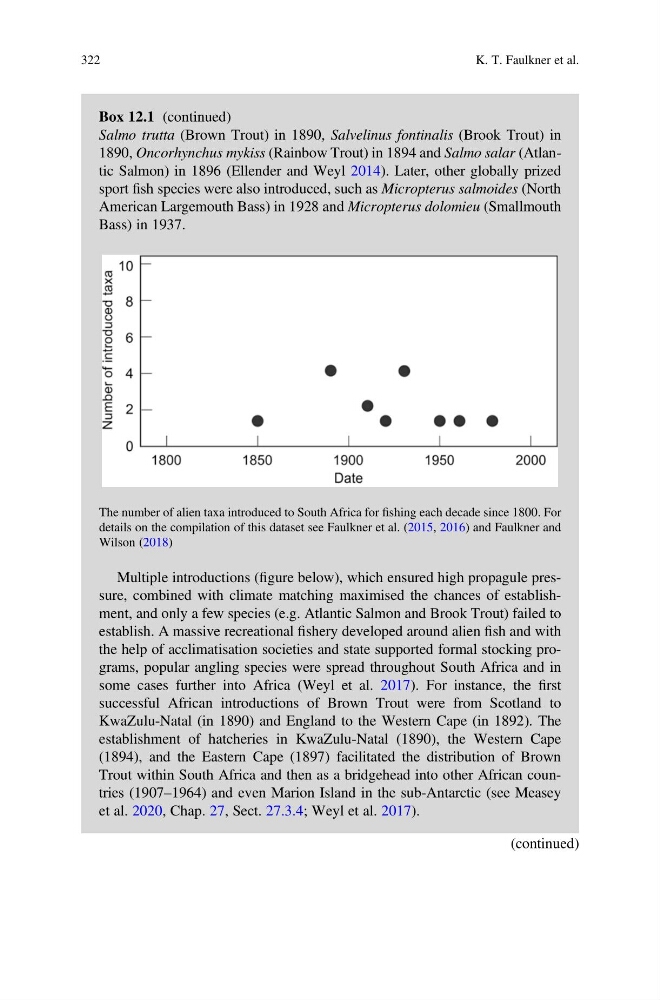
The number of alien taxa introduced to South Africa for fishing each decade since 1800. For
details on the compilation of this dataset see Faulkner et al. (2015, 2016) and Faulkner and
Wilson (2018)
Multiple introductions (figure below), which ensured high propagule pressure, combined with climate matching maximised the chances of establishment, and only a few species (e.g. Atlantic Salmon and Brook Trout) failed to
establish. A massive recreational fishery developed around alien fish and with
the help of acclimatisation societies and state supported formal stocking programs, popular angling species were spread throughout South Africa and in
some cases further into Africa (Weyl et al. 2017). For instance, the first
successful African introductions of Brown Trout were from Scotland to
KwaZulu-Natal (in 1890) and England to the Western Cape (in 1892). The
establishment of hatcheries in KwaZulu-Natal (1890), the Western Cape
(1894), and the Eastern Cape (1897) facilitated the distribution of Brown
Trout within South Africa and then as a bridgehead into other African countries (1907–1964) and even Marion Island in the sub-Antarctic (see Measey
et al. 2020, Chap. 27, Sect. 27.3.4; Weyl et al. 2017).
(continued)
322
K. T. Faulkner et al.
Salmo trutta (Brown Trout) in 1890, Salvelinus fontinalis (Brook Trout) in
1890, Oncorhynchus mykiss (Rainbow Trout) in 1894 and Salmo salar (Atlantic Salmon) in 1896 (Ellender and Weyl 2014). Later, other globally prized
sport fish species were also introduced, such as Micropterus salmoides (North
American Largemouth Bass) in 1928 and Micropterus dolomieu (Smallmouth
Bass) in 1937.
The number of alien taxa introduced to South Africa for fishing each decade since 1800. For
details on the compilation of this dataset see Faulkner et al. (2015, 2016) and Faulkner and
Wilson (2018)
Multiple introductions (figure below), which ensured high propagule pressure, combined with climate matching maximised the chances of establishment, and only a few species (e.g. Atlantic Salmon and Brook Trout) failed to
establish. A massive recreational fishery developed around alien fish and with
the help of acclimatisation societies and state supported formal stocking programs, popular angling species were spread throughout South Africa and in
some cases further into Africa (Weyl et al. 2017). For instance, the first
successful African introductions of Brown Trout were from Scotland to
KwaZulu-Natal (in 1890) and England to the Western Cape (in 1892). The
establishment of hatcheries in KwaZulu-Natal (1890), the Western Cape
(1894), and the Eastern Cape (1897) facilitated the distribution of Brown
Trout within South Africa and then as a bridgehead into other African countries (1907–1964) and even Marion Island in the sub-Antarctic (see Measey
et al. 2020, Chap. 27, Sect. 27.3.4; Weyl et al. 2017).
(continued)
322
K. T. Faulkner et al.