

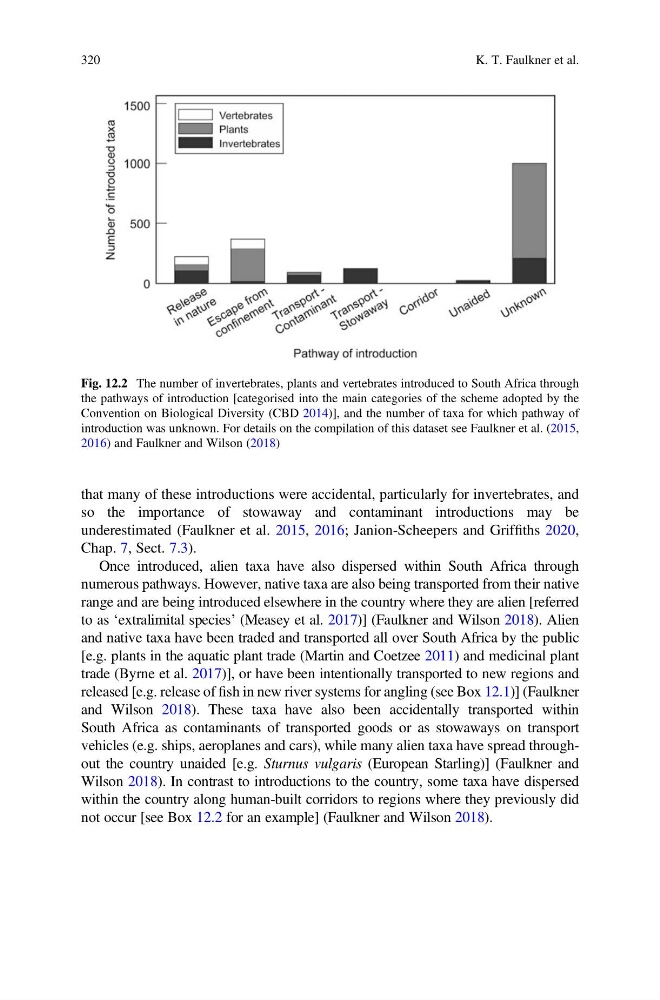
that many of these introductions were accidental, particularly for invertebrates, and
so the importance of stowaway and contaminant introductions may be
underestimated (Faulkner et al. 2015, 2016; Janion-Scheepers and Griffiths 2020,
Chap. 7, Sect. 7.3).
Once introduced, alien taxa have also dispersed within South Africa through
numerous pathways. However, native taxa are also being transported from their native
range and are being introduced elsewhere in the country where they are alien [referred
to as ‘extralimital species’ (Measey et al. 2017)] (Faulkner and Wilson 2018). Alien
and native taxa have been traded and transported all over South Africa by the public
[e.g. plants in the aquatic plant trade (Martin and Coetzee 2011) and medicinal plant
trade (Byrne et al. 2017)], or have been intentionally transported to new regions and
released [e.g. release of fish in new river systems for angling (see Box 12.1)] (Faulkner
and Wilson 2018). These taxa have also been accidentally transported within
South Africa as contaminants of transported goods or as stowaways on transport
vehicles (e.g. ships, aeroplanes and cars), while many alien taxa have spread throughout the country unaided [e.g. Sturnus vulgaris (European Starling)] (Faulkner and
Wilson 2018). In contrast to introductions to the country, some taxa have dispersed
within the country along human-built corridors to regions where they previously did
not occur [see Box 12.2 for an example] (Faulkner and Wilson 2018).
Fig. 12.2 The number of invertebrates, plants and vertebrates introduced to South Africa through
the pathways of introduction [categorised into the main categories of the scheme adopted by the
Convention on Biological Diversity (CBD 2014)], and the number of taxa for which pathway of
introduction was unknown. For details on the compilation of this dataset see Faulkner et al. (2015,
2016) and Faulkner and Wilson (2018)
320
K. T. Faulkner et al.
so the importance of stowaway and contaminant introductions may be
underestimated (Faulkner et al. 2015, 2016; Janion-Scheepers and Griffiths 2020,
Chap. 7, Sect. 7.3).
Once introduced, alien taxa have also dispersed within South Africa through
numerous pathways. However, native taxa are also being transported from their native
range and are being introduced elsewhere in the country where they are alien [referred
to as ‘extralimital species’ (Measey et al. 2017)] (Faulkner and Wilson 2018). Alien
and native taxa have been traded and transported all over South Africa by the public
[e.g. plants in the aquatic plant trade (Martin and Coetzee 2011) and medicinal plant
trade (Byrne et al. 2017)], or have been intentionally transported to new regions and
released [e.g. release of fish in new river systems for angling (see Box 12.1)] (Faulkner
and Wilson 2018). These taxa have also been accidentally transported within
South Africa as contaminants of transported goods or as stowaways on transport
vehicles (e.g. ships, aeroplanes and cars), while many alien taxa have spread throughout the country unaided [e.g. Sturnus vulgaris (European Starling)] (Faulkner and
Wilson 2018). In contrast to introductions to the country, some taxa have dispersed
within the country along human-built corridors to regions where they previously did
not occur [see Box 12.2 for an example] (Faulkner and Wilson 2018).
Fig. 12.2 The number of invertebrates, plants and vertebrates introduced to South Africa through
the pathways of introduction [categorised into the main categories of the scheme adopted by the
Convention on Biological Diversity (CBD 2014)], and the number of taxa for which pathway of
introduction was unknown. For details on the compilation of this dataset see Faulkner et al. (2015,
2016) and Faulkner and Wilson (2018)
320
K. T. Faulkner et al.