

Box 11.2 (continued)
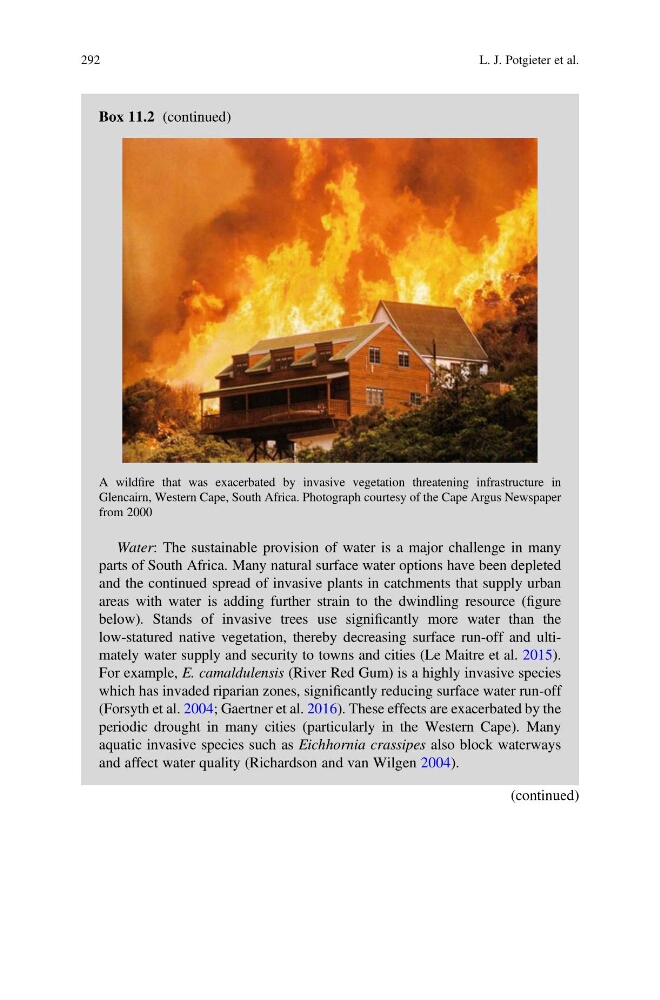
A wildfire that was exacerbated by invasive vegetation threatening infrastructure in
Glencairn, Western Cape, South Africa. Photograph courtesy of the Cape Argus Newspaper
from 2000
Water: The sustainable provision of water is a major challenge in many
parts of South Africa. Many natural surface water options have been depleted
and the continued spread of invasive plants in catchments that supply urban
areas with water is adding further strain to the dwindling resource (figure
below). Stands of invasive trees use significantly more water than the
low-statured native vegetation, thereby decreasing surface run-off and ultimately water supply and security to towns and cities (Le Maitre et al. 2015).
For example, E. camaldulensis (River Red Gum) is a highly invasive species
which has invaded riparian zones, significantly reducing surface water run-off
(Forsyth et al. 2004; Gaertner et al. 2016). These effects are exacerbated by the
periodic drought in many cities (particularly in the Western Cape). Many
aquatic invasive species such as Eichhornia crassipes also block waterways
and affect water quality (Richardson and van Wilgen 2004).
(continued)
292
L. J. Potgieter et al.
A wildfire that was exacerbated by invasive vegetation threatening infrastructure in
Glencairn, Western Cape, South Africa. Photograph courtesy of the Cape Argus Newspaper
from 2000
Water: The sustainable provision of water is a major challenge in many
parts of South Africa. Many natural surface water options have been depleted
and the continued spread of invasive plants in catchments that supply urban
areas with water is adding further strain to the dwindling resource (figure
below). Stands of invasive trees use significantly more water than the
low-statured native vegetation, thereby decreasing surface run-off and ultimately water supply and security to towns and cities (Le Maitre et al. 2015).
For example, E. camaldulensis (River Red Gum) is a highly invasive species
which has invaded riparian zones, significantly reducing surface water run-off
(Forsyth et al. 2004; Gaertner et al. 2016). These effects are exacerbated by the
periodic drought in many cities (particularly in the Western Cape). Many
aquatic invasive species such as Eichhornia crassipes also block waterways
and affect water quality (Richardson and van Wilgen 2004).
(continued)
292
L. J. Potgieter et al.