

Box 11.2 (continued)
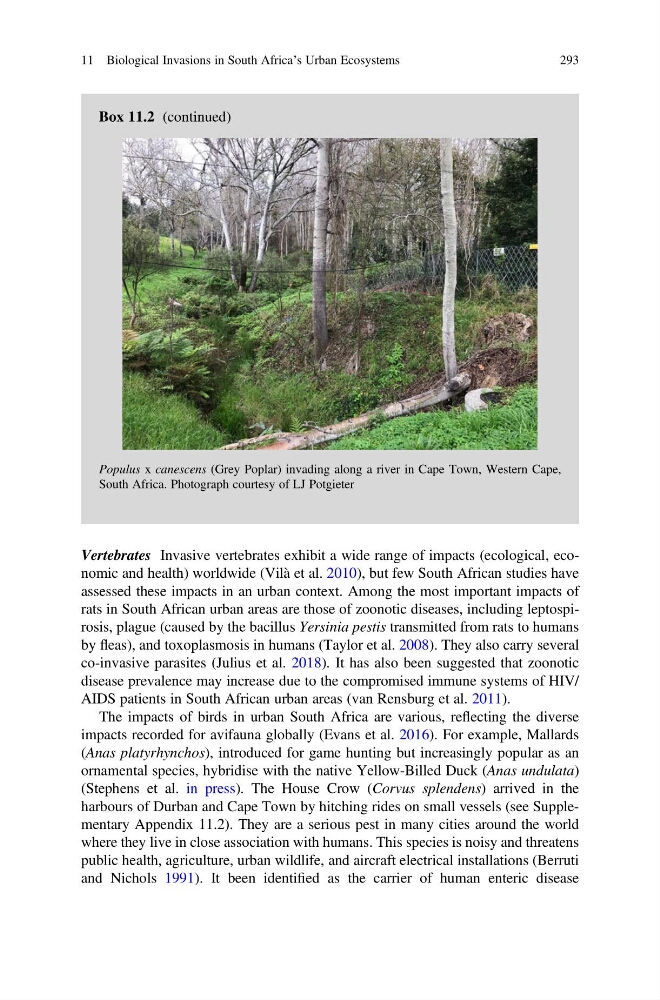
Populus x canescens (Grey Poplar) invading along a river in Cape Town, Western Cape,
South Africa. Photograph courtesy of LJ Potgieter
Vertebrates Invasive vertebrates exhibit a wide range of impacts (ecological, economic and health) worldwide (Vilà et al. 2010), but few South African studies have
assessed these impacts in an urban context. Among the most important impacts of
rats in South African urban areas are those of zoonotic diseases, including leptospirosis, plague (caused by the bacillus Yersinia pestis transmitted from rats to humans
by fleas), and toxoplasmosis in humans (Taylor et al. 2008). They also carry several
co-invasive parasites (Julius et al. 2018). It has also been suggested that zoonotic
disease prevalence may increase due to the compromised immune systems of HIV/
AIDS patients in South African urban areas (van Rensburg et al. 2011).
The impacts of birds in urban South Africa are various, reflecting the diverse
impacts recorded for avifauna globally (Evans et al. 2016). For example, Mallards
(Anas platyrhynchos), introduced for game hunting but increasingly popular as an
ornamental species, hybridise with the native Yellow-Billed Duck (Anas undulata)
(Stephens et al. in press). The House Crow (Corvus splendens) arrived in the
harbours of Durban and Cape Town by hitching rides on small vessels (see Supplementary Appendix 11.2). They are a serious pest in many cities around the world
where they live in close association with humans. This species is noisy and threatens
public health, agriculture, urban wildlife, and aircraft electrical installations (Berruti
and Nichols 1991). It been identified as the carrier of human enteric disease
11 Biological Invasions in South Africa’s Urban Ecosystems
293
Populus x canescens (Grey Poplar) invading along a river in Cape Town, Western Cape,
South Africa. Photograph courtesy of LJ Potgieter
Vertebrates Invasive vertebrates exhibit a wide range of impacts (ecological, economic and health) worldwide (Vilà et al. 2010), but few South African studies have
assessed these impacts in an urban context. Among the most important impacts of
rats in South African urban areas are those of zoonotic diseases, including leptospirosis, plague (caused by the bacillus Yersinia pestis transmitted from rats to humans
by fleas), and toxoplasmosis in humans (Taylor et al. 2008). They also carry several
co-invasive parasites (Julius et al. 2018). It has also been suggested that zoonotic
disease prevalence may increase due to the compromised immune systems of HIV/
AIDS patients in South African urban areas (van Rensburg et al. 2011).
The impacts of birds in urban South Africa are various, reflecting the diverse
impacts recorded for avifauna globally (Evans et al. 2016). For example, Mallards
(Anas platyrhynchos), introduced for game hunting but increasingly popular as an
ornamental species, hybridise with the native Yellow-Billed Duck (Anas undulata)
(Stephens et al. in press). The House Crow (Corvus splendens) arrived in the
harbours of Durban and Cape Town by hitching rides on small vessels (see Supplementary Appendix 11.2). They are a serious pest in many cities around the world
where they live in close association with humans. This species is noisy and threatens
public health, agriculture, urban wildlife, and aircraft electrical installations (Berruti
and Nichols 1991). It been identified as the carrier of human enteric disease
11 Biological Invasions in South Africa’s Urban Ecosystems
293