

Box 11.2 (continued)
a substantial threat to the biodiversity of TMNP (Richardson et al. 1996).
Acacia saligna also reduces avian species richness in urban and peri-urban
areas of Cape Town (Dures and Cumming 2010).
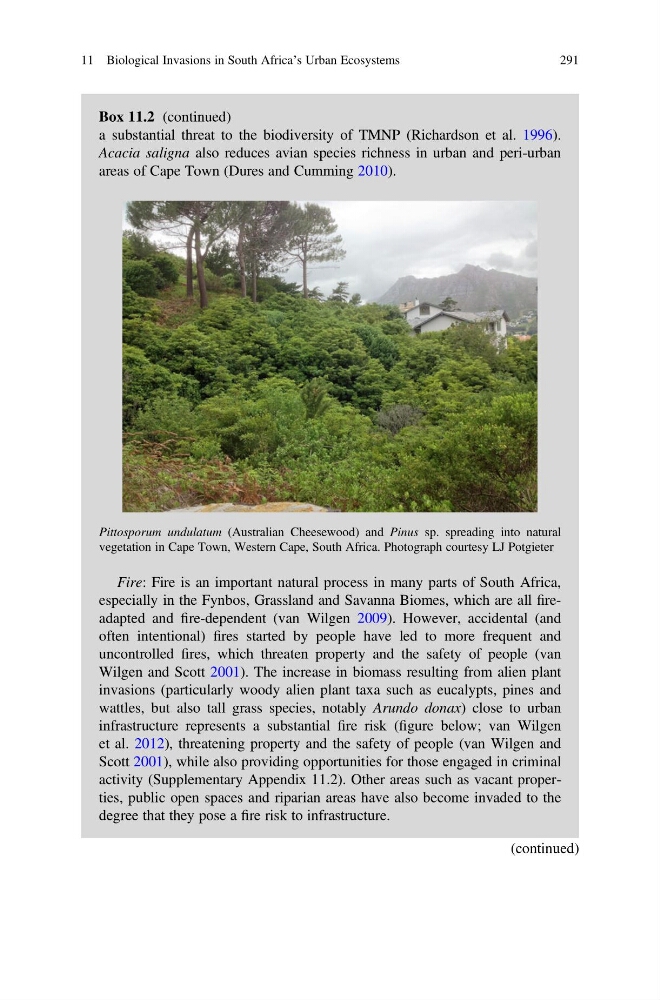
Pittosporum undulatum (Australian Cheesewood) and Pinus sp. spreading into natural
vegetation in Cape Town, Western Cape, South Africa. Photograph courtesy LJ Potgieter
Fire: Fire is an important natural process in many parts of South Africa,
especially in the Fynbos, Grassland and Savanna Biomes, which are all fireadapted and fire-dependent (van Wilgen 2009). However, accidental (and
often intentional) fires started by people have led to more frequent and
uncontrolled fires, which threaten property and the safety of people (van
Wilgen and Scott 2001). The increase in biomass resulting from alien plant
invasions (particularly woody alien plant taxa such as eucalypts, pines and
wattles, but also tall grass species, notably Arundo donax) close to urban
infrastructure represents a substantial fire risk (figure below; van Wilgen
et al. 2012), threatening property and the safety of people (van Wilgen and
Scott 2001), while also providing opportunities for those engaged in criminal
activity (Supplementary Appendix 11.2). Other areas such as vacant properties, public open spaces and riparian areas have also become invaded to the
degree that they pose a fire risk to infrastructure.
(continued)
11 Biological Invasions in South Africa’s Urban Ecosystems
291
a substantial threat to the biodiversity of TMNP (Richardson et al. 1996).
Acacia saligna also reduces avian species richness in urban and peri-urban
areas of Cape Town (Dures and Cumming 2010).
Pittosporum undulatum (Australian Cheesewood) and Pinus sp. spreading into natural
vegetation in Cape Town, Western Cape, South Africa. Photograph courtesy LJ Potgieter
Fire: Fire is an important natural process in many parts of South Africa,
especially in the Fynbos, Grassland and Savanna Biomes, which are all fireadapted and fire-dependent (van Wilgen 2009). However, accidental (and
often intentional) fires started by people have led to more frequent and
uncontrolled fires, which threaten property and the safety of people (van
Wilgen and Scott 2001). The increase in biomass resulting from alien plant
invasions (particularly woody alien plant taxa such as eucalypts, pines and
wattles, but also tall grass species, notably Arundo donax) close to urban
infrastructure represents a substantial fire risk (figure below; van Wilgen
et al. 2012), threatening property and the safety of people (van Wilgen and
Scott 2001), while also providing opportunities for those engaged in criminal
activity (Supplementary Appendix 11.2). Other areas such as vacant properties, public open spaces and riparian areas have also become invaded to the
degree that they pose a fire risk to infrastructure.
(continued)
11 Biological Invasions in South Africa’s Urban Ecosystems
291