

pests in the agricultural sector, but can also prey on other invertebrates. Generally,
the functional impact of invasive soil biota on native communities and ecosystem
function have not been well investigated in South Africa (Janion-Scheepers et al.
2016).
Box 7.3 The White Garden Snail: A Keystone Species in Coastal
Fynbos?
Theba pisana (White Garden Snail) is native to the Mediterranean region, and
was accidentally introduced to the Cape before 1881, probably along with
timber or other imported products. It has now spread throughout the western
and southern coastal regions of South Africa, where it can occur at peak
densities of hundreds per square metre, often climbing upwards in dry weather
to congregate in vast numbers on shrubs, or on fence and telephone poles.
Although there are some data on distribution, density and diurnal activity
patterns, little is known about its ecological impacts in South Africa. It can
be a significant garden and agricultural pest, but its ecological effects in natural
vegetation are unknown (Odendaal et al. 2008). It seems very likely that it
significantly affects plant community structure though its selective grazing
activities, as well as by influencing the food available to other competing
grazers. Dune snails are also the most abundant animal prey in denselyinfected areas, and thus likely form a key component of the diets of various
vertebrate predators. Their impacts thus likely extend both up and down the
food-chain, suggesting that they may be keystone species in heavily-infested
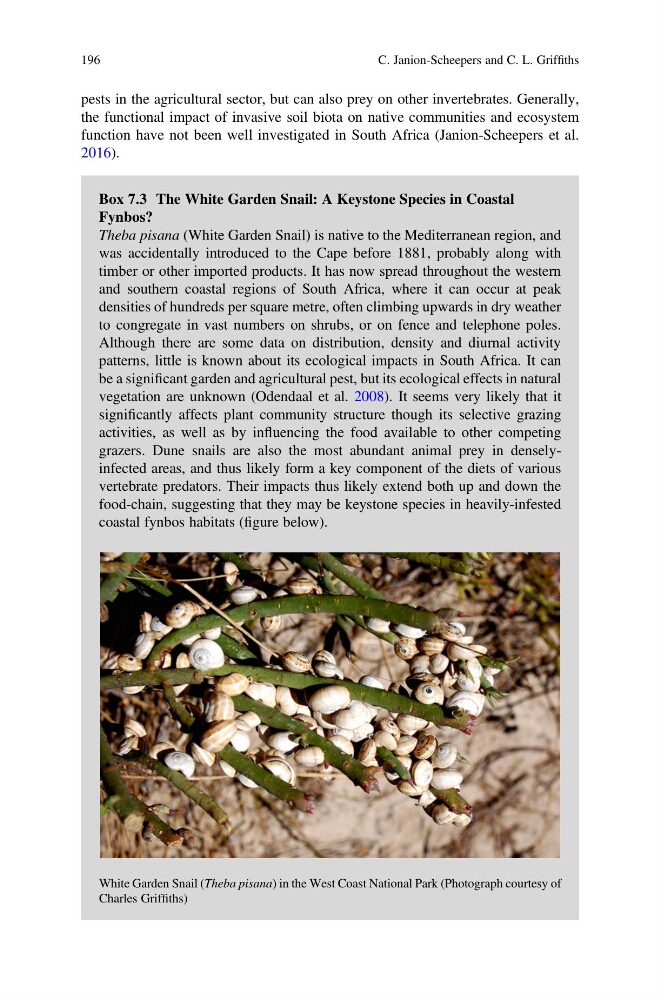
coastal fynbos habitats (figure below).
White Garden Snail (Theba pisana) in the West Coast National Park (Photograph courtesy of
Charles Griffiths)
196
C. Janion-Scheepers and C. L. Griffiths
the functional impact of invasive soil biota on native communities and ecosystem
function have not been well investigated in South Africa (Janion-Scheepers et al.
2016).
Box 7.3 The White Garden Snail: A Keystone Species in Coastal
Fynbos?
Theba pisana (White Garden Snail) is native to the Mediterranean region, and
was accidentally introduced to the Cape before 1881, probably along with
timber or other imported products. It has now spread throughout the western
and southern coastal regions of South Africa, where it can occur at peak
densities of hundreds per square metre, often climbing upwards in dry weather
to congregate in vast numbers on shrubs, or on fence and telephone poles.
Although there are some data on distribution, density and diurnal activity
patterns, little is known about its ecological impacts in South Africa. It can
be a significant garden and agricultural pest, but its ecological effects in natural
vegetation are unknown (Odendaal et al. 2008). It seems very likely that it
significantly affects plant community structure though its selective grazing
activities, as well as by influencing the food available to other competing
grazers. Dune snails are also the most abundant animal prey in denselyinfected areas, and thus likely form a key component of the diets of various
vertebrate predators. Their impacts thus likely extend both up and down the
food-chain, suggesting that they may be keystone species in heavily-infested
coastal fynbos habitats (figure below).
White Garden Snail (Theba pisana) in the West Coast National Park (Photograph courtesy of
Charles Griffiths)
196
C. Janion-Scheepers and C. L. Griffiths