

Box 7.2 (continued)
considered ecologically undesirable (Lubke 1985). Adult wasps live only a
few days and lay their eggs in the developing flower buds of host trees. The
larvae provoke a galling response and live and feed inside the developing
galls. After pupation, the adults chew their way out of the gall, mate and then
disperse in search of more young flower buds. Gall formation greatly suppresses seed set and hence reproductive success of host plants. Importantly,
this is achieved without killing the parent trees, which can be valued for their
shade and as sources of firewood or fodder. A second gall wasp species,
T. signiventris, has subsequently also been introduced to control the Golden
Wattle Acacia pycnantha, and has greatly reduced the reproductive capacity of
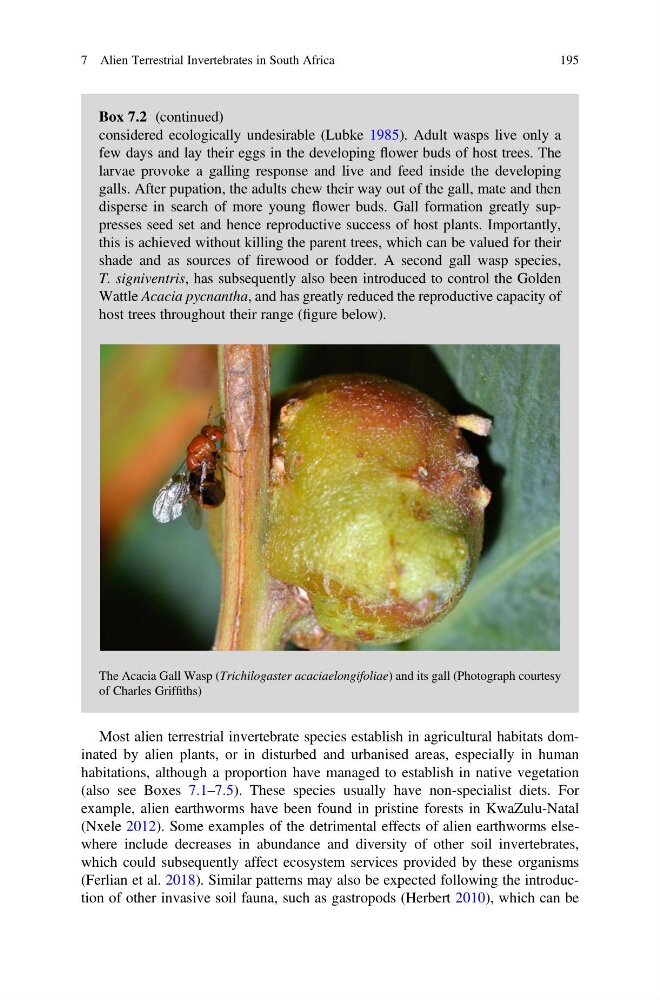
host trees throughout their range (figure below).
The Acacia Gall Wasp (Trichilogaster acaciaelongifoliae) and its gall (Photograph courtesy
of Charles Griffiths)
Most alien terrestrial invertebrate species establish in agricultural habitats dominated by alien plants, or in disturbed and urbanised areas, especially in human
habitations, although a proportion have managed to establish in native vegetation
(also see Boxes 7.1–7.5). These species usually have non-specialist diets. For
example, alien earthworms have been found in pristine forests in KwaZulu-Natal
(Nxele 2012). Some examples of the detrimental effects of alien earthworms elsewhere include decreases in abundance and diversity of other soil invertebrates,
which could subsequently affect ecosystem services provided by these organisms
(Ferlian et al. 2018). Similar patterns may also be expected following the introduction of other invasive soil fauna, such as gastropods (Herbert 2010), which can be
7 Alien Terrestrial Invertebrates in South Africa
195
considered ecologically undesirable (Lubke 1985). Adult wasps live only a
few days and lay their eggs in the developing flower buds of host trees. The
larvae provoke a galling response and live and feed inside the developing
galls. After pupation, the adults chew their way out of the gall, mate and then
disperse in search of more young flower buds. Gall formation greatly suppresses seed set and hence reproductive success of host plants. Importantly,
this is achieved without killing the parent trees, which can be valued for their
shade and as sources of firewood or fodder. A second gall wasp species,
T. signiventris, has subsequently also been introduced to control the Golden
Wattle Acacia pycnantha, and has greatly reduced the reproductive capacity of
host trees throughout their range (figure below).
The Acacia Gall Wasp (Trichilogaster acaciaelongifoliae) and its gall (Photograph courtesy
of Charles Griffiths)
Most alien terrestrial invertebrate species establish in agricultural habitats dominated by alien plants, or in disturbed and urbanised areas, especially in human
habitations, although a proportion have managed to establish in native vegetation
(also see Boxes 7.1–7.5). These species usually have non-specialist diets. For
example, alien earthworms have been found in pristine forests in KwaZulu-Natal
(Nxele 2012). Some examples of the detrimental effects of alien earthworms elsewhere include decreases in abundance and diversity of other soil invertebrates,
which could subsequently affect ecosystem services provided by these organisms
(Ferlian et al. 2018). Similar patterns may also be expected following the introduction of other invasive soil fauna, such as gastropods (Herbert 2010), which can be
7 Alien Terrestrial Invertebrates in South Africa
195