

Box 7.1 (continued)
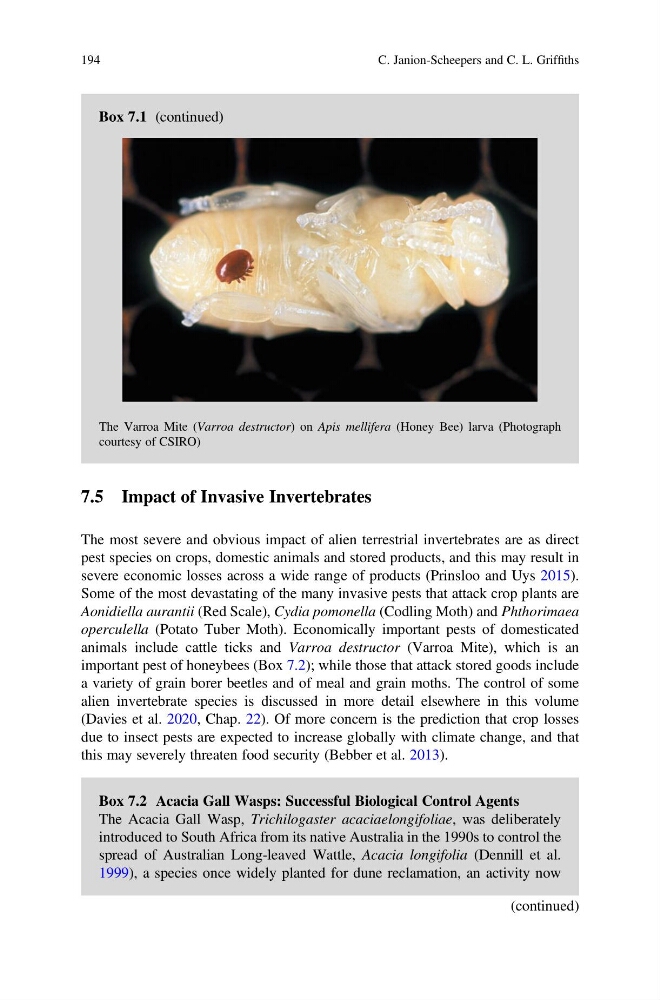
The Varroa Mite (Varroa destructor) on Apis mellifera (Honey Bee) larva (Photograph
courtesy of CSIRO)
7.5 Impact of Invasive Invertebrates
The most severe and obvious impact of alien terrestrial invertebrates are as direct
pest species on crops, domestic animals and stored products, and this may result in
severe economic losses across a wide range of products (Prinsloo and Uys 2015).
Some of the most devastating of the many invasive pests that attack crop plants are
Aonidiella aurantii (Red Scale), Cydia pomonella (Codling Moth) and Phthorimaea
operculella (Potato Tuber Moth). Economically important pests of domesticated
animals include cattle ticks and Varroa destructor (Varroa Mite), which is an
important pest of honeybees (Box 7.2); while those that attack stored goods include
a variety of grain borer beetles and of meal and grain moths. The control of some
alien invertebrate species is discussed in more detail elsewhere in this volume
(Davies et al. 2020, Chap. 22). Of more concern is the prediction that crop losses
due to insect pests are expected to increase globally with climate change, and that
this may severely threaten food security (Bebber et al. 2013).
Box 7.2 Acacia Gall Wasps: Successful Biological Control Agents
The Acacia Gall Wasp, Trichilogaster acaciaelongifoliae, was deliberately
introduced to South Africa from its native Australia in the 1990s to control the
spread of Australian Long-leaved Wattle, Acacia longifolia (Dennill et al.
1999), a species once widely planted for dune reclamation, an activity now
(continued)
194
C. Janion-Scheepers and C. L. Griffiths
The Varroa Mite (Varroa destructor) on Apis mellifera (Honey Bee) larva (Photograph
courtesy of CSIRO)
7.5 Impact of Invasive Invertebrates
The most severe and obvious impact of alien terrestrial invertebrates are as direct
pest species on crops, domestic animals and stored products, and this may result in
severe economic losses across a wide range of products (Prinsloo and Uys 2015).
Some of the most devastating of the many invasive pests that attack crop plants are
Aonidiella aurantii (Red Scale), Cydia pomonella (Codling Moth) and Phthorimaea
operculella (Potato Tuber Moth). Economically important pests of domesticated
animals include cattle ticks and Varroa destructor (Varroa Mite), which is an
important pest of honeybees (Box 7.2); while those that attack stored goods include
a variety of grain borer beetles and of meal and grain moths. The control of some
alien invertebrate species is discussed in more detail elsewhere in this volume
(Davies et al. 2020, Chap. 22). Of more concern is the prediction that crop losses
due to insect pests are expected to increase globally with climate change, and that
this may severely threaten food security (Bebber et al. 2013).
Box 7.2 Acacia Gall Wasps: Successful Biological Control Agents
The Acacia Gall Wasp, Trichilogaster acaciaelongifoliae, was deliberately
introduced to South Africa from its native Australia in the 1990s to control the
spread of Australian Long-leaved Wattle, Acacia longifolia (Dennill et al.
1999), a species once widely planted for dune reclamation, an activity now
(continued)
194
C. Janion-Scheepers and C. L. Griffiths