

Box 7.4 The Harlequin Lady Beetle: A Problematic Predator
Harlequin Lady Beetles, Harmonia axyridis, originate from Central and East
Asia and were deliberately introduced to Europe and the Americas to control
aphids (Roy et al. 2016). The South African introduction appears to have been
accidental, the first records being from the Western Cape in 2001 (Stals 2010).
The species has subsequently spread to all provinces of the country (Stals
2010; Stals and Prinsloo 2007), most likely due to their broad habitat breadth
and thermal tolerance range (Roy et al. 2016). The yellowish eggs are laid in
small clusters under leaves and the spiky black and orange larvae and adults
are voracious generalist predators, feeding on a wide variety of soft-bodied
arthropods, including many beneficial species, such as the eggs, larvae and
pupae of native lady beetles (Roy et al. 2016). Adults also feed on soft-fleshed
fruit and may taint grapes harvested for wine making (Achiano et al. 2017).
When agitated, adults release a foul-smelling haemolymph that can stain
clothing and cause an allergic reaction (Goetz 2008; Koch and Galvan
2008). Due to its threats to biodiversity and impacts on the fruit and wine
industry, this species is now recognised as a serious pest, and is placed in
Category 1b under South Africa’s Invasive and Alien Species Regulations (see
Box 1.1 van Wilgen et al. 2020, Chap. 1). Natural enemies, such as the wasp
Dinocampus coccinellae and the fungus Hesperomyces virescens (that are
present on South African H. axyridis), can perhaps be used as biological
control agents, but their impact on native species needs to be tested (Minnaar
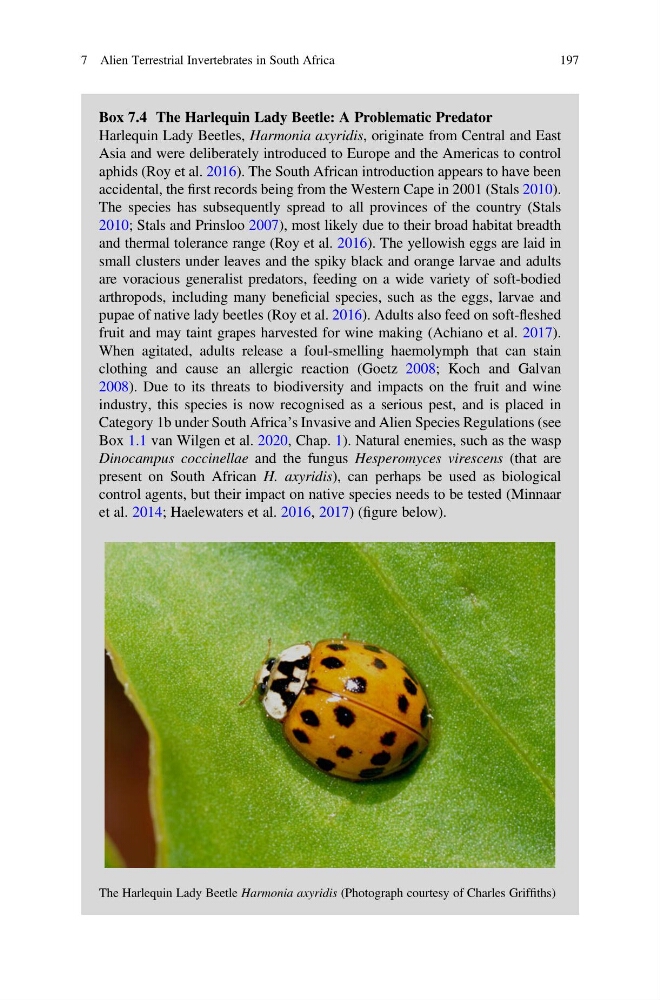
et al. 2014; Haelewaters et al. 2016, 2017) (figure below).
The Harlequin Lady Beetle Harmonia axyridis (Photograph courtesy of Charles Griffiths)
7 Alien Terrestrial Invertebrates in South Africa
197
Harlequin Lady Beetles, Harmonia axyridis, originate from Central and East
Asia and were deliberately introduced to Europe and the Americas to control
aphids (Roy et al. 2016). The South African introduction appears to have been
accidental, the first records being from the Western Cape in 2001 (Stals 2010).
The species has subsequently spread to all provinces of the country (Stals
2010; Stals and Prinsloo 2007), most likely due to their broad habitat breadth
and thermal tolerance range (Roy et al. 2016). The yellowish eggs are laid in
small clusters under leaves and the spiky black and orange larvae and adults
are voracious generalist predators, feeding on a wide variety of soft-bodied
arthropods, including many beneficial species, such as the eggs, larvae and
pupae of native lady beetles (Roy et al. 2016). Adults also feed on soft-fleshed
fruit and may taint grapes harvested for wine making (Achiano et al. 2017).
When agitated, adults release a foul-smelling haemolymph that can stain
clothing and cause an allergic reaction (Goetz 2008; Koch and Galvan
2008). Due to its threats to biodiversity and impacts on the fruit and wine
industry, this species is now recognised as a serious pest, and is placed in
Category 1b under South Africa’s Invasive and Alien Species Regulations (see
Box 1.1 van Wilgen et al. 2020, Chap. 1). Natural enemies, such as the wasp
Dinocampus coccinellae and the fungus Hesperomyces virescens (that are
present on South African H. axyridis), can perhaps be used as biological
control agents, but their impact on native species needs to be tested (Minnaar
et al. 2014; Haelewaters et al. 2016, 2017) (figure below).
The Harlequin Lady Beetle Harmonia axyridis (Photograph courtesy of Charles Griffiths)
7 Alien Terrestrial Invertebrates in South Africa
197