

species is currently naturalised in several salt pans in the country where it might
replace native Artemia species (Kaiser et al. 2006).
The shrimp Atyoida serrata was first sampled from the Vungu River in KwaZuluNatal in 1987, and has subsequently been reported from several other rivers in that
province (Coke 2018). It is native to Madagascar and, although listed as alien in
South Africa, its introduction history and pathway are not known.
The Japanese fish louse Argulus japonicus (Fig. 6.2e) is a branchiuran species
that has very low host specificity and was most likely introduced together with either
C. auratus or C. carpio. This parasite was first reported on common carp in 1983 and
has spread to at least nine native host species (Smit et al. 2017; Table 6.1).
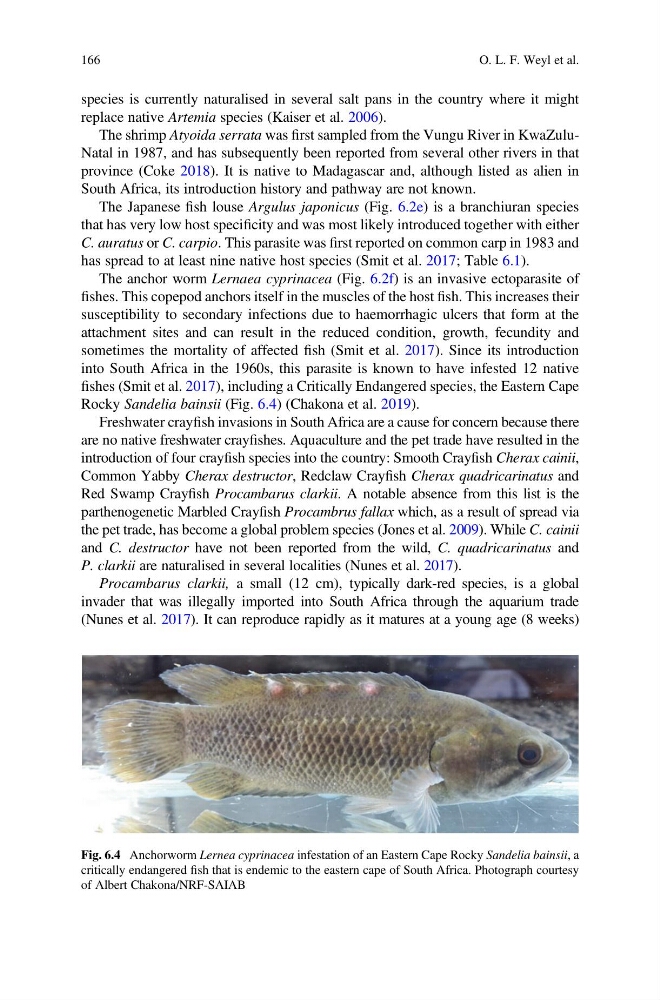
The anchor worm Lernaea cyprinacea (Fig. 6.2f) is an invasive ectoparasite of
fishes. This copepod anchors itself in the muscles of the host fish. This increases their
susceptibility to secondary infections due to haemorrhagic ulcers that form at the
attachment sites and can result in the reduced condition, growth, fecundity and
sometimes the mortality of affected fish (Smit et al. 2017). Since its introduction
into South Africa in the 1960s, this parasite is known to have infested 12 native
fishes (Smit et al. 2017), including a Critically Endangered species, the Eastern Cape
Rocky Sandelia bainsii (Fig. 6.4) (Chakona et al. 2019).
Freshwater crayfish invasions in South Africa are a cause for concern because there
are no native freshwater crayfishes. Aquaculture and the pet trade have resulted in the
introduction of four crayfish species into the country: Smooth Crayfish Cherax cainii,
Common Yabby Cherax destructor, Redclaw Crayfish Cherax quadricarinatus and
Red Swamp Crayfish Procambarus clarkii. A notable absence from this list is the
parthenogenetic Marbled Crayfish Procambrus fallax which, as a result of spread via
the pet trade, has become a global problem species (Jones et al. 2009). While C. cainii
and C. destructor have not been reported from the wild, C. quadricarinatus and
P. clarkii are naturalised in several localities (Nunes et al. 2017).
Procambarus clarkii, a small (12 cm), typically dark-red species, is a global
invader that was illegally imported into South Africa through the aquarium trade
(Nunes et al. 2017). It can reproduce rapidly as it matures at a young age (8 weeks)
Fig. 6.4 Anchorworm Lernea cyprinacea infestation of an Eastern Cape Rocky Sandelia bainsii, a
critically endangered fish that is endemic to the eastern cape of South Africa. Photograph courtesy
of Albert Chakona/NRF-SAIAB
166
O. L. F. Weyl et al.
replace native Artemia species (Kaiser et al. 2006).
The shrimp Atyoida serrata was first sampled from the Vungu River in KwaZuluNatal in 1987, and has subsequently been reported from several other rivers in that
province (Coke 2018). It is native to Madagascar and, although listed as alien in
South Africa, its introduction history and pathway are not known.
The Japanese fish louse Argulus japonicus (Fig. 6.2e) is a branchiuran species
that has very low host specificity and was most likely introduced together with either
C. auratus or C. carpio. This parasite was first reported on common carp in 1983 and
has spread to at least nine native host species (Smit et al. 2017; Table 6.1).
The anchor worm Lernaea cyprinacea (Fig. 6.2f) is an invasive ectoparasite of
fishes. This copepod anchors itself in the muscles of the host fish. This increases their
susceptibility to secondary infections due to haemorrhagic ulcers that form at the
attachment sites and can result in the reduced condition, growth, fecundity and
sometimes the mortality of affected fish (Smit et al. 2017). Since its introduction
into South Africa in the 1960s, this parasite is known to have infested 12 native
fishes (Smit et al. 2017), including a Critically Endangered species, the Eastern Cape
Rocky Sandelia bainsii (Fig. 6.4) (Chakona et al. 2019).
Freshwater crayfish invasions in South Africa are a cause for concern because there
are no native freshwater crayfishes. Aquaculture and the pet trade have resulted in the
introduction of four crayfish species into the country: Smooth Crayfish Cherax cainii,
Common Yabby Cherax destructor, Redclaw Crayfish Cherax quadricarinatus and
Red Swamp Crayfish Procambarus clarkii. A notable absence from this list is the
parthenogenetic Marbled Crayfish Procambrus fallax which, as a result of spread via
the pet trade, has become a global problem species (Jones et al. 2009). While C. cainii
and C. destructor have not been reported from the wild, C. quadricarinatus and
P. clarkii are naturalised in several localities (Nunes et al. 2017).
Procambarus clarkii, a small (12 cm), typically dark-red species, is a global
invader that was illegally imported into South Africa through the aquarium trade
(Nunes et al. 2017). It can reproduce rapidly as it matures at a young age (8 weeks)
Fig. 6.4 Anchorworm Lernea cyprinacea infestation of an Eastern Cape Rocky Sandelia bainsii, a
critically endangered fish that is endemic to the eastern cape of South Africa. Photograph courtesy
of Albert Chakona/NRF-SAIAB
166
O. L. F. Weyl et al.