

play an important role in the regulation of snail populations. No such trematodes
have yet been recorded in this mollusc species in South Africa, presumably giving
T. granifera the advantage of parasite-release over native species. As a result,
population densities in South Africa can attain several thousand individuals per
square metre (Appleton et al. 2009; Miranda and Perissinotto 2014; Jones et al.
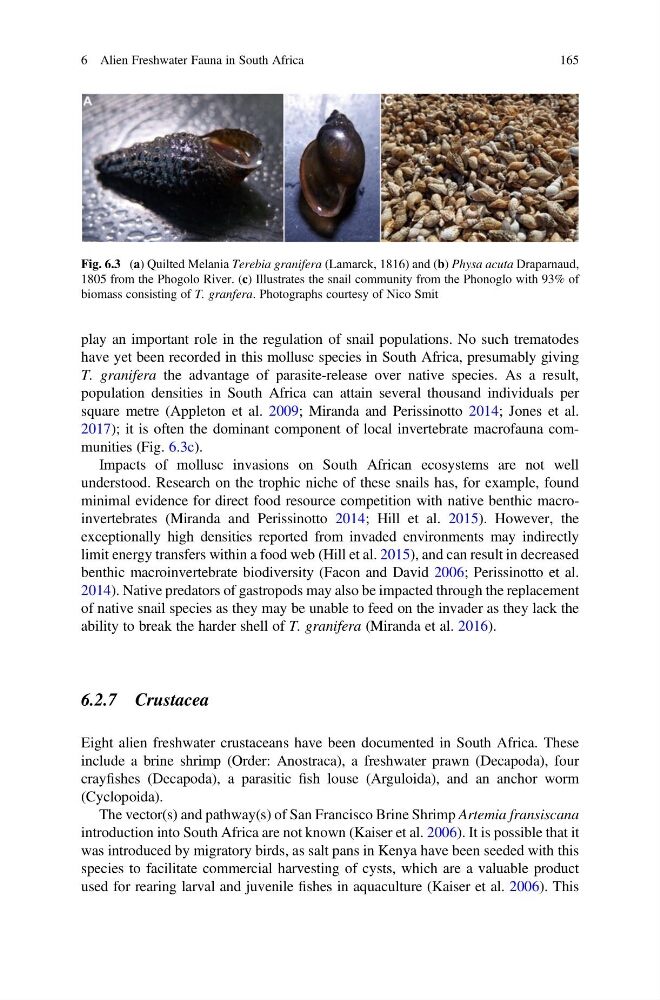
2017); it is often the dominant component of local invertebrate macrofauna communities (Fig. 6.3c).
Impacts of mollusc invasions on South African ecosystems are not well
understood. Research on the trophic niche of these snails has, for example, found
minimal evidence for direct food resource competition with native benthic macroinvertebrates (Miranda and Perissinotto 2014; Hill et al. 2015). However, the
exceptionally high densities reported from invaded environments may indirectly
limit energy transfers within a food web (Hill et al. 2015), and can result in decreased
benthic macroinvertebrate biodiversity (Facon and David 2006; Perissinotto et al.
2014). Native predators of gastropods may also be impacted through the replacement
of native snail species as they may be unable to feed on the invader as they lack the
ability to break the harder shell of T. granifera (Miranda et al. 2016).
6.2.7 Crustacea
Eight alien freshwater crustaceans have been documented in South Africa. These
include a brine shrimp (Order: Anostraca), a freshwater prawn (Decapoda), four
crayfishes (Decapoda), a parasitic fish louse (Arguloida), and an anchor worm
(Cyclopoida).
The vector(s) and pathway(s) of San Francisco Brine Shrimp Artemia fransiscana
introduction into South Africa are not known (Kaiser et al. 2006). It is possible that it
was introduced by migratory birds, as salt pans in Kenya have been seeded with this
species to facilitate commercial harvesting of cysts, which are a valuable product
used for rearing larval and juvenile fishes in aquaculture (Kaiser et al. 2006). This
Fig. 6.3 (a) Quilted Melania Terebia granifera (Lamarck, 1816) and (b) Physa acuta Draparnaud,
1805 from the Phogolo River. (c) Illustrates the snail community from the Phonoglo with 93% of
biomass consisting of T. granfera. Photographs courtesy of Nico Smit
6 Alien Freshwater Fauna in South Africa
165
have yet been recorded in this mollusc species in South Africa, presumably giving
T. granifera the advantage of parasite-release over native species. As a result,
population densities in South Africa can attain several thousand individuals per
square metre (Appleton et al. 2009; Miranda and Perissinotto 2014; Jones et al.
2017); it is often the dominant component of local invertebrate macrofauna communities (Fig. 6.3c).
Impacts of mollusc invasions on South African ecosystems are not well
understood. Research on the trophic niche of these snails has, for example, found
minimal evidence for direct food resource competition with native benthic macroinvertebrates (Miranda and Perissinotto 2014; Hill et al. 2015). However, the
exceptionally high densities reported from invaded environments may indirectly
limit energy transfers within a food web (Hill et al. 2015), and can result in decreased
benthic macroinvertebrate biodiversity (Facon and David 2006; Perissinotto et al.
2014). Native predators of gastropods may also be impacted through the replacement
of native snail species as they may be unable to feed on the invader as they lack the
ability to break the harder shell of T. granifera (Miranda et al. 2016).
6.2.7 Crustacea
Eight alien freshwater crustaceans have been documented in South Africa. These
include a brine shrimp (Order: Anostraca), a freshwater prawn (Decapoda), four
crayfishes (Decapoda), a parasitic fish louse (Arguloida), and an anchor worm
(Cyclopoida).
The vector(s) and pathway(s) of San Francisco Brine Shrimp Artemia fransiscana
introduction into South Africa are not known (Kaiser et al. 2006). It is possible that it
was introduced by migratory birds, as salt pans in Kenya have been seeded with this
species to facilitate commercial harvesting of cysts, which are a valuable product
used for rearing larval and juvenile fishes in aquaculture (Kaiser et al. 2006). This
Fig. 6.3 (a) Quilted Melania Terebia granifera (Lamarck, 1816) and (b) Physa acuta Draparnaud,
1805 from the Phogolo River. (c) Illustrates the snail community from the Phonoglo with 93% of
biomass consisting of T. granfera. Photographs courtesy of Nico Smit
6 Alien Freshwater Fauna in South Africa
165