

and can reproduce several times a year as eggs and larvae remain attached to the female
for only 3 weeks. They occupy burrows during the day but emerge at night to forage.
Procambrus clarkii can disperse over long distances, with reported movements of
17 km over 4 days (Gherardi et al. 2000). Currently, the only populations of P. clarkii
recorded in the wild in South Africa was reported in 1988 from Dullstroom in
Mpumalanga (Nunes et al. 2017) and from a small dam near Welkom in the Free
State (L. Barkhuizen, unpubl data).
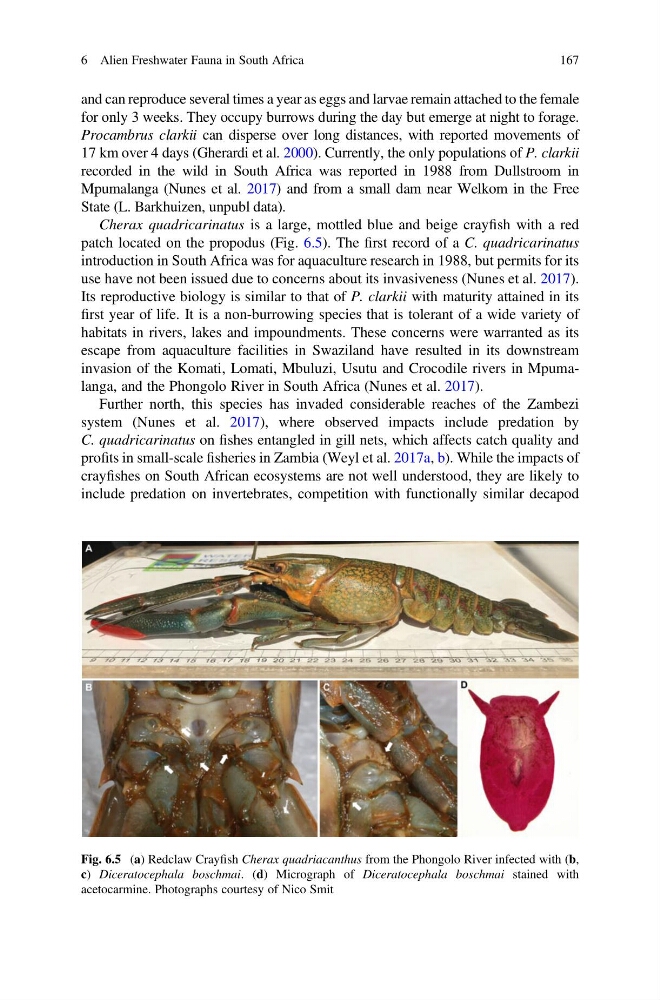
Cherax quadricarinatus is a large, mottled blue and beige crayfish with a red
patch located on the propodus (Fig. 6.5). The first record of a C. quadricarinatus
introduction in South Africa was for aquaculture research in 1988, but permits for its
use have not been issued due to concerns about its invasiveness (Nunes et al. 2017).
Its reproductive biology is similar to that of P. clarkii with maturity attained in its
first year of life. It is a non-burrowing species that is tolerant of a wide variety of
habitats in rivers, lakes and impoundments. These concerns were warranted as its
escape from aquaculture facilities in Swaziland have resulted in its downstream
invasion of the Komati, Lomati, Mbuluzi, Usutu and Crocodile rivers in Mpumalanga, and the Phongolo River in South Africa (Nunes et al. 2017).
Further north, this species has invaded considerable reaches of the Zambezi
system (Nunes et al. 2017), where observed impacts include predation by
C. quadricarinatus on fishes entangled in gill nets, which affects catch quality and
profits in small-scale fisheries in Zambia (Weyl et al. 2017a, b). While the impacts of
crayfishes on South African ecosystems are not well understood, they are likely to
include predation on invertebrates, competition with functionally similar decapod
Fig. 6.5 (a) Redclaw Crayfish Cherax quadriacanthus from the Phongolo River infected with (b,
c) Diceratocephala boschmai. (d) Micrograph of Diceratocephala boschmai stained with
acetocarmine. Photographs courtesy of Nico Smit
6 Alien Freshwater Fauna in South Africa
167
for only 3 weeks. They occupy burrows during the day but emerge at night to forage.
Procambrus clarkii can disperse over long distances, with reported movements of
17 km over 4 days (Gherardi et al. 2000). Currently, the only populations of P. clarkii
recorded in the wild in South Africa was reported in 1988 from Dullstroom in
Mpumalanga (Nunes et al. 2017) and from a small dam near Welkom in the Free
State (L. Barkhuizen, unpubl data).
Cherax quadricarinatus is a large, mottled blue and beige crayfish with a red
patch located on the propodus (Fig. 6.5). The first record of a C. quadricarinatus
introduction in South Africa was for aquaculture research in 1988, but permits for its
use have not been issued due to concerns about its invasiveness (Nunes et al. 2017).
Its reproductive biology is similar to that of P. clarkii with maturity attained in its
first year of life. It is a non-burrowing species that is tolerant of a wide variety of
habitats in rivers, lakes and impoundments. These concerns were warranted as its
escape from aquaculture facilities in Swaziland have resulted in its downstream
invasion of the Komati, Lomati, Mbuluzi, Usutu and Crocodile rivers in Mpumalanga, and the Phongolo River in South Africa (Nunes et al. 2017).
Further north, this species has invaded considerable reaches of the Zambezi
system (Nunes et al. 2017), where observed impacts include predation by
C. quadricarinatus on fishes entangled in gill nets, which affects catch quality and
profits in small-scale fisheries in Zambia (Weyl et al. 2017a, b). While the impacts of
crayfishes on South African ecosystems are not well understood, they are likely to
include predation on invertebrates, competition with functionally similar decapod
Fig. 6.5 (a) Redclaw Crayfish Cherax quadriacanthus from the Phongolo River infected with (b,
c) Diceratocephala boschmai. (d) Micrograph of Diceratocephala boschmai stained with
acetocarmine. Photographs courtesy of Nico Smit
6 Alien Freshwater Fauna in South Africa
167