

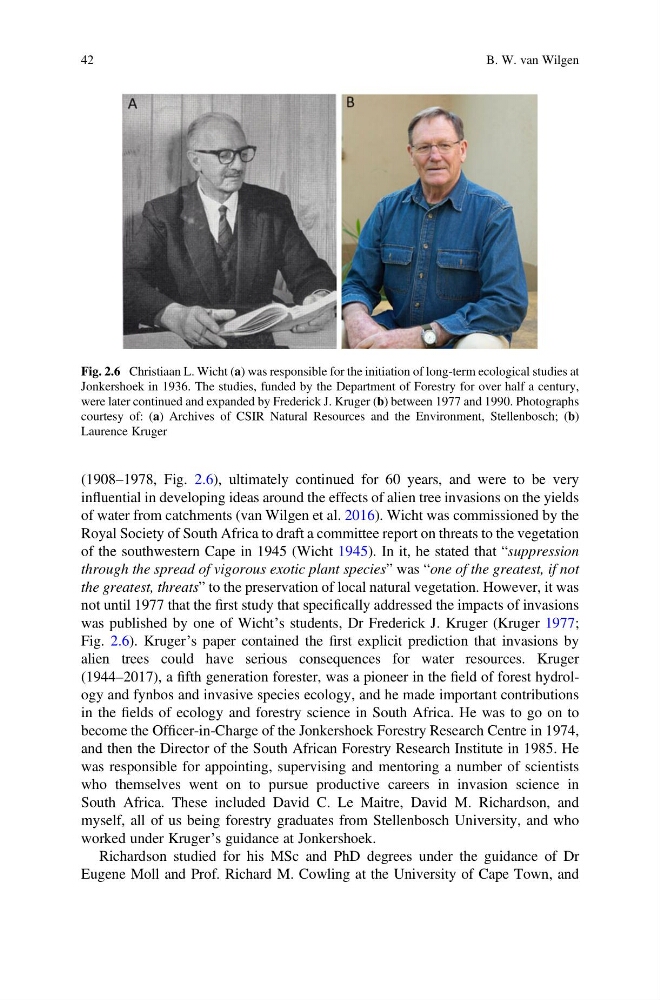
(1908–1978, Fig. 2.6), ultimately continued for 60 years, and were to be very
influential in developing ideas around the effects of alien tree invasions on the yields
of water from catchments (van Wilgen et al. 2016). Wicht was commissioned by the
Royal Society of South Africa to draft a committee report on threats to the vegetation
of the southwestern Cape in 1945 (Wicht 1945). In it, he stated that “suppression
through the spread of vigorous exotic plant species” was “one of the greatest, if not
the greatest, threats” to the preservation of local natural vegetation. However, it was
not until 1977 that the first study that specifically addressed the impacts of invasions
was published by one of Wicht’s students, Dr Frederick J. Kruger (Kruger 1977;
Fig. 2.6). Kruger’s paper contained the first explicit prediction that invasions by
alien trees could have serious consequences for water resources. Kruger
(1944–2017), a fifth generation forester, was a pioneer in the field of forest hydrology and fynbos and invasive species ecology, and he made important contributions
in the fields of ecology and forestry science in South Africa. He was to go on to
become the Officer-in-Charge of the Jonkershoek Forestry Research Centre in 1974,
and then the Director of the South African Forestry Research Institute in 1985. He
was responsible for appointing, supervising and mentoring a number of scientists
who themselves went on to pursue productive careers in invasion science in
South Africa. These included David C. Le Maitre, David M. Richardson, and
myself, all of us being forestry graduates from Stellenbosch University, and who
worked under Kruger’s guidance at Jonkershoek.
Richardson studied for his MSc and PhD degrees under the guidance of Dr
Eugene Moll and Prof. Richard M. Cowling at the University of Cape Town, and
Fig. 2.6 Christiaan L. Wicht (a) was responsible for the initiation of long-term ecological studies at
Jonkershoek in 1936. The studies, funded by the Department of Forestry for over half a century,
were later continued and expanded by Frederick J. Kruger (b) between 1977 and 1990. Photographs
courtesy of: (a) Archives of CSIR Natural Resources and the Environment, Stellenbosch; (b)
Laurence Kruger
42
B. W. van Wilgen
influential in developing ideas around the effects of alien tree invasions on the yields
of water from catchments (van Wilgen et al. 2016). Wicht was commissioned by the
Royal Society of South Africa to draft a committee report on threats to the vegetation
of the southwestern Cape in 1945 (Wicht 1945). In it, he stated that “suppression
through the spread of vigorous exotic plant species” was “one of the greatest, if not
the greatest, threats” to the preservation of local natural vegetation. However, it was
not until 1977 that the first study that specifically addressed the impacts of invasions
was published by one of Wicht’s students, Dr Frederick J. Kruger (Kruger 1977;
Fig. 2.6). Kruger’s paper contained the first explicit prediction that invasions by
alien trees could have serious consequences for water resources. Kruger
(1944–2017), a fifth generation forester, was a pioneer in the field of forest hydrology and fynbos and invasive species ecology, and he made important contributions
in the fields of ecology and forestry science in South Africa. He was to go on to
become the Officer-in-Charge of the Jonkershoek Forestry Research Centre in 1974,
and then the Director of the South African Forestry Research Institute in 1985. He
was responsible for appointing, supervising and mentoring a number of scientists
who themselves went on to pursue productive careers in invasion science in
South Africa. These included David C. Le Maitre, David M. Richardson, and
myself, all of us being forestry graduates from Stellenbosch University, and who
worked under Kruger’s guidance at Jonkershoek.
Richardson studied for his MSc and PhD degrees under the guidance of Dr
Eugene Moll and Prof. Richard M. Cowling at the University of Cape Town, and
Fig. 2.6 Christiaan L. Wicht (a) was responsible for the initiation of long-term ecological studies at
Jonkershoek in 1936. The studies, funded by the Department of Forestry for over half a century,
were later continued and expanded by Frederick J. Kruger (b) between 1977 and 1990. Photographs
courtesy of: (a) Archives of CSIR Natural Resources and the Environment, Stellenbosch; (b)
Laurence Kruger
42
B. W. van Wilgen