

Brian van Wilgen at Jonkershoek. Richardson’s post-graduate studies focused on the
ecology, impacts and management of trees and shrubs in the genera Pinus and Hakea
(Richardson 1985, 1989).
The research group at Jonkershoek were also responsible for publishing the first
papers that attempted to identify why some closely-related species were more
invasive than others (van Wilgen and Siegfried 1986; Richardson et al. 1987). The
South African Forestry Research Institute was shut down in 1990, but the work that
was initiated there continued, as the South African Forestry Research Institute’s
research centres and their staff were all absorbed into the newly-created Division
of Forest Science and Technology in the Council for Scientific and Industrial
Research (CSIR), with Kruger assuming duties as Director.
2.4 The Establishment of Long-Term Monitoring Plots
(1966–Present)
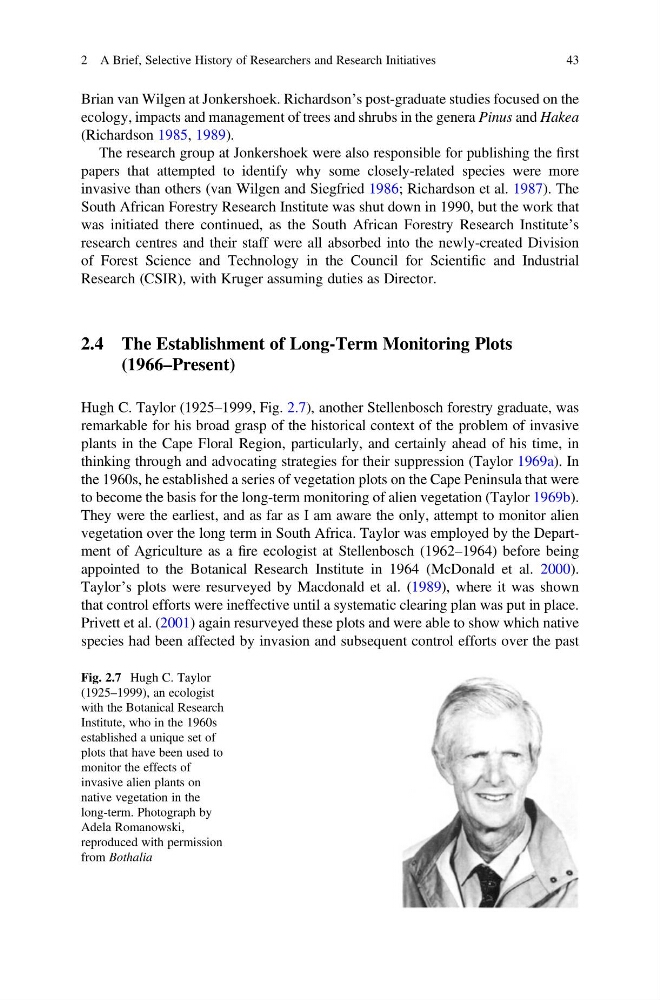
Hugh C. Taylor (1925–1999, Fig. 2.7), another Stellenbosch forestry graduate, was
remarkable for his broad grasp of the historical context of the problem of invasive
plants in the Cape Floral Region, particularly, and certainly ahead of his time, in
thinking through and advocating strategies for their suppression (Taylor 1969a). In
the 1960s, he established a series of vegetation plots on the Cape Peninsula that were
to become the basis for the long-term monitoring of alien vegetation (Taylor 1969b).
They were the earliest, and as far as I am aware the only, attempt to monitor alien
vegetation over the long term in South Africa. Taylor was employed by the Department of Agriculture as a fire ecologist at Stellenbosch (1962–1964) before being
appointed to the Botanical Research Institute in 1964 (McDonald et al. 2000).
Taylor’s plots were resurveyed by Macdonald et al. (1989), where it was shown
that control efforts were ineffective until a systematic clearing plan was put in place.
Privett et al. (2001) again resurveyed these plots and were able to show which native
species had been affected by invasion and subsequent control efforts over the past
Fig. 2.7 Hugh C. Taylor
(1925–1999), an ecologist
with the Botanical Research
Institute, who in the 1960s
established a unique set of
plots that have been used to
monitor the effects of
invasive alien plants on
native vegetation in the
long-term. Photograph by
Adela Romanowski,
reproduced with permission
from Bothalia
2 A Brief, Selective History of Researchers and Research Initiatives
43
ecology, impacts and management of trees and shrubs in the genera Pinus and Hakea
(Richardson 1985, 1989).
The research group at Jonkershoek were also responsible for publishing the first
papers that attempted to identify why some closely-related species were more
invasive than others (van Wilgen and Siegfried 1986; Richardson et al. 1987). The
South African Forestry Research Institute was shut down in 1990, but the work that
was initiated there continued, as the South African Forestry Research Institute’s
research centres and their staff were all absorbed into the newly-created Division
of Forest Science and Technology in the Council for Scientific and Industrial
Research (CSIR), with Kruger assuming duties as Director.
2.4 The Establishment of Long-Term Monitoring Plots
(1966–Present)
Hugh C. Taylor (1925–1999, Fig. 2.7), another Stellenbosch forestry graduate, was
remarkable for his broad grasp of the historical context of the problem of invasive
plants in the Cape Floral Region, particularly, and certainly ahead of his time, in
thinking through and advocating strategies for their suppression (Taylor 1969a). In
the 1960s, he established a series of vegetation plots on the Cape Peninsula that were
to become the basis for the long-term monitoring of alien vegetation (Taylor 1969b).
They were the earliest, and as far as I am aware the only, attempt to monitor alien
vegetation over the long term in South Africa. Taylor was employed by the Department of Agriculture as a fire ecologist at Stellenbosch (1962–1964) before being
appointed to the Botanical Research Institute in 1964 (McDonald et al. 2000).
Taylor’s plots were resurveyed by Macdonald et al. (1989), where it was shown
that control efforts were ineffective until a systematic clearing plan was put in place.
Privett et al. (2001) again resurveyed these plots and were able to show which native
species had been affected by invasion and subsequent control efforts over the past
Fig. 2.7 Hugh C. Taylor
(1925–1999), an ecologist
with the Botanical Research
Institute, who in the 1960s
established a unique set of
plots that have been used to
monitor the effects of
invasive alien plants on
native vegetation in the
long-term. Photograph by
Adela Romanowski,
reproduced with permission
from Bothalia
2 A Brief, Selective History of Researchers and Research Initiatives
43