

3.9 Higher-Order Effects
71
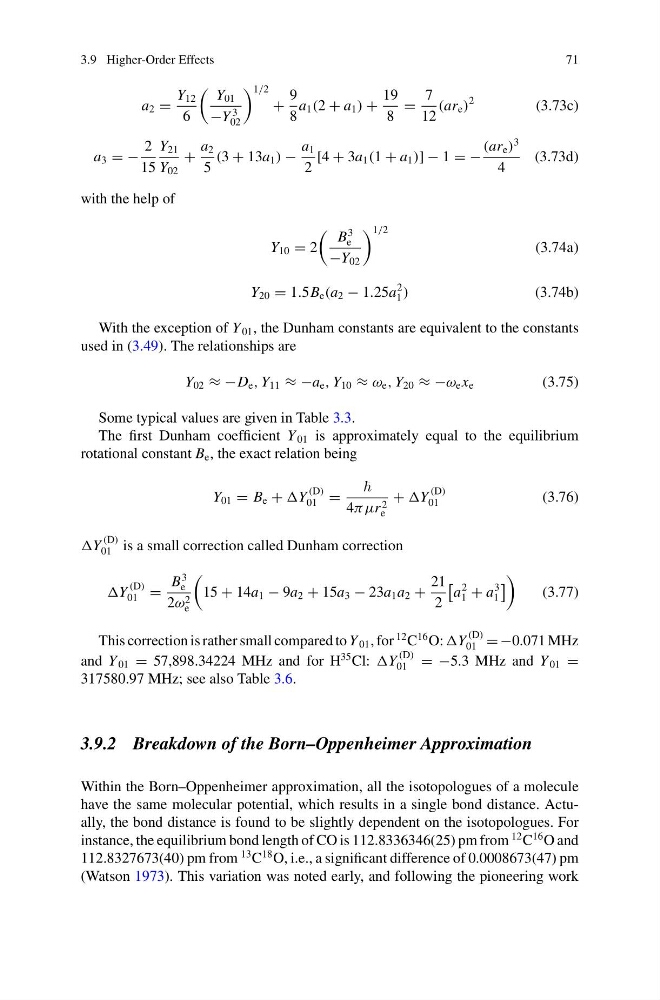
a 2 =
Y 12
6
Y 01
−Y
3
02
1/2
+
9
8
a 1 (2 + a 1 ) +
19
8
=
7
12
(ar e )
2
(3.73c)
a 3 = −
2
15
Y 21
Y 02
+
a 2
5
(3 + 13a 1 ) −
a 1
2
[4 + 3a 1 (1 + a 1 )] − 1 = −
(ar e )
3
4
(3.73d)
with the help of
Y 10 = 2
B
3
e
−Y 02
1/2
(3.74a)
Y 20 = 1.5B e (a 2 − 1.25a
2
1 )
(3.74b)
With the exception of Y 01 , the Dunham constants are equivalent to the constants
used in (3.49). The relationships are
Y 02 ≈ −D e , Y 11 ≈ −a e , Y 10 ≈ ω e , Y 20 ≈ −ω e x e
(3.75)
Some typical values are given in Table 3.3.
The first Dunham coefficient Y 01 is approximately equal to the equilibrium
rotational constant B e , the exact relation being
Y 01 = B e + Y
(D)
01 =
4πμr 2
e
+ Y
(D)
01
(3.76)
Y
(D)
01 is a small correction called Dunham correction
Y
(D)
01 =
B
3
e
2ω 2
e
15 + 14a 1 − 9a 2 + 15a 3 − 23a 1 a 2 +
21
2
a
2
1 + a
3
1
(3.77)
This correction is rather small compared to Y 01 , for
12 C
16 O: Y
(D)
01 = −0.071 MHz
and Y 01 = 57,898.34224 MHz and for H
35 Cl: Y
(D)
01 = −5.3 MHz and Y 01 =
317580.97 MHz; see also Table 3.6.
3.9.2 Breakdown of the Born–Oppenheimer Approximation
Within the Born–Oppenheimer approximation, all the isotopologues of a molecule
have the same molecular potential, which results in a single bond distance. Actually, the bond distance is found to be slightly dependent on the isotopologues. For
instance, the equilibrium bond length of CO is 112.8336346(25) pm from
12 C
16 O and
112.8327673(40) pm from
13 C
18 O, i.e., a significant difference of 0.0008673(47) pm
(Watson 1973). This variation was noted early, and following the pioneering work
71
a 2 =
Y 12
6
Y 01
−Y
3
02
1/2
+
9
8
a 1 (2 + a 1 ) +
19
8
=
7
12
(ar e )
2
(3.73c)
a 3 = −
2
15
Y 21
Y 02
+
a 2
5
(3 + 13a 1 ) −
a 1
2
[4 + 3a 1 (1 + a 1 )] − 1 = −
(ar e )
3
4
(3.73d)
with the help of
Y 10 = 2
B
3
e
−Y 02
1/2
(3.74a)
Y 20 = 1.5B e (a 2 − 1.25a
2
1 )
(3.74b)
With the exception of Y 01 , the Dunham constants are equivalent to the constants
used in (3.49). The relationships are
Y 02 ≈ −D e , Y 11 ≈ −a e , Y 10 ≈ ω e , Y 20 ≈ −ω e x e
(3.75)
Some typical values are given in Table 3.3.
The first Dunham coefficient Y 01 is approximately equal to the equilibrium
rotational constant B e , the exact relation being
Y 01 = B e + Y
(D)
01 =
4πμr 2
e
+ Y
(D)
01
(3.76)
Y
(D)
01 is a small correction called Dunham correction
Y
(D)
01 =
B
3
e
2ω 2
e
15 + 14a 1 − 9a 2 + 15a 3 − 23a 1 a 2 +
21
2
a
2
1 + a
3
1
(3.77)
This correction is rather small compared to Y 01 , for
12 C
16 O: Y
(D)
01 = −0.071 MHz
and Y 01 = 57,898.34224 MHz and for H
35 Cl: Y
(D)
01 = −5.3 MHz and Y 01 =
317580.97 MHz; see also Table 3.6.
3.9.2 Breakdown of the Born–Oppenheimer Approximation
Within the Born–Oppenheimer approximation, all the isotopologues of a molecule
have the same molecular potential, which results in a single bond distance. Actually, the bond distance is found to be slightly dependent on the isotopologues. For
instance, the equilibrium bond length of CO is 112.8336346(25) pm from
12 C
16 O and
112.8327673(40) pm from
13 C
18 O, i.e., a significant difference of 0.0008673(47) pm
(Watson 1973). This variation was noted early, and following the pioneering work