

72
3 Diatomic Molecules
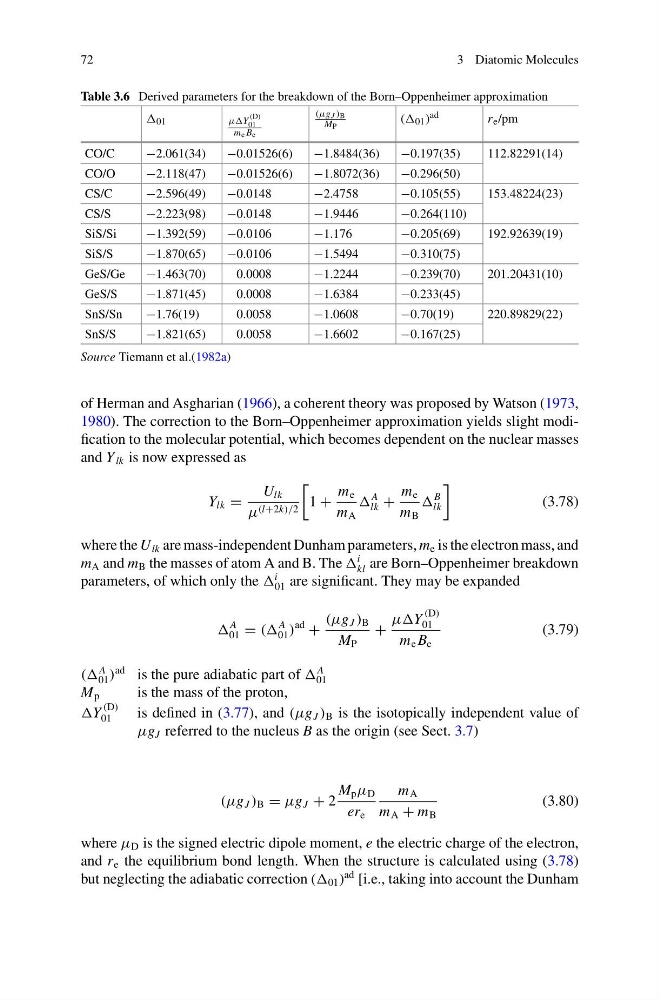
Table 3.6 Derived parameters for the breakdown of the Born–Oppenheimer approximation
01
μμY
(D)
01
me Be
(μg J )B
MP
( 01 ) ad
r e /pm
CO/C
−2.061(34)
−0.01526(6)
−1.8484(36)
−0.197(35)
112.82291(14)
CO/O
−2.118(47)
−0.01526(6)
−1.8072(36)
−0.296(50)
CS/C
−2.596(49)
−0.0148
−2.4758
−0.105(55)
153.48224(23)
CS/S
−2.223(98)
−0.0148
−1.9446
−0.264(110)
SiS/Si
−1.392(59)
−0.0106
−1.176
−0.205(69)
192.92639(19)
SiS/S
−1.870(65)
−0.0106
−1.5494
−0.310(75)
GeS/Ge
−1.463(70)
0.0008
−1.2244
−0.239(70)
201.20431(10)
GeS/S
−1.871(45)
0.0008
−1.6384
−0.233(45)
SnS/Sn
−1.76(19)
0.0058
−1.0608
−0.70(19)
220.89829(22)
SnS/S
−1.821(65)
0.0058
−1.6602
−0.167(25)
Source Tiemann et al.(1982a)
of Herman and Asgharian (1966), a coherent theory was proposed by Watson (1973,
1980). The correction to the Born–Oppenheimer approximation yields slight modification to the molecular potential, which becomes dependent on the nuclear masses
and Y lk is now expressed as
Y lk =
U lk
μ (l+2k)/2
1 +
m e
m A
A
lk +
m e
m B
B
lk
(3.78)
where the U lk are mass-independent Dunham parameters, m e is the electron mass, and
m A and m B the masses of atom A and B. The
i
kl are Born–Oppenheimer breakdown
parameters, of which only the
i
01 are significant. They may be expanded
A
01 = ((
A
01 )
ad
+
(μg J ) B
M P
+
μμY
(D)
01
m e B e
(3.79)
((
A
01 )
ad is the pure adiabatic part of
A
01
M p
is the mass of the proton,
Y
(D)
01
is defined in (3.77), and (μg J ) B is the isotopically independent value of
μg J referred to the nucleus B as the origin (see Sect. 3.7)
(μg J ) B = μg J + 2
M p μ D
er e
m A
m A + m B
(3.80)
where μ D is the signed electric dipole moment, e the electric charge of the electron,
and r e the equilibrium bond length. When the structure is calculated using (3.78)
but neglecting the adiabatic correction ( 01 )
ad [i.e., taking into account the Dunham
3 Diatomic Molecules
Table 3.6 Derived parameters for the breakdown of the Born–Oppenheimer approximation
01
μμY
(D)
01
me Be
(μg J )B
MP
( 01 ) ad
r e /pm
CO/C
−2.061(34)
−0.01526(6)
−1.8484(36)
−0.197(35)
112.82291(14)
CO/O
−2.118(47)
−0.01526(6)
−1.8072(36)
−0.296(50)
CS/C
−2.596(49)
−0.0148
−2.4758
−0.105(55)
153.48224(23)
CS/S
−2.223(98)
−0.0148
−1.9446
−0.264(110)
SiS/Si
−1.392(59)
−0.0106
−1.176
−0.205(69)
192.92639(19)
SiS/S
−1.870(65)
−0.0106
−1.5494
−0.310(75)
GeS/Ge
−1.463(70)
0.0008
−1.2244
−0.239(70)
201.20431(10)
GeS/S
−1.871(45)
0.0008
−1.6384
−0.233(45)
SnS/Sn
−1.76(19)
0.0058
−1.0608
−0.70(19)
220.89829(22)
SnS/S
−1.821(65)
0.0058
−1.6602
−0.167(25)
Source Tiemann et al.(1982a)
of Herman and Asgharian (1966), a coherent theory was proposed by Watson (1973,
1980). The correction to the Born–Oppenheimer approximation yields slight modification to the molecular potential, which becomes dependent on the nuclear masses
and Y lk is now expressed as
Y lk =
U lk
μ (l+2k)/2
1 +
m e
m A
A
lk +
m e
m B
B
lk
(3.78)
where the U lk are mass-independent Dunham parameters, m e is the electron mass, and
m A and m B the masses of atom A and B. The
i
kl are Born–Oppenheimer breakdown
parameters, of which only the
i
01 are significant. They may be expanded
A
01 = ((
A
01 )
ad
+
(μg J ) B
M P
+
μμY
(D)
01
m e B e
(3.79)
((
A
01 )
ad is the pure adiabatic part of
A
01
M p
is the mass of the proton,
Y
(D)
01
is defined in (3.77), and (μg J ) B is the isotopically independent value of
μg J referred to the nucleus B as the origin (see Sect. 3.7)
(μg J ) B = μg J + 2
M p μ D
er e
m A
m A + m B
(3.80)
where μ D is the signed electric dipole moment, e the electric charge of the electron,
and r e the equilibrium bond length. When the structure is calculated using (3.78)
but neglecting the adiabatic correction ( 01 )
ad [i.e., taking into account the Dunham