

70
3 Diatomic Molecules
r z = r e
1 −
3
2
a 1
B e
ω e
= r e + r
(3.68)
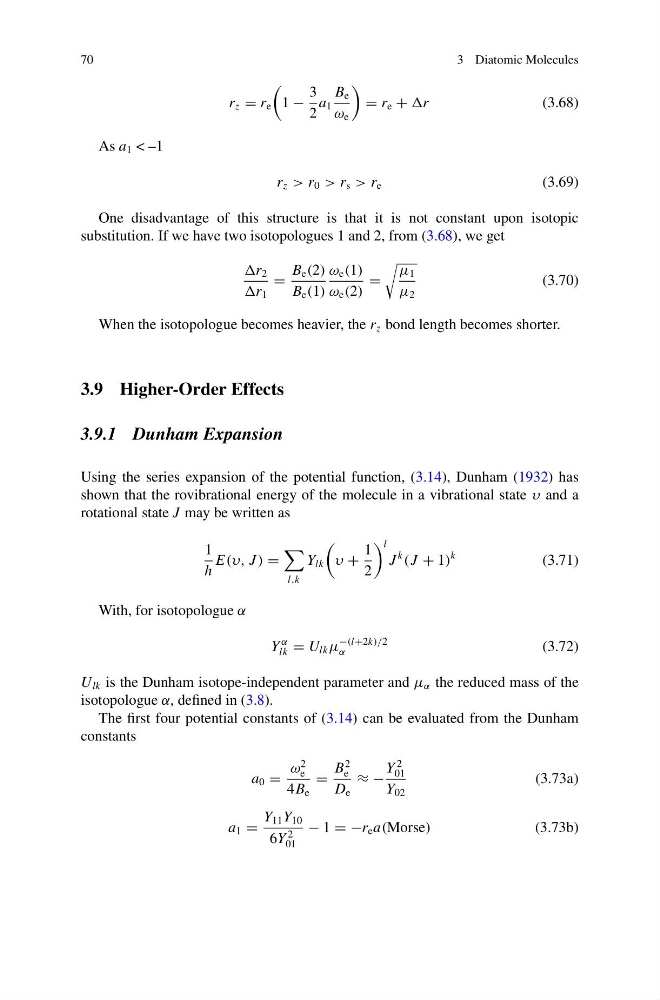
As a 1 < –1
r z > r 0 > r s > r e
(3.69)
One disadvantage of this structure is that it is not constant upon isotopic
substitution. If we have two isotopologues 1 and 2, from (3.68), we get
r 2
r 1
=
B e (2)
B e (1)
ω e (1)
ω e (2)
=
μ 1
μ 2
(3.70)
When the isotopologue becomes heavier, the r z bond length becomes shorter.
3.9 Higher-Order Effects
3.9.1 Dunham Expansion
Using the series expansion of the potential function, (3.14), Dunham (1932) has
shown that the rovibrational energy of the molecule in a vibrational state υ and a
rotational state J may be written as
1
h
E(υ, J ) =
l,k
Y lk
υ +
1
2
l
J
k
(J + 1)
k
(3.71)
With, for isotopologue α
Y
α
lk = U lk μ
−(l+2k)/2
α
(3.72)
U lk is the Dunham isotope-independent parameter and μ α the reduced mass of the
isotopologue α, defined in (3.8).
The first four potential constants of (3.14) can be evaluated from the Dunham
constants
a 0 =
ω
2
e
4B e
=
B
2
e
D e
≈ −
Y
2
01
Y 02
(3.73a)
a 1 =
Y 11 Y 10
6Y
2
01
− 1 = −r e a(Morse)
(3.73b)
3 Diatomic Molecules
r z = r e
1 −
3
2
a 1
B e
ω e
= r e + r
(3.68)
As a 1 < –1
r z > r 0 > r s > r e
(3.69)
One disadvantage of this structure is that it is not constant upon isotopic
substitution. If we have two isotopologues 1 and 2, from (3.68), we get
r 2
r 1
=
B e (2)
B e (1)
ω e (1)
ω e (2)
=
μ 1
μ 2
(3.70)
When the isotopologue becomes heavier, the r z bond length becomes shorter.
3.9 Higher-Order Effects
3.9.1 Dunham Expansion
Using the series expansion of the potential function, (3.14), Dunham (1932) has
shown that the rovibrational energy of the molecule in a vibrational state υ and a
rotational state J may be written as
1
h
E(υ, J ) =
l,k
Y lk
υ +
1
2
l
J
k
(J + 1)
k
(3.71)
With, for isotopologue α
Y
α
lk = U lk μ
−(l+2k)/2
α
(3.72)
U lk is the Dunham isotope-independent parameter and μ α the reduced mass of the
isotopologue α, defined in (3.8).
The first four potential constants of (3.14) can be evaluated from the Dunham
constants
a 0 =
ω
2
e
4B e
=
B
2
e
D e
≈ −
Y
2
01
Y 02
(3.73a)
a 1 =
Y 11 Y 10
6Y
2
01
− 1 = −r e a(Morse)
(3.73b)