

3.7 Electronic Correction
67
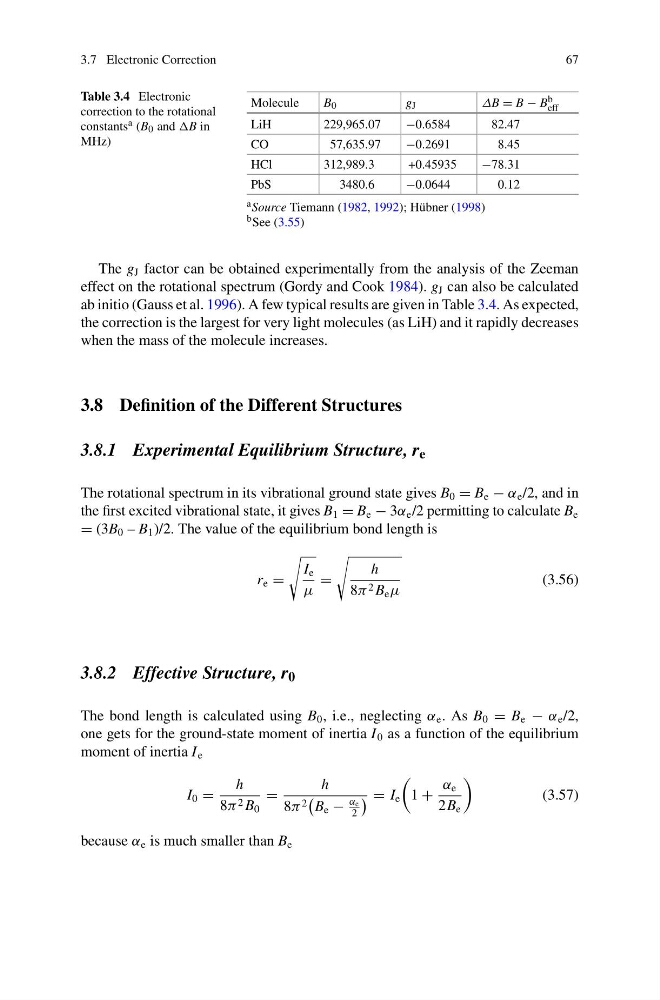
Table 3.4 Electronic
correction to the rotational
constants a (B 0 and B in
MHz)
Molecule
B 0
g J
ΔB = B − B b
eff
LiH
229,965.07
−0.6584
82.47
CO
57,635.97
−0.2691
8.45
HCl
312,989.3
+0.45935
−78.31
PbS
3480.6
−0.0644
0.12
a Source Tiemann (1982, 1992); Hübner (1998)
b See (3.55)
The g J factor can be obtained experimentally from the analysis of the Zeeman
effect on the rotational spectrum (Gordy and Cook 1984). g J can also be calculated
ab initio (Gauss et al. 1996). A few typical results are given in Table 3.4. As expected,
the correction is the largest for very light molecules (as LiH) and it rapidly decreases
when the mass of the molecule increases.
3.8 Definition of the Different Structures
3.8.1 Experimental Equilibrium Structure, r e
The rotational spectrum in its vibrational ground state gives B 0 = B e − α e /2, and in
the first excited vibrational state, it gives B 1 = B e − 3α e /2 permitting to calculate B e
= (3B 0 – B 1 )/2. The value of the equilibrium bond length is
r e =
I e
μ
=
h
8π 2 B e μ
(3.56)
3.8.2 Effective Structure, r 0
The bond length is calculated using B 0 , i.e., neglecting α e . As B 0 = B e − α e /2,
one gets for the ground-state moment of inertia I 0 as a function of the equilibrium
moment of inertia I e
I 0 =
h
8π 2 B 0
=
h
8π 2
B e −
α e
2
= I e
1 +
α e
2B e
(3.57)
because α e is much smaller than B e
67
Table 3.4 Electronic
correction to the rotational
constants a (B 0 and B in
MHz)
Molecule
B 0
g J
ΔB = B − B b
eff
LiH
229,965.07
−0.6584
82.47
CO
57,635.97
−0.2691
8.45
HCl
312,989.3
+0.45935
−78.31
PbS
3480.6
−0.0644
0.12
a Source Tiemann (1982, 1992); Hübner (1998)
b See (3.55)
The g J factor can be obtained experimentally from the analysis of the Zeeman
effect on the rotational spectrum (Gordy and Cook 1984). g J can also be calculated
ab initio (Gauss et al. 1996). A few typical results are given in Table 3.4. As expected,
the correction is the largest for very light molecules (as LiH) and it rapidly decreases
when the mass of the molecule increases.
3.8 Definition of the Different Structures
3.8.1 Experimental Equilibrium Structure, r e
The rotational spectrum in its vibrational ground state gives B 0 = B e − α e /2, and in
the first excited vibrational state, it gives B 1 = B e − 3α e /2 permitting to calculate B e
= (3B 0 – B 1 )/2. The value of the equilibrium bond length is
r e =
I e
μ
=
h
8π 2 B e μ
(3.56)
3.8.2 Effective Structure, r 0
The bond length is calculated using B 0 , i.e., neglecting α e . As B 0 = B e − α e /2,
one gets for the ground-state moment of inertia I 0 as a function of the equilibrium
moment of inertia I e
I 0 =
h
8π 2 B 0
=
h
8π 2
B e −
α e
2
= I e
1 +
α e
2B e
(3.57)
because α e is much smaller than B e