

68
3 Diatomic Molecules
Table 3.5 Structure of HCl a
H
Cl
B 0 /MHz
r 0 /pm
r 0 (exp) − r 0 (calc)
1
35
312,989.2551
128.387028
0.000032
1
37
312,519.084
128.386308
0.000015
2
35
161,656.313
128.124347
−0.000097
2
37
161,183.063
128.123405
−0.000059
3
35
111,075.84
128.010150
0.000113
3
37
110,601.62
128.008849
−0.000004
a Source Tiemann (1982, 1992); Hübner (1998)
r 0 =
I 0
μ
=
I e
μ
1 +
α e
2B e
= r e
1 +
α e
4B e
(3.58)
From (3.51), Sect. 3.6, it appears that the error decreases with the mass of the
molecule. Replacing α e by its expression, (3.40), one finds that
r 0 = r e −
3(1 + a 1 )
4r e
√
k
μ
−1/2
(3.59)
The term in brackets is a constant for a given molecule. It is then possible to
rewrite this equation (Laurie 1958)
r 0 = r e +
A
√
μ
(3.60)
where A is a positive constant for a given molecule. When r 0 has been determined
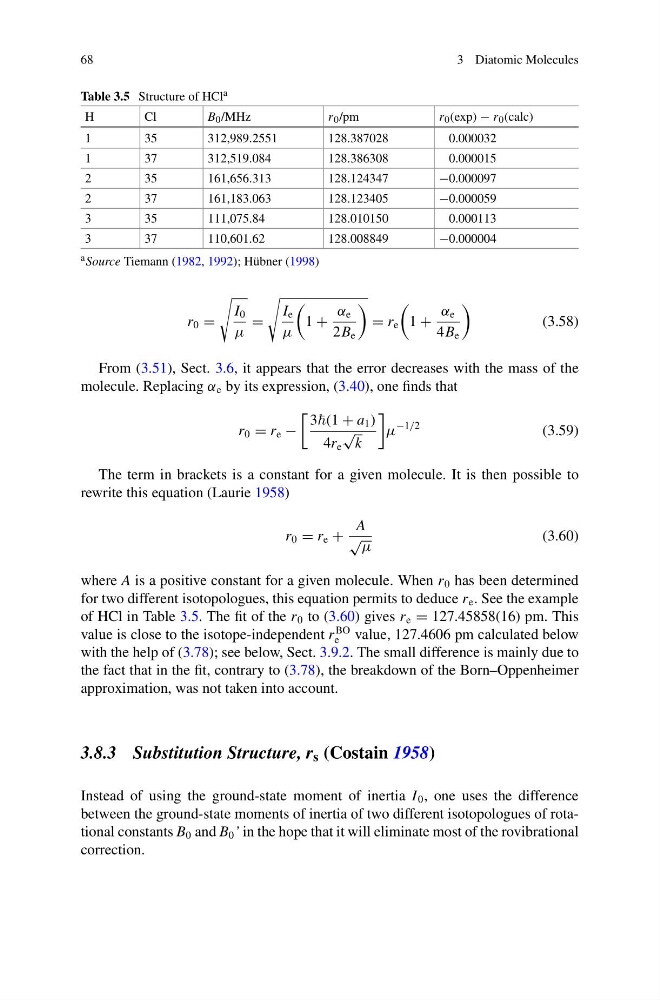
for two different isotopologues, this equation permits to deduce r e . See the example
of HCl in Table 3.5. The fit of the r 0 to (3.60) gives r e = 127.45858(16) pm. This
value is close to the isotope-independent r
BO
e
value, 127.4606 pm calculated below
with the help of (3.78); see below, Sect. 3.9.2. The small difference is mainly due to
the fact that in the fit, contrary to (3.78), the breakdown of the Born–Oppenheimer
approximation, was not taken into account.
3.8.3 Substitution Structure, r s (Costain 1958)
Instead of using the ground-state moment of inertia I 0 , one uses the difference
between the ground-state moments of inertia of two different isotopologues of rotational constants B 0 and B 0 ’ in the hope that it will eliminate most of the rovibrational
correction.
3 Diatomic Molecules
Table 3.5 Structure of HCl a
H
Cl
B 0 /MHz
r 0 /pm
r 0 (exp) − r 0 (calc)
1
35
312,989.2551
128.387028
0.000032
1
37
312,519.084
128.386308
0.000015
2
35
161,656.313
128.124347
−0.000097
2
37
161,183.063
128.123405
−0.000059
3
35
111,075.84
128.010150
0.000113
3
37
110,601.62
128.008849
−0.000004
a Source Tiemann (1982, 1992); Hübner (1998)
r 0 =
I 0
μ
=
I e
μ
1 +
α e
2B e
= r e
1 +
α e
4B e
(3.58)
From (3.51), Sect. 3.6, it appears that the error decreases with the mass of the
molecule. Replacing α e by its expression, (3.40), one finds that
r 0 = r e −
3(1 + a 1 )
4r e
√
k
μ
−1/2
(3.59)
The term in brackets is a constant for a given molecule. It is then possible to
rewrite this equation (Laurie 1958)
r 0 = r e +
A
√
μ
(3.60)
where A is a positive constant for a given molecule. When r 0 has been determined
for two different isotopologues, this equation permits to deduce r e . See the example
of HCl in Table 3.5. The fit of the r 0 to (3.60) gives r e = 127.45858(16) pm. This
value is close to the isotope-independent r
BO
e
value, 127.4606 pm calculated below
with the help of (3.78); see below, Sect. 3.9.2. The small difference is mainly due to
the fact that in the fit, contrary to (3.78), the breakdown of the Born–Oppenheimer
approximation, was not taken into account.
3.8.3 Substitution Structure, r s (Costain 1958)
Instead of using the ground-state moment of inertia I 0 , one uses the difference
between the ground-state moments of inertia of two different isotopologues of rotational constants B 0 and B 0 ’ in the hope that it will eliminate most of the rovibrational
correction.