

66
3 Diatomic Molecules
More generally, when a vibrational mode has a characteristic frequency far from the
others, it may be considered as isolated. It applies in particular to the OH bond. For
more details, see Sect. 8.7.1.
3.7 Electronic Correction
Before going further, it is now necessary to discuss the approximation that we have
made: The center of mass of the electrons coincides with the nucleus.
This is a very good approximation for most molecules. However, a small correction
for unequal sharing of the electrons by the atoms and for non-spherical distribution
of the electronic clouds around the atoms is sometimes non-negligible and has to
be taken into account. This electronic correction can indeed be important for light
molecules. We will only give here a brief summary, the full treatment being given in
Sect. 4.10 for the polyatomic molecule.
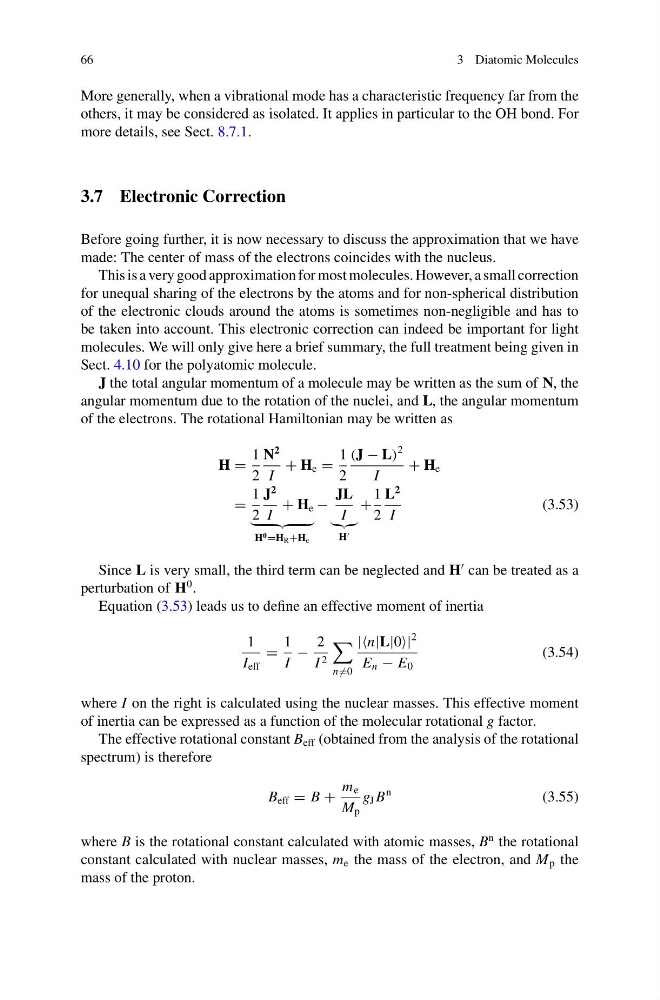
J the total angular momentum of a molecule may be written as the sum of N, the
angular momentum due to the rotation of the nuclei, and L, the angular momentum
of the electrons. The rotational Hamiltonian may be written as
H =
1
2
N
2
I
+ H e =
1
2
(J − L)
2
I
+ H e
=
1
2
J
2
I
+ H e
H 0 =H R +H e
−
JL
I
H
+
1
2
L
2
I
(3.53)
Since L is very small, the third term can be neglected and H
can be treated as a
perturbation of H
0 .
Equation (3.53) leads us to define an effective moment of inertia
1
I eff
=
1
I
−
2
I 2
n =0
||n|L|0|
2
E n − E 0
(3.54)
where I on the right is calculated using the nuclear masses. This effective moment
of inertia can be expressed as a function of the molecular rotational g factor.
The effective rotational constant B eff (obtained from the analysis of the rotational
spectrum) is therefore
B eff = B +
m e
M p
g J B
n
(3.55)
where B is the rotational constant calculated with atomic masses, B
n the rotational
constant calculated with nuclear masses, m e the mass of the electron, and M p the
mass of the proton.
3 Diatomic Molecules
More generally, when a vibrational mode has a characteristic frequency far from the
others, it may be considered as isolated. It applies in particular to the OH bond. For
more details, see Sect. 8.7.1.
3.7 Electronic Correction
Before going further, it is now necessary to discuss the approximation that we have
made: The center of mass of the electrons coincides with the nucleus.
This is a very good approximation for most molecules. However, a small correction
for unequal sharing of the electrons by the atoms and for non-spherical distribution
of the electronic clouds around the atoms is sometimes non-negligible and has to
be taken into account. This electronic correction can indeed be important for light
molecules. We will only give here a brief summary, the full treatment being given in
Sect. 4.10 for the polyatomic molecule.
J the total angular momentum of a molecule may be written as the sum of N, the
angular momentum due to the rotation of the nuclei, and L, the angular momentum
of the electrons. The rotational Hamiltonian may be written as
H =
1
2
N
2
I
+ H e =
1
2
(J − L)
2
I
+ H e
=
1
2
J
2
I
+ H e
H 0 =H R +H e
−
JL
I
H
+
1
2
L
2
I
(3.53)
Since L is very small, the third term can be neglected and H
can be treated as a
perturbation of H
0 .
Equation (3.53) leads us to define an effective moment of inertia
1
I eff
=
1
I
−
2
I 2
n =0
||n|L|0|
2
E n − E 0
(3.54)
where I on the right is calculated using the nuclear masses. This effective moment
of inertia can be expressed as a function of the molecular rotational g factor.
The effective rotational constant B eff (obtained from the analysis of the rotational
spectrum) is therefore
B eff = B +
m e
M p
g J B
n
(3.55)
where B is the rotational constant calculated with atomic masses, B
n the rotational
constant calculated with nuclear masses, m e the mass of the electron, and M p the
mass of the proton.