

3.2 The Vibrational Energy
57
it is above the bottom of the potential. It is a consequence of the uncertainty principle
of Heisenberg.
Example: the harmonic vibrational frequency of H
35 Cl
The atomic masses are usually given in atomic units, they have to be converted
using m u = 1.6605388×10
−27 kg, the force constant is given in dyn cm
−1 , and it has
to be converted in N m
−1 . For H
35 Cl, k = 4.84×10
5 dyn cm
−1
= 484 N m
−1 . It gives
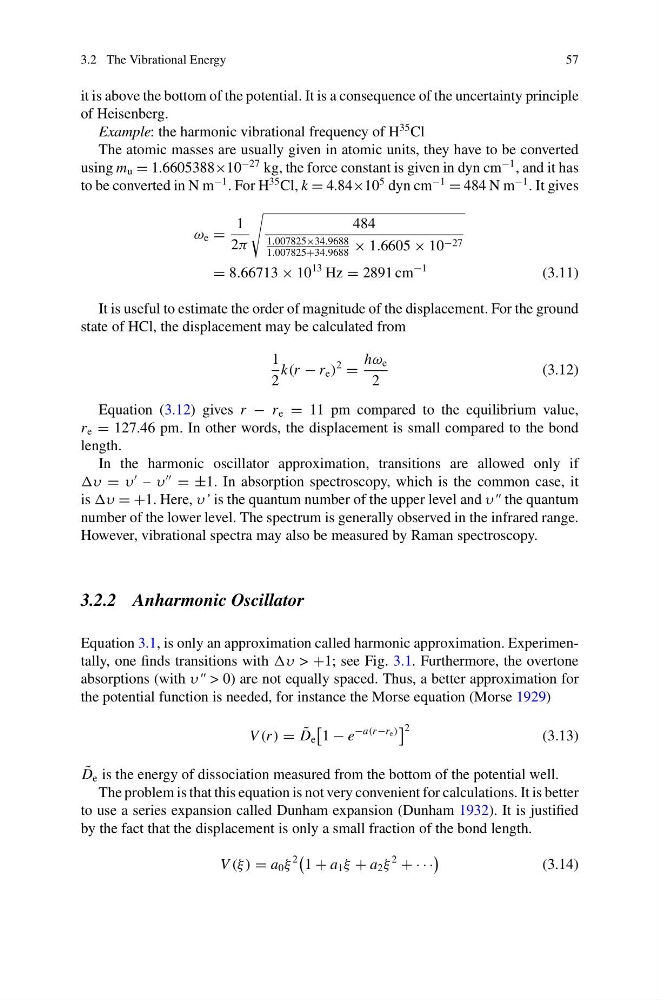
ω e =
1
2π
484
1.007825×34.9688
1.007825+34.9688
× 1.6605 × 10 −27
= 8.66713 × 10
13 Hz = 2891 cm
−1
(3.11)
It is useful to estimate the order of magnitude of the displacement. For the ground
state of HCl, the displacement may be calculated from
1
2
k(r − r e )
2
=
hω e
2
(3.12)
Equation (3.12) gives r − r e = 11 pm compared to the equilibrium value,
r e = 127.46 pm. In other words, the displacement is small compared to the bond
length.
In the harmonic oscillator approximation, transitions are allowed only if
υ = υ
– υ
= ±1. In absorption spectroscopy, which is the common case, it
is υ = +1. Here, υ’ is the quantum number of the upper level and υ" the quantum
number of the lower level. The spectrum is generally observed in the infrared range.
However, vibrational spectra may also be measured by Raman spectroscopy.
3.2.2 Anharmonic Oscillator
Equation 3.1, is only an approximation called harmonic approximation. Experimentally, one finds transitions with υ > +1; see Fig. 3.1. Furthermore, the overtone
absorptions (with υ" > 0) are not equally spaced. Thus, a better approximation for
the potential function is needed, for instance the Morse equation (Morse 1929)
V (r ) = ˜
D e
1 − e
−a(r −r e )
2
(3.13)
˜
D e is the energy of dissociation measured from the bottom of the potential well.
The problem is that this equation is not very convenient for calculations. It is better
to use a series expansion called Dunham expansion (Dunham 1932). It is justified
by the fact that the displacement is only a small fraction of the bond length.
V (ξ ) = a 0 ξ
2
1 + a 1 ξ + a 2 ξ
2
+ · · ·
(3.14)
57
it is above the bottom of the potential. It is a consequence of the uncertainty principle
of Heisenberg.
Example: the harmonic vibrational frequency of H
35 Cl
The atomic masses are usually given in atomic units, they have to be converted
using m u = 1.6605388×10
−27 kg, the force constant is given in dyn cm
−1 , and it has
to be converted in N m
−1 . For H
35 Cl, k = 4.84×10
5 dyn cm
−1
= 484 N m
−1 . It gives
ω e =
1
2π
484
1.007825×34.9688
1.007825+34.9688
× 1.6605 × 10 −27
= 8.66713 × 10
13 Hz = 2891 cm
−1
(3.11)
It is useful to estimate the order of magnitude of the displacement. For the ground
state of HCl, the displacement may be calculated from
1
2
k(r − r e )
2
=
hω e
2
(3.12)
Equation (3.12) gives r − r e = 11 pm compared to the equilibrium value,
r e = 127.46 pm. In other words, the displacement is small compared to the bond
length.
In the harmonic oscillator approximation, transitions are allowed only if
υ = υ
– υ
= ±1. In absorption spectroscopy, which is the common case, it
is υ = +1. Here, υ’ is the quantum number of the upper level and υ" the quantum
number of the lower level. The spectrum is generally observed in the infrared range.
However, vibrational spectra may also be measured by Raman spectroscopy.
3.2.2 Anharmonic Oscillator
Equation 3.1, is only an approximation called harmonic approximation. Experimentally, one finds transitions with υ > +1; see Fig. 3.1. Furthermore, the overtone
absorptions (with υ" > 0) are not equally spaced. Thus, a better approximation for
the potential function is needed, for instance the Morse equation (Morse 1929)
V (r ) = ˜
D e
1 − e
−a(r −r e )
2
(3.13)
˜
D e is the energy of dissociation measured from the bottom of the potential well.
The problem is that this equation is not very convenient for calculations. It is better
to use a series expansion called Dunham expansion (Dunham 1932). It is justified
by the fact that the displacement is only a small fraction of the bond length.
V (ξ ) = a 0 ξ
2
1 + a 1 ξ + a 2 ξ
2
+ · · ·
(3.14)