

58
3 Diatomic Molecules
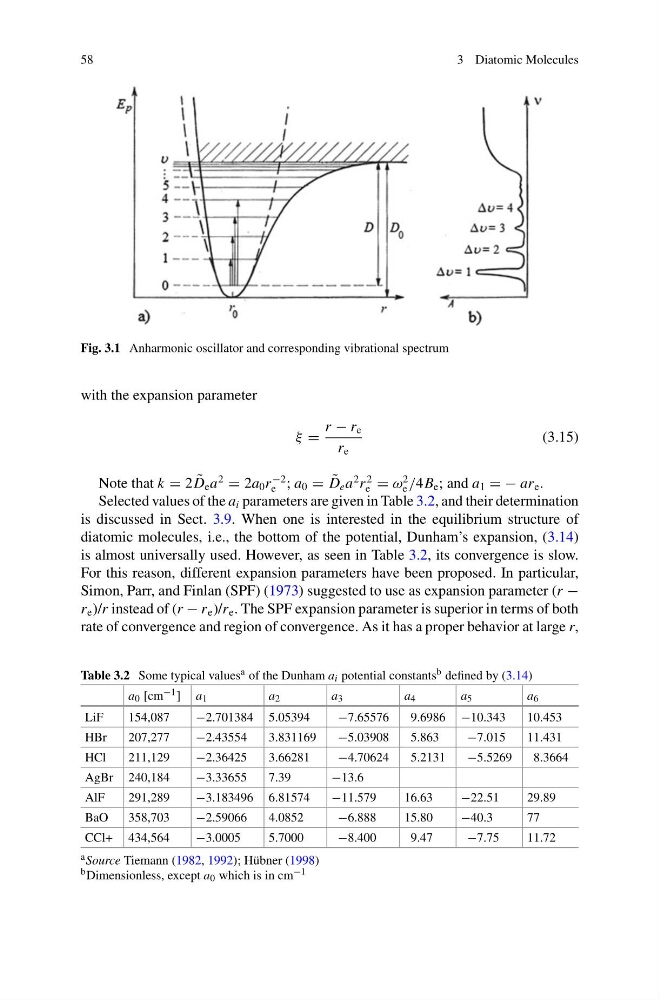
Fig. 3.1 Anharmonic oscillator and corresponding vibrational spectrum
with the expansion parameter
ξ =
r − r e
r e
(3.15)
Note that k = 2 ˜
D e a
2
= 2a 0 r
−2
e ; a 0 = ˜
D e a
2 r
2
e = ω
2
e /4B e ; and a 1 = − ar e .
Selected values of the a i parameters are given in Table 3.2, and their determination
is discussed in Sect. 3.9. When one is interested in the equilibrium structure of
diatomic molecules, i.e., the bottom of the potential, Dunham’s expansion, (3.14)
is almost universally used. However, as seen in Table 3.2, its convergence is slow.
For this reason, different expansion parameters have been proposed. In particular,
Simon, Parr, and Finlan (SPF) (1973) suggested to use as expansion parameter (r −
r e )/r instead of (r − r e )/r e . The SPF expansion parameter is superior in terms of both
rate of convergence and region of convergence. As it has a proper behavior at large r,
Table 3.2 Some typical values a of the Dunham a i potential constants b defined by (3.14)
a 0 [cm −1 ] a 1
a 2
a 3
a 4
a 5
a 6
LiF
154,087
−2.701384 5.05394
−7.65576
9.6986 −10.343
10.453
HBr
207,277
−2.43554
3.831169
−5.03908
5.863
−7.015
11.431
HCl
211,129
−2.36425
3.66281
−4.70624
5.2131
−5.5269
8.3664
AgBr 240,184
−3.33655
7.39
−13.6
AlF
291,289
−3.183496 6.81574
−11.579
16.63
−22.51
29.89
BaO
358,703
−2.59066
4.0852
−6.888
15.80
−40.3
77
CCl+ 434,564
−3.0005
5.7000
−8.400
9.47
−7.75
11.72
a Source Tiemann (1982, 1992); Hübner (1998)
b Dimensionless, except a 0 which is in cm −1
3 Diatomic Molecules
Fig. 3.1 Anharmonic oscillator and corresponding vibrational spectrum
with the expansion parameter
ξ =
r − r e
r e
(3.15)
Note that k = 2 ˜
D e a
2
= 2a 0 r
−2
e ; a 0 = ˜
D e a
2 r
2
e = ω
2
e /4B e ; and a 1 = − ar e .
Selected values of the a i parameters are given in Table 3.2, and their determination
is discussed in Sect. 3.9. When one is interested in the equilibrium structure of
diatomic molecules, i.e., the bottom of the potential, Dunham’s expansion, (3.14)
is almost universally used. However, as seen in Table 3.2, its convergence is slow.
For this reason, different expansion parameters have been proposed. In particular,
Simon, Parr, and Finlan (SPF) (1973) suggested to use as expansion parameter (r −
r e )/r instead of (r − r e )/r e . The SPF expansion parameter is superior in terms of both
rate of convergence and region of convergence. As it has a proper behavior at large r,
Table 3.2 Some typical values a of the Dunham a i potential constants b defined by (3.14)
a 0 [cm −1 ] a 1
a 2
a 3
a 4
a 5
a 6
LiF
154,087
−2.701384 5.05394
−7.65576
9.6986 −10.343
10.453
HBr
207,277
−2.43554
3.831169
−5.03908
5.863
−7.015
11.431
HCl
211,129
−2.36425
3.66281
−4.70624
5.2131
−5.5269
8.3664
AgBr 240,184
−3.33655
7.39
−13.6
AlF
291,289
−3.183496 6.81574
−11.579
16.63
−22.51
29.89
BaO
358,703
−2.59066
4.0852
−6.888
15.80
−40.3
77
CCl+ 434,564
−3.0005
5.7000
−8.400
9.47
−7.75
11.72
a Source Tiemann (1982, 1992); Hübner (1998)
b Dimensionless, except a 0 which is in cm −1