

56
3 Diatomic Molecules
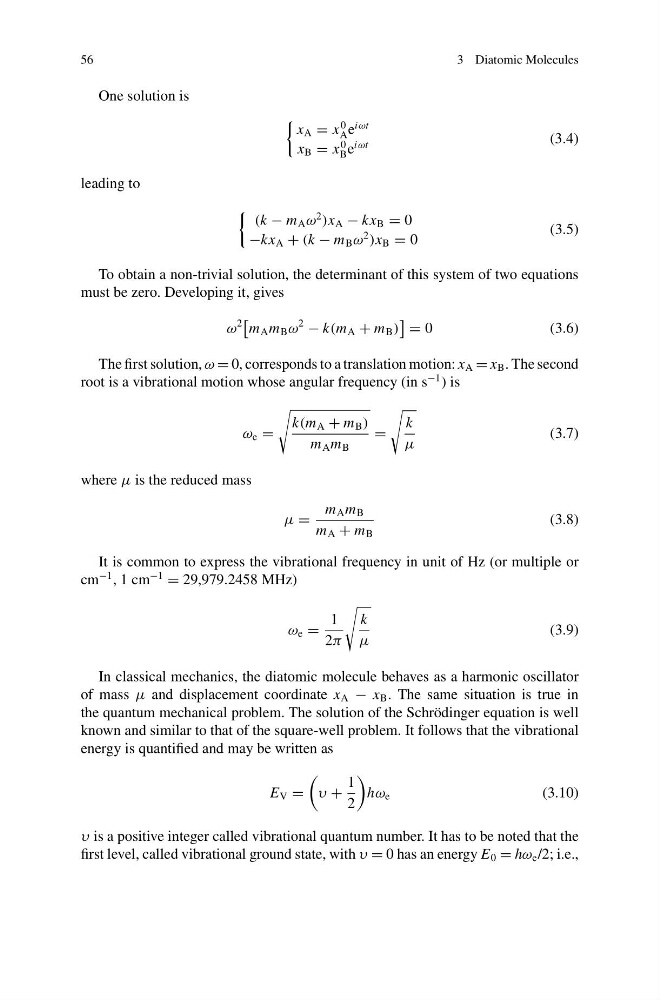
One solution is
x A = x
0
A e
iωt
x B = x
0
B e
iωt
(3.4)
leading to
(k − m A ω
2
)x A − kx B = 0
−kx A + (k − m B ω
2
)x B = 0
(3.5)
To obtain a non-trivial solution, the determinant of this system of two equations
must be zero. Developing it, gives
ω
2
m A m B ω
2
− k(m A + m B )
= 0
(3.6)
The first solution, ω = 0, corresponds to a translation motion: x A = x B . The second
root is a vibrational motion whose angular frequency (in s
−1 ) is
ω e =
k(m A + m B )
m A m B
=
k
μ
(3.7)
where μ is the reduced mass
μ =
m A m B
m A + m B
(3.8)
It is common to express the vibrational frequency in unit of Hz (or multiple or
cm
−1 , 1 cm
−1
= 29,979.2458 MHz)
ω e =
1
2π
k
μ
(3.9)
In classical mechanics, the diatomic molecule behaves as a harmonic oscillator
of mass μ and displacement coordinate x A − x B . The same situation is true in
the quantum mechanical problem. The solution of the Schrödinger equation is well
known and similar to that of the square-well problem. It follows that the vibrational
energy is quantified and may be written as
E V =
υ +
1
2
hω e
(3.10)
υ is a positive integer called vibrational quantum number. It has to be noted that the
first level, called vibrational ground state, with υ = 0 has an energy E 0 = hω e /2; i.e.,
3 Diatomic Molecules
One solution is
x A = x
0
A e
iωt
x B = x
0
B e
iωt
(3.4)
leading to
(k − m A ω
2
)x A − kx B = 0
−kx A + (k − m B ω
2
)x B = 0
(3.5)
To obtain a non-trivial solution, the determinant of this system of two equations
must be zero. Developing it, gives
ω
2
m A m B ω
2
− k(m A + m B )
= 0
(3.6)
The first solution, ω = 0, corresponds to a translation motion: x A = x B . The second
root is a vibrational motion whose angular frequency (in s
−1 ) is
ω e =
k(m A + m B )
m A m B
=
k
μ
(3.7)
where μ is the reduced mass
μ =
m A m B
m A + m B
(3.8)
It is common to express the vibrational frequency in unit of Hz (or multiple or
cm
−1 , 1 cm
−1
= 29,979.2458 MHz)
ω e =
1
2π
k
μ
(3.9)
In classical mechanics, the diatomic molecule behaves as a harmonic oscillator
of mass μ and displacement coordinate x A − x B . The same situation is true in
the quantum mechanical problem. The solution of the Schrödinger equation is well
known and similar to that of the square-well problem. It follows that the vibrational
energy is quantified and may be written as
E V =
υ +
1
2
hω e
(3.10)
υ is a positive integer called vibrational quantum number. It has to be noted that the
first level, called vibrational ground state, with υ = 0 has an energy E 0 = hω e /2; i.e.,