

2.16 Molecular Mechanics (MM)
39
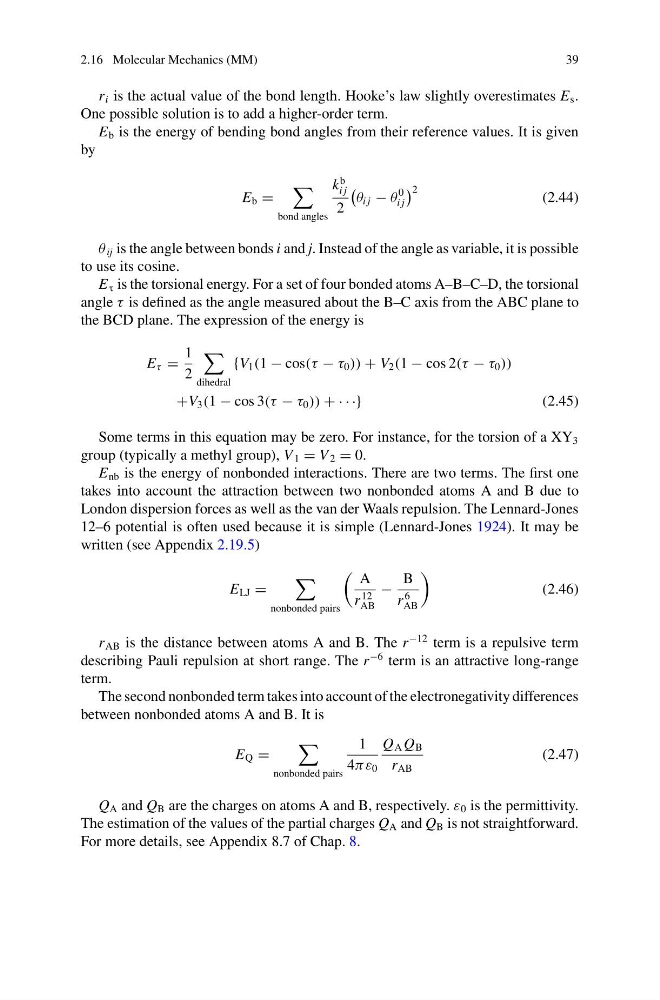
r i is the actual value of the bond length. Hooke’s law slightly overestimates E s .
One possible solution is to add a higher-order term.
E b is the energy of bending bond angles from their reference values. It is given
by
E b =
bond angles
k
b
i j
2
θ i j − θ
0
i j
2
(2.44)
θ ij is the angle between bonds i and j. Instead of the angle as variable, it is possible
to use its cosine.
E τ is the torsional energy. For a set of four bonded atoms A–B–C–D, the torsional
angle τ is defined as the angle measured about the B–C axis from the ABC plane to
the BCD plane. The expression of the energy is
E τ =
1
2
dihedral
{V 1 (1 − cos(τ − τ 0 )) + V 2 (1 − cos 2(τ − τ 0 ))
+V 3 (1 − cos 3(τ − τ 0 )) + · · ·}
(2.45)
Some terms in this equation may be zero. For instance, for the torsion of a XY 3
group (typically a methyl group), V 1 = V 2 = 0.
E nb is the energy of nonbonded interactions. There are two terms. The first one
takes into account the attraction between two nonbonded atoms A and B due to
London dispersion forces as well as the van der Waals repulsion. The Lennard-Jones
12–6 potential is often used because it is simple (Lennard-Jones 1924). It may be
written (see Appendix 2.19.5)
E LJ =
nonbonded pairs
A
r
12
AB
−
B
r
6
AB
(2.46)
r AB is the distance between atoms A and B. The r
−12 term is a repulsive term
describing Pauli repulsion at short range. The r
−6 term is an attractive long-range
term.
The second nonbonded term takes into account of the electronegativity differences
between nonbonded atoms A and B. It is
E Q =
nonbonded pairs
1
4πε 0
Q A Q B
r AB
(2.47)
Q A and Q B are the charges on atoms A and B, respectively. ε 0 is the permittivity.
The estimation of the values of the partial charges Q A and Q B is not straightforward.
For more details, see Appendix 8.7 of Chap. 8.
39
r i is the actual value of the bond length. Hooke’s law slightly overestimates E s .
One possible solution is to add a higher-order term.
E b is the energy of bending bond angles from their reference values. It is given
by
E b =
bond angles
k
b
i j
2
θ i j − θ
0
i j
2
(2.44)
θ ij is the angle between bonds i and j. Instead of the angle as variable, it is possible
to use its cosine.
E τ is the torsional energy. For a set of four bonded atoms A–B–C–D, the torsional
angle τ is defined as the angle measured about the B–C axis from the ABC plane to
the BCD plane. The expression of the energy is
E τ =
1
2
dihedral
{V 1 (1 − cos(τ − τ 0 )) + V 2 (1 − cos 2(τ − τ 0 ))
+V 3 (1 − cos 3(τ − τ 0 )) + · · ·}
(2.45)
Some terms in this equation may be zero. For instance, for the torsion of a XY 3
group (typically a methyl group), V 1 = V 2 = 0.
E nb is the energy of nonbonded interactions. There are two terms. The first one
takes into account the attraction between two nonbonded atoms A and B due to
London dispersion forces as well as the van der Waals repulsion. The Lennard-Jones
12–6 potential is often used because it is simple (Lennard-Jones 1924). It may be
written (see Appendix 2.19.5)
E LJ =
nonbonded pairs
A
r
12
AB
−
B
r
6
AB
(2.46)
r AB is the distance between atoms A and B. The r
−12 term is a repulsive term
describing Pauli repulsion at short range. The r
−6 term is an attractive long-range
term.
The second nonbonded term takes into account of the electronegativity differences
between nonbonded atoms A and B. It is
E Q =
nonbonded pairs
1
4πε 0
Q A Q B
r AB
(2.47)
Q A and Q B are the charges on atoms A and B, respectively. ε 0 is the permittivity.
The estimation of the values of the partial charges Q A and Q B is not straightforward.
For more details, see Appendix 8.7 of Chap. 8.