

40
2 Computational Methods
2.16.3 Accuracy and Limitations
The best achievable accuracy is 1–3 pm for the bond lengths, 1°–3° for the bond
angles and up to 8° for the dihedral angles.
Another important limitation is that electrons are ignored in molecular mechanics
force fields; therefore, processes that involve electronic rearrangements, such as
chemical reactions, cannot be described at the MM level. Finally, their applicability
is restricted to those classes of compounds and bonding situations the force field was
parameterized for.
2.17 Combined Quantum/Classical (QM/MM) Methods
(Senn and Thiel 2009; Brunk and Rothlisberger 2015;
Groenhof 2013)
When the ab initio methods cannot be used because the molecule is too large, a solution is the combination of quantum mechanics and molecular mechanics (QM/MM).
The reacting part of the molecule (abbreviated as Q) is treated with a quantum
mechanical method and its environment (i.e., the rest of the molecule, abbreviated as
M) with simpler molecular mechanical methods. This hybrid QM/MM strategy was
originally introduced by Warshel and Levitt (1976) who studied enzymatic reactions.
The main difficulty is to correctly describe the interactions between the two systems
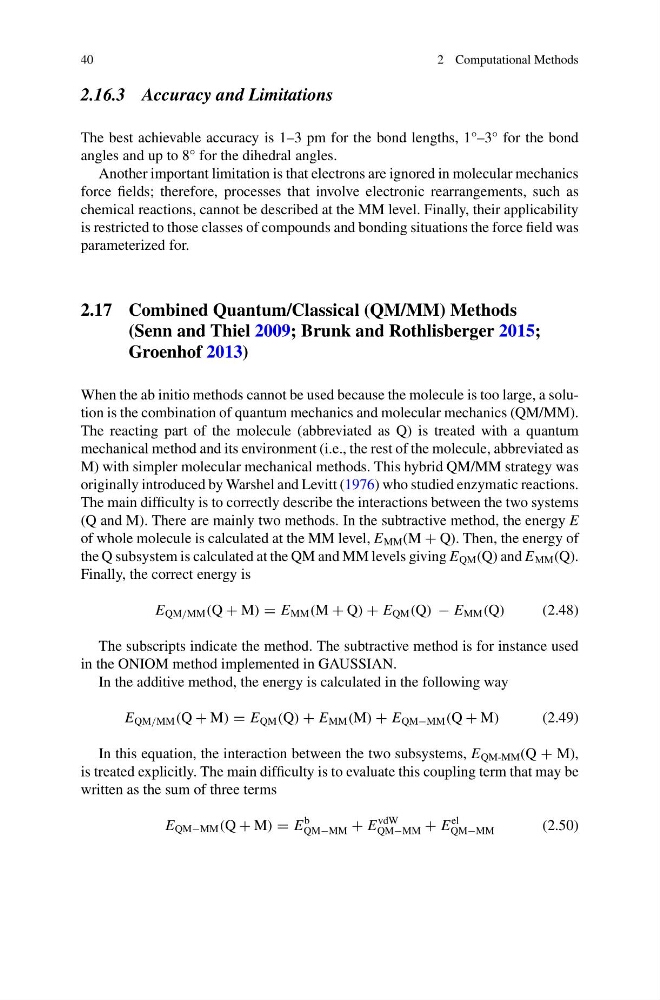
(Q and M). There are mainly two methods. In the subtractive method, the energy E
of whole molecule is calculated at the MM level, E MM (M + Q). Then, the energy of
the Q subsystem is calculated at the QM and MM levels giving E QM (Q) and E MM (Q).
Finally, the correct energy is
E QM/MM (Q + M) = E MM (M + Q) + E QM (Q) − E MM (Q)
(2.48)
The subscripts indicate the method. The subtractive method is for instance used
in the ONIOM method implemented in GAUSSIAN.
In the additive method, the energy is calculated in the following way
E QM/MM (Q + M) = E QM (Q) + E MM (M) + E QM−MM (Q + M)
(2.49)
In this equation, the interaction between the two subsystems, E QM-MM (Q + M),
is treated explicitly. The main difficulty is to evaluate this coupling term that may be
written as the sum of three terms
E QM−MM (Q + M) = E
b
QM−MM + E
vdW
QM−MM + E
el
QM−MM
(2.50)
2 Computational Methods
2.16.3 Accuracy and Limitations
The best achievable accuracy is 1–3 pm for the bond lengths, 1°–3° for the bond
angles and up to 8° for the dihedral angles.
Another important limitation is that electrons are ignored in molecular mechanics
force fields; therefore, processes that involve electronic rearrangements, such as
chemical reactions, cannot be described at the MM level. Finally, their applicability
is restricted to those classes of compounds and bonding situations the force field was
parameterized for.
2.17 Combined Quantum/Classical (QM/MM) Methods
(Senn and Thiel 2009; Brunk and Rothlisberger 2015;
Groenhof 2013)
When the ab initio methods cannot be used because the molecule is too large, a solution is the combination of quantum mechanics and molecular mechanics (QM/MM).
The reacting part of the molecule (abbreviated as Q) is treated with a quantum
mechanical method and its environment (i.e., the rest of the molecule, abbreviated as
M) with simpler molecular mechanical methods. This hybrid QM/MM strategy was
originally introduced by Warshel and Levitt (1976) who studied enzymatic reactions.
The main difficulty is to correctly describe the interactions between the two systems
(Q and M). There are mainly two methods. In the subtractive method, the energy E
of whole molecule is calculated at the MM level, E MM (M + Q). Then, the energy of
the Q subsystem is calculated at the QM and MM levels giving E QM (Q) and E MM (Q).
Finally, the correct energy is
E QM/MM (Q + M) = E MM (M + Q) + E QM (Q) − E MM (Q)
(2.48)
The subscripts indicate the method. The subtractive method is for instance used
in the ONIOM method implemented in GAUSSIAN.
In the additive method, the energy is calculated in the following way
E QM/MM (Q + M) = E QM (Q) + E MM (M) + E QM−MM (Q + M)
(2.49)
In this equation, the interaction between the two subsystems, E QM-MM (Q + M),
is treated explicitly. The main difficulty is to evaluate this coupling term that may be
written as the sum of three terms
E QM−MM (Q + M) = E
b
QM−MM + E
vdW
QM−MM + E
el
QM−MM
(2.50)