

38
2 Computational Methods
2.16 Molecular Mechanics (MM)
2.16.1 Introduction
The aim of molecular mechanics is to calculate the lowest energy of a molecular
structure using the principle of classical physics and assuming that the contributions
to energy are additive. Its main advantage, beyond its simplicity, is that it can be used
for systems of thousands to millions of atoms.
The objective of molecular mechanics is to find a force field that can be transferred
from molecule to molecule in order to predict some properties of the molecule such as
its structure. The basic assumption is that, for given bonds, their length and their angle
do not vary much. For instance, The C–H bond lengths are between 106 and 110 pm
for most molecules, with stretching frequencies between 2900 and 3300 cm
−1 , the
C=C bond lengths are close to 133 pm with stretching frequencies between 1620 an
1680 cm
−1 , and the C–C bond length in alkanes is close to 153 pm and the ∠(CCC)
bond angle is close to 109–114°.
The structure of a given molecule, being close to the reference structure, is simply
obtained by minimizing the potential energy. The parameterization of the force field
and the reference structure is made using results from (mainly) small molecules
whose properties (experimental or ab initio) are accurately known.
2.16.2 Calculation of the Energy
One assumes that the molecule is made of point masses (atoms) mainly held together
by strings obeying Hooke’s law. It is a first-order linear approximation according
to which the force to compress or extend an elastic body is proportional to the
deformation; see also (3.1) in Chap. 3. The steric energy E is the difference in
energy between the real molecule and a hypothetical molecule where all the structural
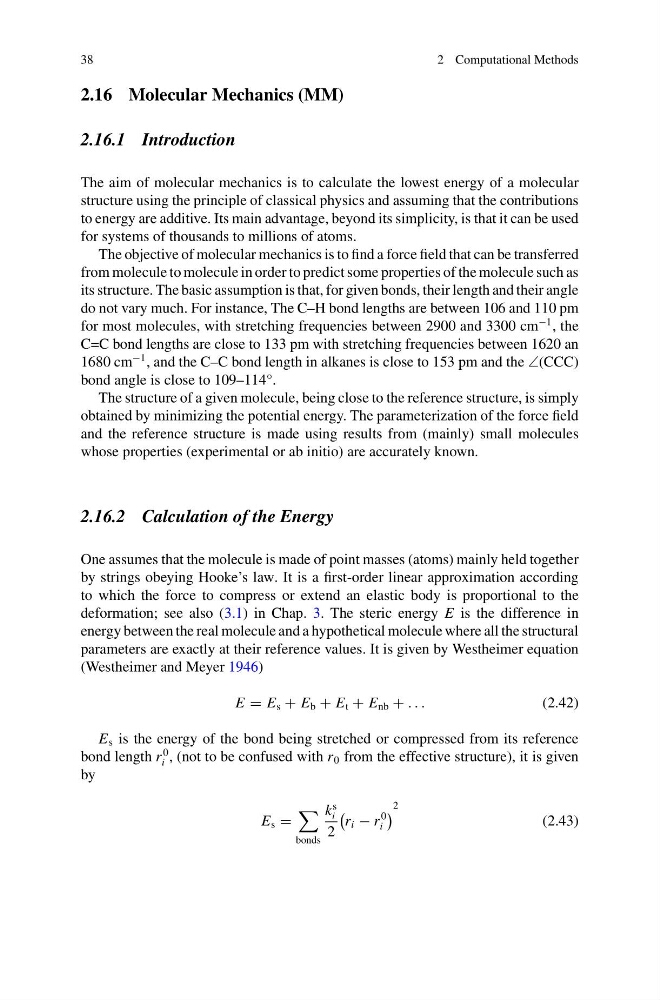
parameters are exactly at their reference values. It is given by Westheimer equation
(Westheimer and Meyer 1946)
E = E s + E b + E t + E nb + . . .
(2.42)
E s is the energy of the bond being stretched or compressed from its reference
bond length r
0
i , (not to be confused with r 0 from the effective structure), it is given
by
E s =
bonds
k
s
i
2
r i − r
0
i
2
(2.43)
2 Computational Methods
2.16 Molecular Mechanics (MM)
2.16.1 Introduction
The aim of molecular mechanics is to calculate the lowest energy of a molecular
structure using the principle of classical physics and assuming that the contributions
to energy are additive. Its main advantage, beyond its simplicity, is that it can be used
for systems of thousands to millions of atoms.
The objective of molecular mechanics is to find a force field that can be transferred
from molecule to molecule in order to predict some properties of the molecule such as
its structure. The basic assumption is that, for given bonds, their length and their angle
do not vary much. For instance, The C–H bond lengths are between 106 and 110 pm
for most molecules, with stretching frequencies between 2900 and 3300 cm
−1 , the
C=C bond lengths are close to 133 pm with stretching frequencies between 1620 an
1680 cm
−1 , and the C–C bond length in alkanes is close to 153 pm and the ∠(CCC)
bond angle is close to 109–114°.
The structure of a given molecule, being close to the reference structure, is simply
obtained by minimizing the potential energy. The parameterization of the force field
and the reference structure is made using results from (mainly) small molecules
whose properties (experimental or ab initio) are accurately known.
2.16.2 Calculation of the Energy
One assumes that the molecule is made of point masses (atoms) mainly held together
by strings obeying Hooke’s law. It is a first-order linear approximation according
to which the force to compress or extend an elastic body is proportional to the
deformation; see also (3.1) in Chap. 3. The steric energy E is the difference in
energy between the real molecule and a hypothetical molecule where all the structural
parameters are exactly at their reference values. It is given by Westheimer equation
(Westheimer and Meyer 1946)
E = E s + E b + E t + E nb + . . .
(2.42)
E s is the energy of the bond being stretched or compressed from its reference
bond length r
0
i , (not to be confused with r 0 from the effective structure), it is given
by
E s =
bonds
k
s
i
2
r i − r
0
i
2
(2.43)