

2.14 Calculation of the Force Field (Császár 2012)
37
is rather complex. For the usual spectroscopic applications, it is enough to limit the
development up to fourth order.
Most computer packages compute analytically second (f ij ) derivatives for most
methods. There are two ways to obtain all force constants (i.e., the cubic and quartic
ones, and, eventually the quadratic ones): a least-squares fitting of the energy as
described in Sect. 2.10 or by numerical differentiation. The second method is easier
to use and often more accurate. For instance, when analytic second-order derivatives
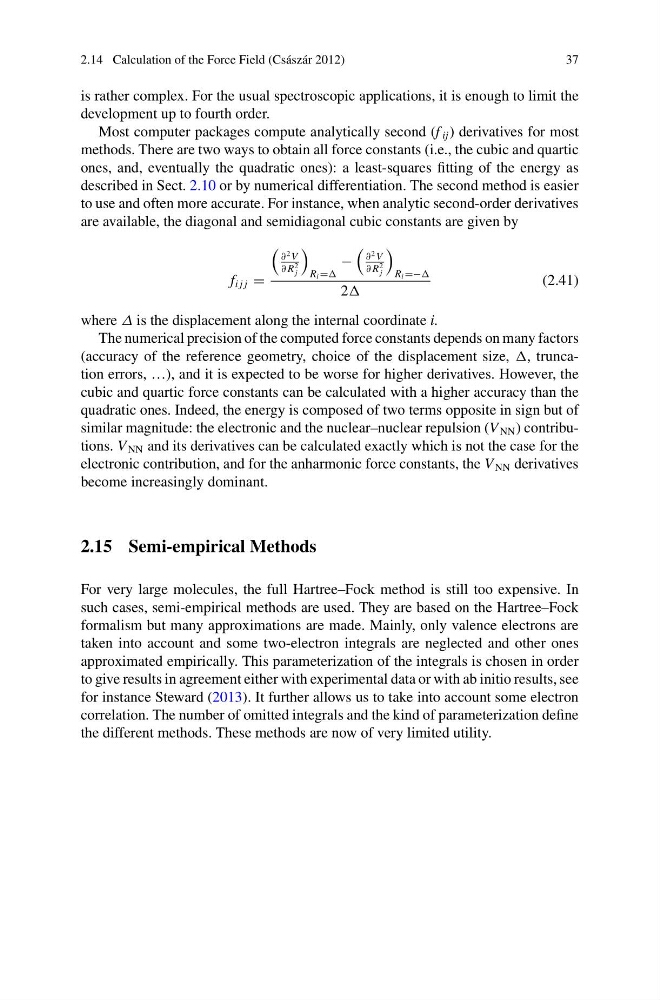
are available, the diagonal and semidiagonal cubic constants are given by
f i j j =
∂
2 V
∂ R
2
j
R i =
−
∂
2 V
∂ R
2
j
R i =−
2
(2.41)
where Δ is the displacement along the internal coordinate i.
The numerical precision of the computed force constants depends on many factors
(accuracy of the reference geometry, choice of the displacement size, , truncation errors, …), and it is expected to be worse for higher derivatives. However, the
cubic and quartic force constants can be calculated with a higher accuracy than the
quadratic ones. Indeed, the energy is composed of two terms opposite in sign but of
similar magnitude: the electronic and the nuclear–nuclear repulsion (V NN ) contributions. V NN and its derivatives can be calculated exactly which is not the case for the
electronic contribution, and for the anharmonic force constants, the V NN derivatives
become increasingly dominant.
2.15 Semi-empirical Methods
For very large molecules, the full Hartree–Fock method is still too expensive. In
such cases, semi-empirical methods are used. They are based on the Hartree–Fock
formalism but many approximations are made. Mainly, only valence electrons are
taken into account and some two-electron integrals are neglected and other ones
approximated empirically. This parameterization of the integrals is chosen in order
to give results in agreement either with experimental data or with ab initio results, see
for instance Steward (2013). It further allows us to take into account some electron
correlation. The number of omitted integrals and the kind of parameterization define
the different methods. These methods are now of very limited utility.
37
is rather complex. For the usual spectroscopic applications, it is enough to limit the
development up to fourth order.
Most computer packages compute analytically second (f ij ) derivatives for most
methods. There are two ways to obtain all force constants (i.e., the cubic and quartic
ones, and, eventually the quadratic ones): a least-squares fitting of the energy as
described in Sect. 2.10 or by numerical differentiation. The second method is easier
to use and often more accurate. For instance, when analytic second-order derivatives
are available, the diagonal and semidiagonal cubic constants are given by
f i j j =
∂
2 V
∂ R
2
j
R i =
−
∂
2 V
∂ R
2
j
R i =−
2
(2.41)
where Δ is the displacement along the internal coordinate i.
The numerical precision of the computed force constants depends on many factors
(accuracy of the reference geometry, choice of the displacement size, , truncation errors, …), and it is expected to be worse for higher derivatives. However, the
cubic and quartic force constants can be calculated with a higher accuracy than the
quadratic ones. Indeed, the energy is composed of two terms opposite in sign but of
similar magnitude: the electronic and the nuclear–nuclear repulsion (V NN ) contributions. V NN and its derivatives can be calculated exactly which is not the case for the
electronic contribution, and for the anharmonic force constants, the V NN derivatives
become increasingly dominant.
2.15 Semi-empirical Methods
For very large molecules, the full Hartree–Fock method is still too expensive. In
such cases, semi-empirical methods are used. They are based on the Hartree–Fock
formalism but many approximations are made. Mainly, only valence electrons are
taken into account and some two-electron integrals are neglected and other ones
approximated empirically. This parameterization of the integrals is chosen in order
to give results in agreement either with experimental data or with ab initio results, see
for instance Steward (2013). It further allows us to take into account some electron
correlation. The number of omitted integrals and the kind of parameterization define
the different methods. These methods are now of very limited utility.