

2.8 Relativistic Effects (Pyykkö 1988)
25
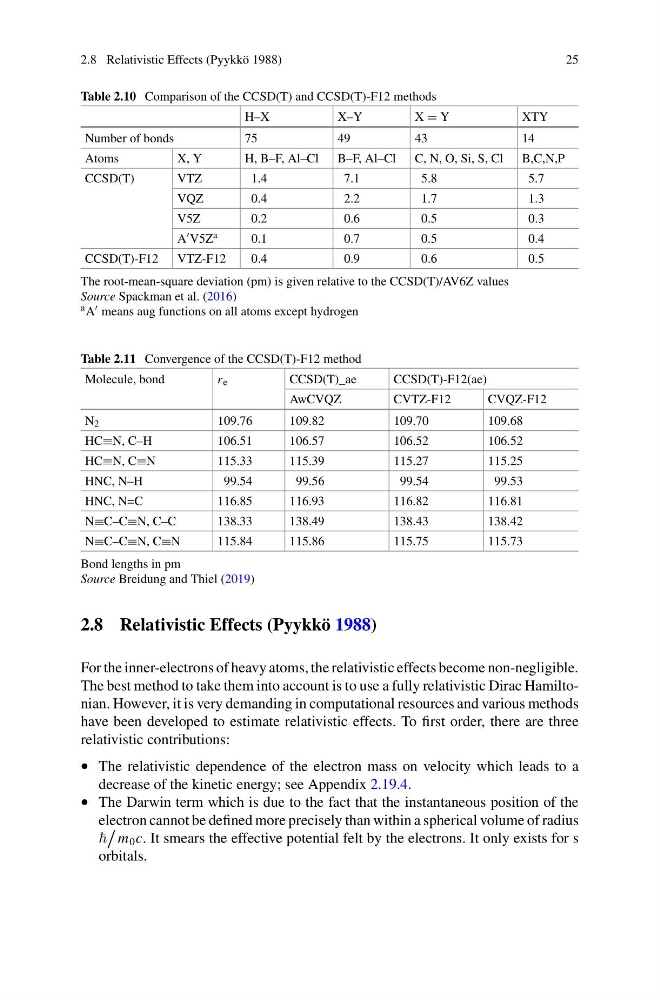
Table 2.10 Comparison of the CCSD(T) and CCSD(T)-F12 methods
H–X
X–Y
X = Y
XTY
Number of bonds
75
49
43
14
Atoms
X, Y
H, B–F, Al–Cl B–F, Al–Cl C, N, O, Si, S, Cl B,C,N,P
CCSD(T)
VTZ
1.4
7.1
5.8
5.7
VQZ
0.4
2.2
1.7
1.3
V5Z
0.2
0.6
0.5
0.3
A V5Z a
0.1
0.7
0.5
0.4
CCSD(T)-F12 VTZ-F12
0.4
0.9
0.6
0.5
The root-mean-square deviation (pm) is given relative to the CCSD(T)/AV6Z values
Source Spackman et al. (2016)
a A means aug functions on all atoms except hydrogen
Table 2.11 Convergence of the CCSD(T)-F12 method
Molecule, bond
r e
CCSD(T)_ae
CCSD(T)-F12(ae)
AwCVQZ
CVTZ-F12
CVQZ-F12
N 2
109.76
109.82
109.70
109.68
HC≡N, C–H
106.51
106.57
106.52
106.52
HC≡N, C≡N
115.33
115.39
115.27
115.25
HNC, N–H
99.54
99.56
99.54
99.53
HNC, N=C
116.85
116.93
116.82
116.81
N≡C–C≡N, C–C
138.33
138.49
138.43
138.42
N≡C–C≡N, C≡N
115.84
115.86
115.75
115.73
Bond lengths in pm
Source Breidung and Thiel (2019)
2.8 Relativistic Effects (Pyykkö 1988)
For the inner-electrons of heavy atoms, the relativistic effects become non-negligible.
The best method to take them into account is to use a fully relativistic Dirac Hamiltonian. However, it is very demanding in computational resources and various methods
have been developed to estimate relativistic effects. To first order, there are three
relativistic contributions:
• The relativistic dependence of the electron mass on velocity which leads to a
decrease of the kinetic energy; see Appendix 2.19.4.
• The Darwin term which is due to the fact that the instantaneous position of the
electron cannot be defined more precisely than within a spherical volume of radius
m 0 c. It smears the effective potential felt by the electrons. It only exists for s
orbitals.
25
Table 2.10 Comparison of the CCSD(T) and CCSD(T)-F12 methods
H–X
X–Y
X = Y
XTY
Number of bonds
75
49
43
14
Atoms
X, Y
H, B–F, Al–Cl B–F, Al–Cl C, N, O, Si, S, Cl B,C,N,P
CCSD(T)
VTZ
1.4
7.1
5.8
5.7
VQZ
0.4
2.2
1.7
1.3
V5Z
0.2
0.6
0.5
0.3
A V5Z a
0.1
0.7
0.5
0.4
CCSD(T)-F12 VTZ-F12
0.4
0.9
0.6
0.5
The root-mean-square deviation (pm) is given relative to the CCSD(T)/AV6Z values
Source Spackman et al. (2016)
a A means aug functions on all atoms except hydrogen
Table 2.11 Convergence of the CCSD(T)-F12 method
Molecule, bond
r e
CCSD(T)_ae
CCSD(T)-F12(ae)
AwCVQZ
CVTZ-F12
CVQZ-F12
N 2
109.76
109.82
109.70
109.68
HC≡N, C–H
106.51
106.57
106.52
106.52
HC≡N, C≡N
115.33
115.39
115.27
115.25
HNC, N–H
99.54
99.56
99.54
99.53
HNC, N=C
116.85
116.93
116.82
116.81
N≡C–C≡N, C–C
138.33
138.49
138.43
138.42
N≡C–C≡N, C≡N
115.84
115.86
115.75
115.73
Bond lengths in pm
Source Breidung and Thiel (2019)
2.8 Relativistic Effects (Pyykkö 1988)
For the inner-electrons of heavy atoms, the relativistic effects become non-negligible.
The best method to take them into account is to use a fully relativistic Dirac Hamiltonian. However, it is very demanding in computational resources and various methods
have been developed to estimate relativistic effects. To first order, there are three
relativistic contributions:
• The relativistic dependence of the electron mass on velocity which leads to a
decrease of the kinetic energy; see Appendix 2.19.4.
• The Darwin term which is due to the fact that the instantaneous position of the
electron cannot be defined more precisely than within a spherical volume of radius
m 0 c. It smears the effective potential felt by the electrons. It only exists for s
orbitals.