

24
2 Computational Methods
E
∞
HF = E
n
HF + ae
−bn
(2.24)
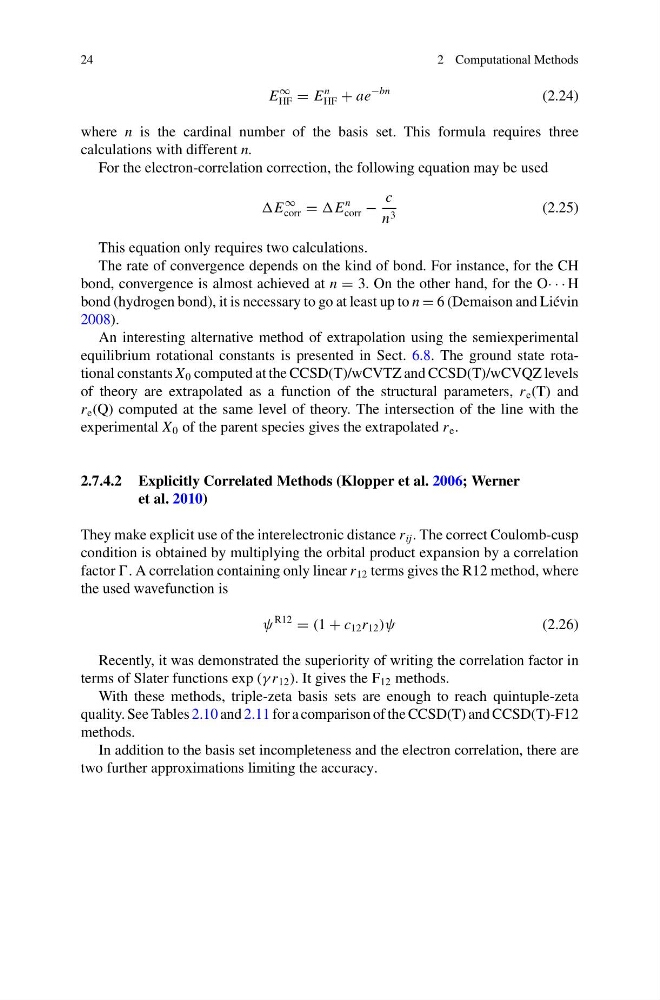
where n is the cardinal number of the basis set. This formula requires three
calculations with different n.
For the electron-correlation correction, the following equation may be used
E
∞
corr = E
n
corr −
c
n 3
(2.25)
This equation only requires two calculations.
The rate of convergence depends on the kind of bond. For instance, for the CH
bond, convergence is almost achieved at n = 3. On the other hand, for the O· · · H
bond (hydrogen bond), it is necessary to go at least up to n = 6 (Demaison and Liévin
2008).
An interesting alternative method of extrapolation using the semiexperimental
equilibrium rotational constants is presented in Sect. 6.8. The ground state rotational constants X 0 computed at the CCSD(T)/wCVTZ and CCSD(T)/wCVQZ levels
of theory are extrapolated as a function of the structural parameters, r e (T) and
r e (Q) computed at the same level of theory. The intersection of the line with the
experimental X 0 of the parent species gives the extrapolated r e .
2.7.4.2 Explicitly Correlated Methods (Klopper et al. 2006; Werner
et al. 2010)
They make explicit use of the interelectronic distance r ij . The correct Coulomb-cusp
condition is obtained by multiplying the orbital product expansion by a correlation
factor . A correlation containing only linear r 12 terms gives the R12 method, where
the used wavefunction is
ψ
R12
= (1 + c 12 r 12 )ψ
(2.26)
Recently, it was demonstrated the superiority of writing the correlation factor in
terms of Slater functions exp (γ r 12 ). It gives the F 12 methods.
With these methods, triple-zeta basis sets are enough to reach quintuple-zeta
quality. See Tables 2.10 and 2.11 for a comparison of the CCSD(T) and CCSD(T)-F12
methods.
In addition to the basis set incompleteness and the electron correlation, there are
two further approximations limiting the accuracy.
2 Computational Methods
E
∞
HF = E
n
HF + ae
−bn
(2.24)
where n is the cardinal number of the basis set. This formula requires three
calculations with different n.
For the electron-correlation correction, the following equation may be used
E
∞
corr = E
n
corr −
c
n 3
(2.25)
This equation only requires two calculations.
The rate of convergence depends on the kind of bond. For instance, for the CH
bond, convergence is almost achieved at n = 3. On the other hand, for the O· · · H
bond (hydrogen bond), it is necessary to go at least up to n = 6 (Demaison and Liévin
2008).
An interesting alternative method of extrapolation using the semiexperimental
equilibrium rotational constants is presented in Sect. 6.8. The ground state rotational constants X 0 computed at the CCSD(T)/wCVTZ and CCSD(T)/wCVQZ levels
of theory are extrapolated as a function of the structural parameters, r e (T) and
r e (Q) computed at the same level of theory. The intersection of the line with the
experimental X 0 of the parent species gives the extrapolated r e .
2.7.4.2 Explicitly Correlated Methods (Klopper et al. 2006; Werner
et al. 2010)
They make explicit use of the interelectronic distance r ij . The correct Coulomb-cusp
condition is obtained by multiplying the orbital product expansion by a correlation
factor . A correlation containing only linear r 12 terms gives the R12 method, where
the used wavefunction is
ψ
R12
= (1 + c 12 r 12 )ψ
(2.26)
Recently, it was demonstrated the superiority of writing the correlation factor in
terms of Slater functions exp (γ r 12 ). It gives the F 12 methods.
With these methods, triple-zeta basis sets are enough to reach quintuple-zeta
quality. See Tables 2.10 and 2.11 for a comparison of the CCSD(T) and CCSD(T)-F12
methods.
In addition to the basis set incompleteness and the electron correlation, there are
two further approximations limiting the accuracy.