

26
2 Computational Methods
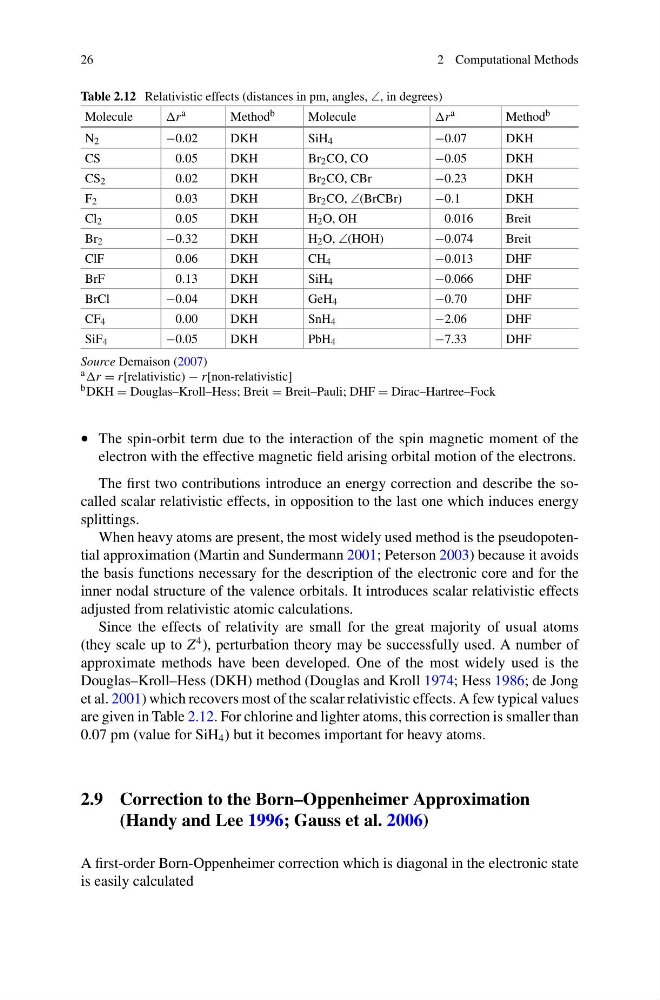
Table 2.12 Relativistic effects (distances in pm, angles, ∠, in degrees)
Molecule
r a
Method b
Molecule
r a
Method b
N 2
−0.02
DKH
SiH 4
−0.07
DKH
CS
0.05
DKH
Br 2 CO, CO
−0.05
DKH
CS 2
0.02
DKH
Br 2 CO, CBr
−0.23
DKH
F 2
0.03
DKH
Br 2 CO, ∠(BrCBr)
−0.1
DKH
Cl 2
0.05
DKH
H 2 O, OH
0.016
Breit
Br 2
−0.32
DKH
H 2 O, ∠(HOH)
−0.074
Breit
ClF
0.06
DKH
CH 4
−0.013
DHF
BrF
0.13
DKH
SiH 4
−0.066
DHF
BrCl
−0.04
DKH
GeH 4
−0.70
DHF
CF 4
0.00
DKH
SnH 4
−2.06
DHF
SiF 4
−0.05
DKH
PbH 4
−7.33
DHF
Source Demaison (2007)
a r = r[relativistic) − r[non-relativistic]
b DKH = Douglas–Kroll–Hess; Breit = Breit–Pauli; DHF = Dirac–Hartree–Fock
• The spin-orbit term due to the interaction of the spin magnetic moment of the
electron with the effective magnetic field arising orbital motion of the electrons.
The first two contributions introduce an energy correction and describe the socalled scalar relativistic effects, in opposition to the last one which induces energy
splittings.
When heavy atoms are present, the most widely used method is the pseudopotential approximation (Martin and Sundermann 2001; Peterson 2003) because it avoids
the basis functions necessary for the description of the electronic core and for the
inner nodal structure of the valence orbitals. It introduces scalar relativistic effects
adjusted from relativistic atomic calculations.
Since the effects of relativity are small for the great majority of usual atoms
(they scale up to Z
4 ), perturbation theory may be successfully used. A number of
approximate methods have been developed. One of the most widely used is the
Douglas–Kroll–Hess (DKH) method (Douglas and Kroll 1974; Hess 1986; de Jong
et al. 2001) which recovers most of the scalar relativistic effects. A few typical values
are given in Table 2.12. For chlorine and lighter atoms, this correction is smaller than
0.07 pm (value for SiH 4 ) but it becomes important for heavy atoms.
2.9 Correction to the Born–Oppenheimer Approximation
(Handy and Lee 1996; Gauss et al. 2006)
A first-order Born-Oppenheimer correction which is diagonal in the electronic state
is easily calculated
2 Computational Methods
Table 2.12 Relativistic effects (distances in pm, angles, ∠, in degrees)
Molecule
r a
Method b
Molecule
r a
Method b
N 2
−0.02
DKH
SiH 4
−0.07
DKH
CS
0.05
DKH
Br 2 CO, CO
−0.05
DKH
CS 2
0.02
DKH
Br 2 CO, CBr
−0.23
DKH
F 2
0.03
DKH
Br 2 CO, ∠(BrCBr)
−0.1
DKH
Cl 2
0.05
DKH
H 2 O, OH
0.016
Breit
Br 2
−0.32
DKH
H 2 O, ∠(HOH)
−0.074
Breit
ClF
0.06
DKH
CH 4
−0.013
DHF
BrF
0.13
DKH
SiH 4
−0.066
DHF
BrCl
−0.04
DKH
GeH 4
−0.70
DHF
CF 4
0.00
DKH
SnH 4
−2.06
DHF
SiF 4
−0.05
DKH
PbH 4
−7.33
DHF
Source Demaison (2007)
a r = r[relativistic) − r[non-relativistic]
b DKH = Douglas–Kroll–Hess; Breit = Breit–Pauli; DHF = Dirac–Hartree–Fock
• The spin-orbit term due to the interaction of the spin magnetic moment of the
electron with the effective magnetic field arising orbital motion of the electrons.
The first two contributions introduce an energy correction and describe the socalled scalar relativistic effects, in opposition to the last one which induces energy
splittings.
When heavy atoms are present, the most widely used method is the pseudopotential approximation (Martin and Sundermann 2001; Peterson 2003) because it avoids
the basis functions necessary for the description of the electronic core and for the
inner nodal structure of the valence orbitals. It introduces scalar relativistic effects
adjusted from relativistic atomic calculations.
Since the effects of relativity are small for the great majority of usual atoms
(they scale up to Z
4 ), perturbation theory may be successfully used. A number of
approximate methods have been developed. One of the most widely used is the
Douglas–Kroll–Hess (DKH) method (Douglas and Kroll 1974; Hess 1986; de Jong
et al. 2001) which recovers most of the scalar relativistic effects. A few typical values
are given in Table 2.12. For chlorine and lighter atoms, this correction is smaller than
0.07 pm (value for SiH 4 ) but it becomes important for heavy atoms.
2.9 Correction to the Born–Oppenheimer Approximation
(Handy and Lee 1996; Gauss et al. 2006)
A first-order Born-Oppenheimer correction which is diagonal in the electronic state
is easily calculated