

18
2 Computational Methods
Table 2.3 Constrained
optimization of the r(N–O)
bond length (in pm) in
trans-HONO using various
levels of theory
Method a
r(N–O)
CCSD
140.1
CCSD(T)
142.1
CCSDT
142.4
CCSDTQ
142.9
Reprinted With Permission from Demaison et al. (2006).
Copyright 2006. American Chemical Society
a The pVDZ basis of Ahlrichs for the middle two atoms and the
VDZ basis of Ahlrichs for the two terminal atoms have been used.
The frozen-core approximation is employed throughout
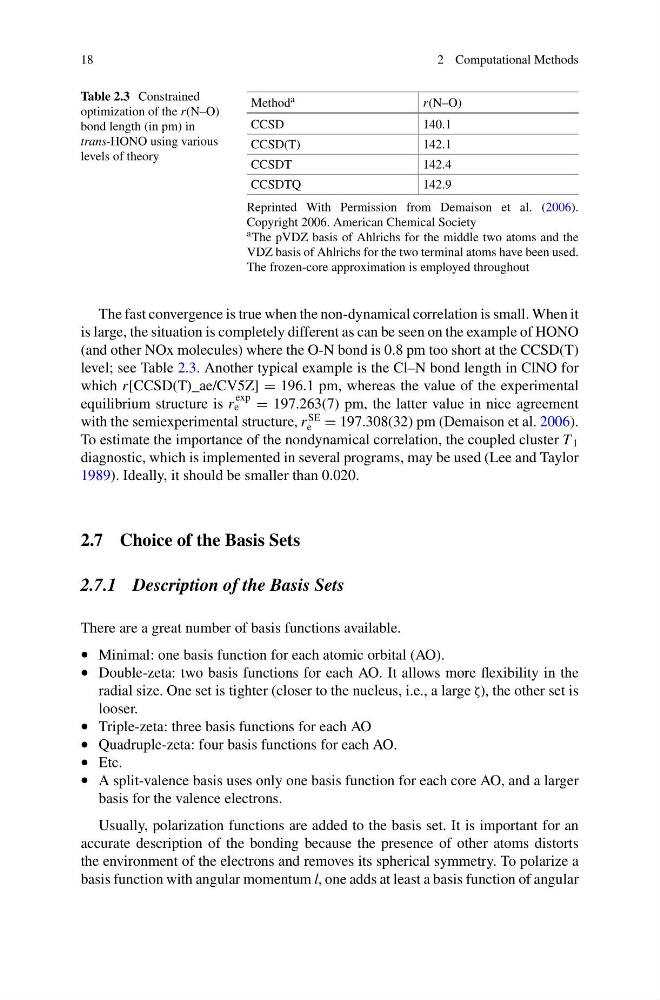
The fast convergence is true when the non-dynamical correlation is small. When it
is large, the situation is completely different as can be seen on the example of HONO
(and other NOx molecules) where the O-N bond is 0.8 pm too short at the CCSD(T)
level; see Table 2.3. Another typical example is the Cl–N bond length in ClNO for
which r[CCSD(T)_ae/CV5Z] = 196.1 pm, whereas the value of the experimental
equilibrium structure is r
exp
e
= 197.263(7) pm, the latter value in nice agreement
with the semiexperimental structure, r
SE
e = 197.308(32) pm (Demaison et al. 2006).
To estimate the importance of the nondynamical correlation, the coupled cluster T 1
diagnostic, which is implemented in several programs, may be used (Lee and Taylor
1989). Ideally, it should be smaller than 0.020.
2.7 Choice of the Basis Sets
2.7.1 Description of the Basis Sets
There are a great number of basis functions available.
• Minimal: one basis function for each atomic orbital (AO).
• Double-zeta: two basis functions for each AO. It allows more flexibility in the
radial size. One set is tighter (closer to the nucleus, i.e., a large ζ), the other set is
looser.
• Triple-zeta: three basis functions for each AO
• Quadruple-zeta: four basis functions for each AO.
• Etc.
• A split-valence basis uses only one basis function for each core AO, and a larger
basis for the valence electrons.
Usually, polarization functions are added to the basis set. It is important for an
accurate description of the bonding because the presence of other atoms distorts
the environment of the electrons and removes its spherical symmetry. To polarize a
basis function with angular momentum l, one adds at least a basis function of angular
2 Computational Methods
Table 2.3 Constrained
optimization of the r(N–O)
bond length (in pm) in
trans-HONO using various
levels of theory
Method a
r(N–O)
CCSD
140.1
CCSD(T)
142.1
CCSDT
142.4
CCSDTQ
142.9
Reprinted With Permission from Demaison et al. (2006).
Copyright 2006. American Chemical Society
a The pVDZ basis of Ahlrichs for the middle two atoms and the
VDZ basis of Ahlrichs for the two terminal atoms have been used.
The frozen-core approximation is employed throughout
The fast convergence is true when the non-dynamical correlation is small. When it
is large, the situation is completely different as can be seen on the example of HONO
(and other NOx molecules) where the O-N bond is 0.8 pm too short at the CCSD(T)
level; see Table 2.3. Another typical example is the Cl–N bond length in ClNO for
which r[CCSD(T)_ae/CV5Z] = 196.1 pm, whereas the value of the experimental
equilibrium structure is r
exp
e
= 197.263(7) pm, the latter value in nice agreement
with the semiexperimental structure, r
SE
e = 197.308(32) pm (Demaison et al. 2006).
To estimate the importance of the nondynamical correlation, the coupled cluster T 1
diagnostic, which is implemented in several programs, may be used (Lee and Taylor
1989). Ideally, it should be smaller than 0.020.
2.7 Choice of the Basis Sets
2.7.1 Description of the Basis Sets
There are a great number of basis functions available.
• Minimal: one basis function for each atomic orbital (AO).
• Double-zeta: two basis functions for each AO. It allows more flexibility in the
radial size. One set is tighter (closer to the nucleus, i.e., a large ζ), the other set is
looser.
• Triple-zeta: three basis functions for each AO
• Quadruple-zeta: four basis functions for each AO.
• Etc.
• A split-valence basis uses only one basis function for each core AO, and a larger
basis for the valence electrons.
Usually, polarization functions are added to the basis set. It is important for an
accurate description of the bonding because the presence of other atoms distorts
the environment of the electrons and removes its spherical symmetry. To polarize a
basis function with angular momentum l, one adds at least a basis function of angular