

2.6 Choice of the Method …
17
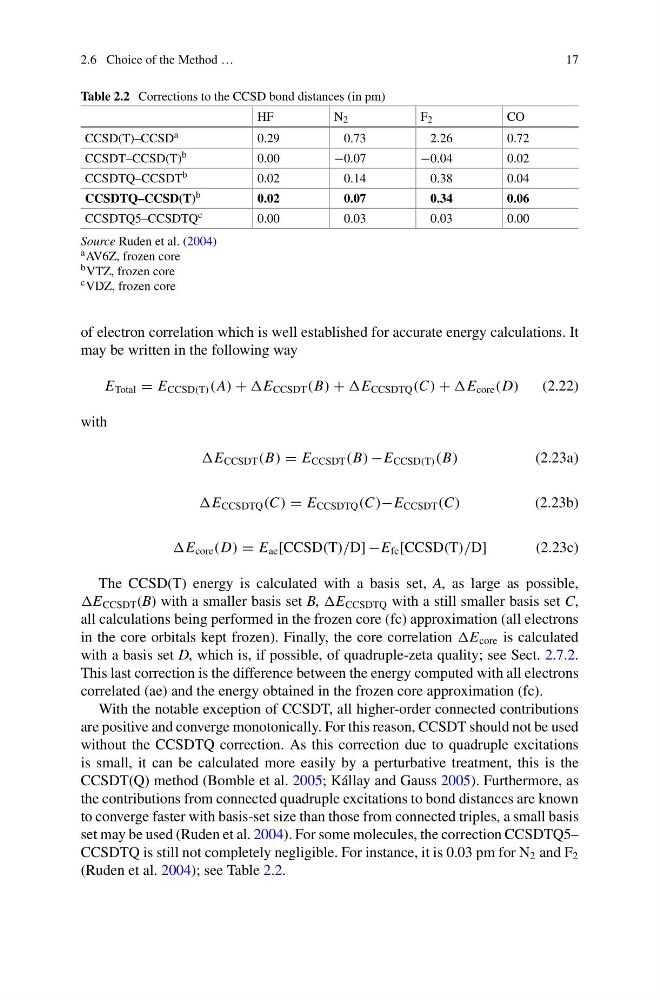
Table 2.2 Corrections to the CCSD bond distances (in pm)
HF
N 2
F 2
CO
CCSD(T)–CCSD a
0.29
0.73
2.26
0.72
CCSDT–CCSD(T) b
0.00
−0.07
−0.04
0.02
CCSDTQ–CCSDT b
0.02
0.14
0.38
0.04
CCSDTQ–CCSD(T) b
0.02
0.07
0.34
0.06
CCSDTQ5–CCSDTQ c
0.00
0.03
0.03
0.00
Source Ruden et al. (2004)
a AV6Z, frozen core
b VTZ, frozen core
c VDZ, frozen core
of electron correlation which is well established for accurate energy calculations. It
may be written in the following way
E Total = E CCSD(T) (A) + E CCSDT (B) + E CCSDTQ (C) + E core (D)
(2.22)
with
E CCSDT (B) = E CCSDT (B) −E CCSD(T) (B)
(2.23a)
E CCSDTQ (C) = E CCSDTQ (C)−E CCSDT (C)
(2.23b)
E core (D) = E ae [CCSD(T)/D] −E fc [CCSD(T)/D]
(2.23c)
The CCSD(T) energy is calculated with a basis set, A, as large as possible,
E CCSDT (B) with a smaller basis set B, E CCSDTQ with a still smaller basis set C,
all calculations being performed in the frozen core (fc) approximation (all electrons
in the core orbitals kept frozen). Finally, the core correlation E core is calculated
with a basis set D, which is, if possible, of quadruple-zeta quality; see Sect. 2.7.2.
This last correction is the difference between the energy computed with all electrons
correlated (ae) and the energy obtained in the frozen core approximation (fc).
With the notable exception of CCSDT, all higher-order connected contributions
are positive and converge monotonically. For this reason, CCSDT should not be used
without the CCSDTQ correction. As this correction due to quadruple excitations
is small, it can be calculated more easily by a perturbative treatment, this is the
CCSDT(Q) method (Bomble et al. 2005; Kállay and Gauss 2005). Furthermore, as
the contributions from connected quadruple excitations to bond distances are known
to converge faster with basis-set size than those from connected triples, a small basis
set may be used (Ruden et al. 2004). For some molecules, the correction CCSDTQ5–
CCSDTQ is still not completely negligible. For instance, it is 0.03 pm for N 2 and F 2
(Ruden et al. 2004); see Table 2.2.
17
Table 2.2 Corrections to the CCSD bond distances (in pm)
HF
N 2
F 2
CO
CCSD(T)–CCSD a
0.29
0.73
2.26
0.72
CCSDT–CCSD(T) b
0.00
−0.07
−0.04
0.02
CCSDTQ–CCSDT b
0.02
0.14
0.38
0.04
CCSDTQ–CCSD(T) b
0.02
0.07
0.34
0.06
CCSDTQ5–CCSDTQ c
0.00
0.03
0.03
0.00
Source Ruden et al. (2004)
a AV6Z, frozen core
b VTZ, frozen core
c VDZ, frozen core
of electron correlation which is well established for accurate energy calculations. It
may be written in the following way
E Total = E CCSD(T) (A) + E CCSDT (B) + E CCSDTQ (C) + E core (D)
(2.22)
with
E CCSDT (B) = E CCSDT (B) −E CCSD(T) (B)
(2.23a)
E CCSDTQ (C) = E CCSDTQ (C)−E CCSDT (C)
(2.23b)
E core (D) = E ae [CCSD(T)/D] −E fc [CCSD(T)/D]
(2.23c)
The CCSD(T) energy is calculated with a basis set, A, as large as possible,
E CCSDT (B) with a smaller basis set B, E CCSDTQ with a still smaller basis set C,
all calculations being performed in the frozen core (fc) approximation (all electrons
in the core orbitals kept frozen). Finally, the core correlation E core is calculated
with a basis set D, which is, if possible, of quadruple-zeta quality; see Sect. 2.7.2.
This last correction is the difference between the energy computed with all electrons
correlated (ae) and the energy obtained in the frozen core approximation (fc).
With the notable exception of CCSDT, all higher-order connected contributions
are positive and converge monotonically. For this reason, CCSDT should not be used
without the CCSDTQ correction. As this correction due to quadruple excitations
is small, it can be calculated more easily by a perturbative treatment, this is the
CCSDT(Q) method (Bomble et al. 2005; Kállay and Gauss 2005). Furthermore, as
the contributions from connected quadruple excitations to bond distances are known
to converge faster with basis-set size than those from connected triples, a small basis
set may be used (Ruden et al. 2004). For some molecules, the correction CCSDTQ5–
CCSDTQ is still not completely negligible. For instance, it is 0.03 pm for N 2 and F 2
(Ruden et al. 2004); see Table 2.2.