

16
2 Computational Methods
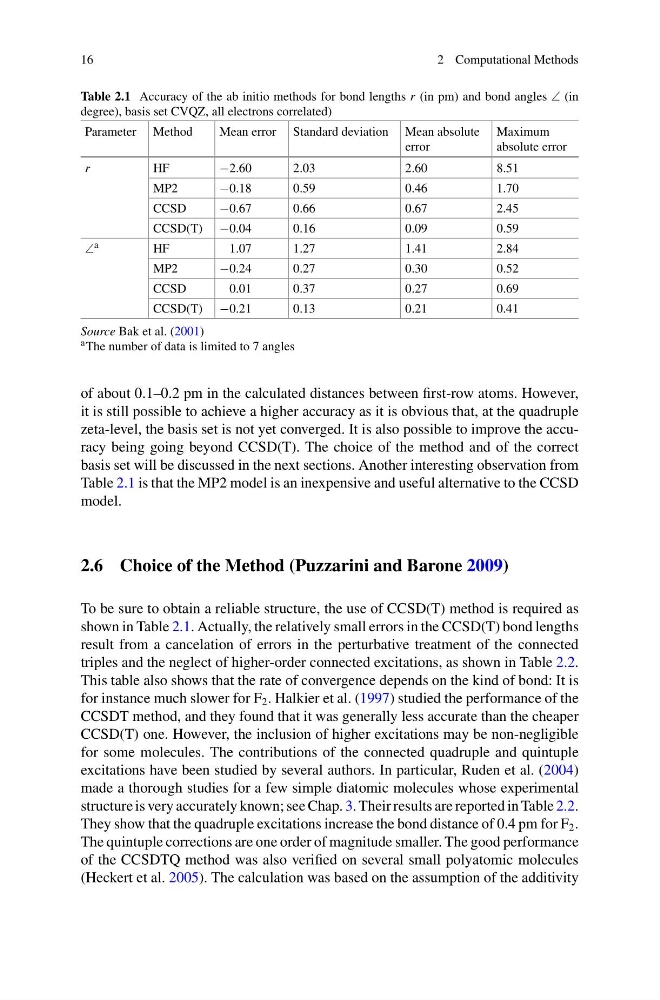
Table 2.1 Accuracy of the ab initio methods for bond lengths r (in pm) and bond angles ∠ (in
degree), basis set CVQZ, all electrons correlated)
Parameter Method
Mean error Standard deviation Mean absolute
error
Maximum
absolute error
r
HF
−2.60
2.03
2.60
8.51
MP2
−0.18
0.59
0.46
1.70
CCSD
−0.67
0.66
0.67
2.45
CCSD(T) −0.04
0.16
0.09
0.59
∠ a
HF
1.07
1.27
1.41
2.84
MP2
−0.24
0.27
0.30
0.52
CCSD
0.01
0.37
0.27
0.69
CCSD(T) −0.21
0.13
0.21
0.41
Source Bak et al. (2001)
a The number of data is limited to 7 angles
of about 0.1–0.2 pm in the calculated distances between first-row atoms. However,
it is still possible to achieve a higher accuracy as it is obvious that, at the quadruple
zeta-level, the basis set is not yet converged. It is also possible to improve the accuracy being going beyond CCSD(T). The choice of the method and of the correct
basis set will be discussed in the next sections. Another interesting observation from
Table 2.1 is that the MP2 model is an inexpensive and useful alternative to the CCSD
model.
2.6 Choice of the Method (Puzzarini and Barone 2009)
To be sure to obtain a reliable structure, the use of CCSD(T) method is required as
shown in Table 2.1. Actually, the relatively small errors in the CCSD(T) bond lengths
result from a cancelation of errors in the perturbative treatment of the connected
triples and the neglect of higher-order connected excitations, as shown in Table 2.2.
This table also shows that the rate of convergence depends on the kind of bond: It is
for instance much slower for F 2 . Halkier et al. (1997) studied the performance of the
CCSDT method, and they found that it was generally less accurate than the cheaper
CCSD(T) one. However, the inclusion of higher excitations may be non-negligible
for some molecules. The contributions of the connected quadruple and quintuple
excitations have been studied by several authors. In particular, Ruden et al. (2004)
made a thorough studies for a few simple diatomic molecules whose experimental
structure is very accurately known; see Chap. 3. Their results are reported in Table 2.2.
They show that the quadruple excitations increase the bond distance of 0.4 pm for F 2 .
The quintuple corrections are one order of magnitude smaller. The good performance
of the CCSDTQ method was also verified on several small polyatomic molecules
(Heckert et al. 2005). The calculation was based on the assumption of the additivity
2 Computational Methods
Table 2.1 Accuracy of the ab initio methods for bond lengths r (in pm) and bond angles ∠ (in
degree), basis set CVQZ, all electrons correlated)
Parameter Method
Mean error Standard deviation Mean absolute
error
Maximum
absolute error
r
HF
−2.60
2.03
2.60
8.51
MP2
−0.18
0.59
0.46
1.70
CCSD
−0.67
0.66
0.67
2.45
CCSD(T) −0.04
0.16
0.09
0.59
∠ a
HF
1.07
1.27
1.41
2.84
MP2
−0.24
0.27
0.30
0.52
CCSD
0.01
0.37
0.27
0.69
CCSD(T) −0.21
0.13
0.21
0.41
Source Bak et al. (2001)
a The number of data is limited to 7 angles
of about 0.1–0.2 pm in the calculated distances between first-row atoms. However,
it is still possible to achieve a higher accuracy as it is obvious that, at the quadruple
zeta-level, the basis set is not yet converged. It is also possible to improve the accuracy being going beyond CCSD(T). The choice of the method and of the correct
basis set will be discussed in the next sections. Another interesting observation from
Table 2.1 is that the MP2 model is an inexpensive and useful alternative to the CCSD
model.
2.6 Choice of the Method (Puzzarini and Barone 2009)
To be sure to obtain a reliable structure, the use of CCSD(T) method is required as
shown in Table 2.1. Actually, the relatively small errors in the CCSD(T) bond lengths
result from a cancelation of errors in the perturbative treatment of the connected
triples and the neglect of higher-order connected excitations, as shown in Table 2.2.
This table also shows that the rate of convergence depends on the kind of bond: It is
for instance much slower for F 2 . Halkier et al. (1997) studied the performance of the
CCSDT method, and they found that it was generally less accurate than the cheaper
CCSD(T) one. However, the inclusion of higher excitations may be non-negligible
for some molecules. The contributions of the connected quadruple and quintuple
excitations have been studied by several authors. In particular, Ruden et al. (2004)
made a thorough studies for a few simple diatomic molecules whose experimental
structure is very accurately known; see Chap. 3. Their results are reported in Table 2.2.
They show that the quadruple excitations increase the bond distance of 0.4 pm for F 2 .
The quintuple corrections are one order of magnitude smaller. The good performance
of the CCSDTQ method was also verified on several small polyatomic molecules
(Heckert et al. 2005). The calculation was based on the assumption of the additivity