

2.5 Post Hartree–Fock Methods …
15
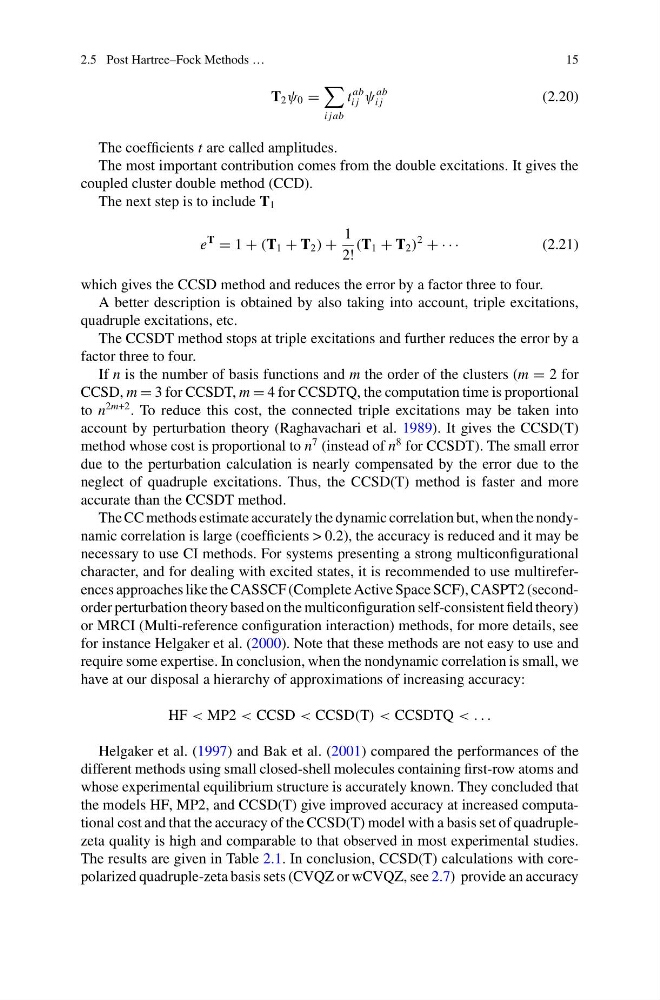
T 2 ψ 0 =
i jab
t
ab
i j ψ
ab
i j
(2.20)
The coefficients t are called amplitudes.
The most important contribution comes from the double excitations. It gives the
coupled cluster double method (CCD).
The next step is to include T 1
e
T
= 1 + (T 1 + T 2 ) +
1
2!
(T 1 + T 2 )
2
+ · · ·
(2.21)
which gives the CCSD method and reduces the error by a factor three to four.
A better description is obtained by also taking into account, triple excitations,
quadruple excitations, etc.
The CCSDT method stops at triple excitations and further reduces the error by a
factor three to four.
If n is the number of basis functions and m the order of the clusters (m = 2 for
CCSD, m = 3 for CCSDT, m = 4 for CCSDTQ, the computation time is proportional
to n
2m+2 . To reduce this cost, the connected triple excitations may be taken into
account by perturbation theory (Raghavachari et al. 1989). It gives the CCSD(T)
method whose cost is proportional to n
7 (instead of n
8 for CCSDT). The small error
due to the perturbation calculation is nearly compensated by the error due to the
neglect of quadruple excitations. Thus, the CCSD(T) method is faster and more
accurate than the CCSDT method.
The CC methods estimate accurately the dynamic correlation but, when the nondynamic correlation is large (coefficients > 0.2), the accuracy is reduced and it may be
necessary to use CI methods. For systems presenting a strong multiconfigurational
character, and for dealing with excited states, it is recommended to use multireferences approaches like the CASSCF (Complete Active Space SCF), CASPT2 (secondorder perturbation theory based on the multiconfiguration self-consistent field theory)
or MRCI (Multi-reference configuration interaction) methods, for more details, see
for instance Helgaker et al. (2000). Note that these methods are not easy to use and
require some expertise. In conclusion, when the nondynamic correlation is small, we
have at our disposal a hierarchy of approximations of increasing accuracy:
HF < MP2 < CCSD < CCSD(T) < CCSDTQ < . . .
Helgaker et al. (1997) and Bak et al. (2001) compared the performances of the
different methods using small closed-shell molecules containing first-row atoms and
whose experimental equilibrium structure is accurately known. They concluded that
the models HF, MP2, and CCSD(T) give improved accuracy at increased computational cost and that the accuracy of the CCSD(T) model with a basis set of quadruplezeta quality is high and comparable to that observed in most experimental studies.
The results are given in Table 2.1. In conclusion, CCSD(T) calculations with corepolarized quadruple-zeta basis sets (CVQZ or wCVQZ, see 2.7) provide an accuracy
15
T 2 ψ 0 =
i jab
t
ab
i j ψ
ab
i j
(2.20)
The coefficients t are called amplitudes.
The most important contribution comes from the double excitations. It gives the
coupled cluster double method (CCD).
The next step is to include T 1
e
T
= 1 + (T 1 + T 2 ) +
1
2!
(T 1 + T 2 )
2
+ · · ·
(2.21)
which gives the CCSD method and reduces the error by a factor three to four.
A better description is obtained by also taking into account, triple excitations,
quadruple excitations, etc.
The CCSDT method stops at triple excitations and further reduces the error by a
factor three to four.
If n is the number of basis functions and m the order of the clusters (m = 2 for
CCSD, m = 3 for CCSDT, m = 4 for CCSDTQ, the computation time is proportional
to n
2m+2 . To reduce this cost, the connected triple excitations may be taken into
account by perturbation theory (Raghavachari et al. 1989). It gives the CCSD(T)
method whose cost is proportional to n
7 (instead of n
8 for CCSDT). The small error
due to the perturbation calculation is nearly compensated by the error due to the
neglect of quadruple excitations. Thus, the CCSD(T) method is faster and more
accurate than the CCSDT method.
The CC methods estimate accurately the dynamic correlation but, when the nondynamic correlation is large (coefficients > 0.2), the accuracy is reduced and it may be
necessary to use CI methods. For systems presenting a strong multiconfigurational
character, and for dealing with excited states, it is recommended to use multireferences approaches like the CASSCF (Complete Active Space SCF), CASPT2 (secondorder perturbation theory based on the multiconfiguration self-consistent field theory)
or MRCI (Multi-reference configuration interaction) methods, for more details, see
for instance Helgaker et al. (2000). Note that these methods are not easy to use and
require some expertise. In conclusion, when the nondynamic correlation is small, we
have at our disposal a hierarchy of approximations of increasing accuracy:
HF < MP2 < CCSD < CCSD(T) < CCSDTQ < . . .
Helgaker et al. (1997) and Bak et al. (2001) compared the performances of the
different methods using small closed-shell molecules containing first-row atoms and
whose experimental equilibrium structure is accurately known. They concluded that
the models HF, MP2, and CCSD(T) give improved accuracy at increased computational cost and that the accuracy of the CCSD(T) model with a basis set of quadruplezeta quality is high and comparable to that observed in most experimental studies.
The results are given in Table 2.1. In conclusion, CCSD(T) calculations with corepolarized quadruple-zeta basis sets (CVQZ or wCVQZ, see 2.7) provide an accuracy