

14
2 Computational Methods
… χ n are a subset of the larger set used in the variational procedure. The unused
spin orbitals, called virtual orbitals, are noted χ a with a = n + 1, n + 2, …
In configuration interaction (CI) methods, other determinants are constructed by
replacing one or more occupied orbitals χ i , χ j , … within the HF determinant with
a virtual orbital χ a , χ b , … A determinant where χ i is replaced by χ a will be called
ψ
a
i , a determinant where χ i , χ j are replaced by χ a , χ b will be called ψ
ab
i j
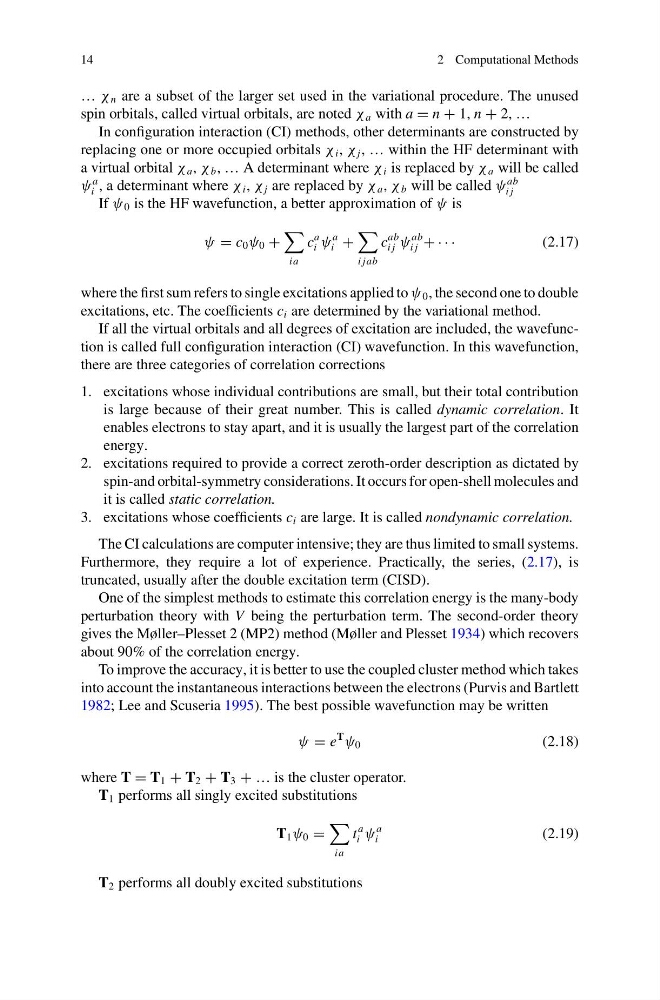
If ψ 0 is the HF wavefunction, a better approximation of ψ is
ψ = c 0 ψ 0 +
ia
c
a
i ψ
a
i +
i jab
c
ab
i j ψ
ab
i j + · · ·
(2.17)
where the first sum refers to single excitations applied to ψ 0 , the second one to double
excitations, etc. The coefficients c i are determined by the variational method.
If all the virtual orbitals and all degrees of excitation are included, the wavefunction is called full configuration interaction (CI) wavefunction. In this wavefunction,
there are three categories of correlation corrections
1. excitations whose individual contributions are small, but their total contribution
is large because of their great number. This is called dynamic correlation. It
enables electrons to stay apart, and it is usually the largest part of the correlation
energy.
2. excitations required to provide a correct zeroth-order description as dictated by
spin-and orbital-symmetry considerations. It occurs for open-shell molecules and
it is called static correlation.
3. excitations whose coefficients c i are large. It is called nondynamic correlation.
The CI calculations are computer intensive; they are thus limited to small systems.
Furthermore, they require a lot of experience. Practically, the series, (2.17), is
truncated, usually after the double excitation term (CISD).
One of the simplest methods to estimate this correlation energy is the many-body
perturbation theory with V being the perturbation term. The second-order theory
gives the Møller–Plesset 2 (MP2) method (Møller and Plesset 1934) which recovers
about 90% of the correlation energy.
To improve the accuracy, it is better to use the coupled cluster method which takes
into account the instantaneous interactions between the electrons (Purvis and Bartlett
1982; Lee and Scuseria 1995). The best possible wavefunction may be written
ψ = e
T
ψ 0
(2.18)
where T = T 1 + T 2 + T 3 + … is the cluster operator.
T 1 performs all singly excited substitutions
T 1 ψ 0 =
ia
t
a
i ψ
a
i
(2.19)
T 2 performs all doubly excited substitutions
2 Computational Methods
… χ n are a subset of the larger set used in the variational procedure. The unused
spin orbitals, called virtual orbitals, are noted χ a with a = n + 1, n + 2, …
In configuration interaction (CI) methods, other determinants are constructed by
replacing one or more occupied orbitals χ i , χ j , … within the HF determinant with
a virtual orbital χ a , χ b , … A determinant where χ i is replaced by χ a will be called
ψ
a
i , a determinant where χ i , χ j are replaced by χ a , χ b will be called ψ
ab
i j
If ψ 0 is the HF wavefunction, a better approximation of ψ is
ψ = c 0 ψ 0 +
ia
c
a
i ψ
a
i +
i jab
c
ab
i j ψ
ab
i j + · · ·
(2.17)
where the first sum refers to single excitations applied to ψ 0 , the second one to double
excitations, etc. The coefficients c i are determined by the variational method.
If all the virtual orbitals and all degrees of excitation are included, the wavefunction is called full configuration interaction (CI) wavefunction. In this wavefunction,
there are three categories of correlation corrections
1. excitations whose individual contributions are small, but their total contribution
is large because of their great number. This is called dynamic correlation. It
enables electrons to stay apart, and it is usually the largest part of the correlation
energy.
2. excitations required to provide a correct zeroth-order description as dictated by
spin-and orbital-symmetry considerations. It occurs for open-shell molecules and
it is called static correlation.
3. excitations whose coefficients c i are large. It is called nondynamic correlation.
The CI calculations are computer intensive; they are thus limited to small systems.
Furthermore, they require a lot of experience. Practically, the series, (2.17), is
truncated, usually after the double excitation term (CISD).
One of the simplest methods to estimate this correlation energy is the many-body
perturbation theory with V being the perturbation term. The second-order theory
gives the Møller–Plesset 2 (MP2) method (Møller and Plesset 1934) which recovers
about 90% of the correlation energy.
To improve the accuracy, it is better to use the coupled cluster method which takes
into account the instantaneous interactions between the electrons (Purvis and Bartlett
1982; Lee and Scuseria 1995). The best possible wavefunction may be written
ψ = e
T
ψ 0
(2.18)
where T = T 1 + T 2 + T 3 + … is the cluster operator.
T 1 performs all singly excited substitutions
T 1 ψ 0 =
ia
t
a
i ψ
a
i
(2.19)
T 2 performs all doubly excited substitutions