

2.7 Choice of the Basis Sets
19
momentum l + 1. p orbitals polarize if they are mixed with d orbitals. There should be
5 d functions: d x 2 −y 2 , d z 2 , d xy , d xz , and d yz called pure angular momentum functions.
However, 6 d functions (called Cartesian) are regularly used: d x 2 , d y 2 , d z 2 , d xy , d xz ,
and d yz . The same situation is encountered with f orbitals: There are only seven pure
angular momentum functions but ten Cartesian functions.
Diffuse functions may also be added. They have a very small exponent and, thus,
decay slowly with the distance from the nucleus. They are mainly of s and p type. They
are necessary for a correct description of anions, weak bonds, and for electronegative
atoms as fluorine.
For correlated calculations, it is recommended to use a hierarchy of basis sets
which provide a systematic approach to the complete basis set. One of the most
popular are the correlation-consistent polarized valence basis sets of Dunning (1989):
cc-pVnZ (often abbreviated as VnZ) where n = D, T, Q, 5, … is the cardinal number
and represents the highest spherical harmonic. The cc-pVnZ basis sets are designed
for correlation of valence electrons only. To correlate all electrons, the correlation–
consistent core–valence cc-pCVnZ, basis sets (Woon and Dunning 1995) or the
correlation-consistent weighted core-valence basis sets, cc-pwCVnZ (often abbreviated as wCVnZ) (Peterson and Dunning 2002) which significantly improve the
convergence with n have to be used (Gaussians with large exponents are added to the
VnZ basis sets). On the other hand, for an accurate description of the outer valence
region, diffuse functions (Gaussians with small exponents) are added to the VnZ
basis sets to give the aug(mented)-cc-pVnZ basis sets (often abbreviated as AVnZ)
(Kendall et al. 1992). In the case of complexes, doubly and triply augmented sets may
also be used. Thus the most general basis sets are aug-cc-pwCVnZ (AwCVnZ). For
instance, for the carbon atom, cc-pVDZ consists of 3s2p1d, cc-pVTZ is 4s3p2d1f,
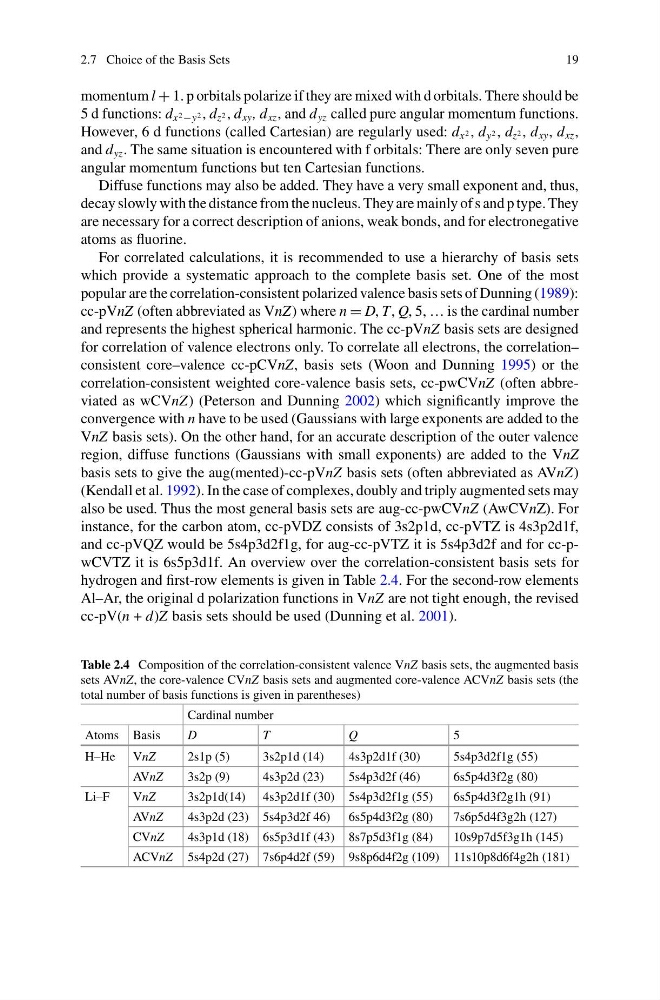
and cc-pVQZ would be 5s4p3d2f1g, for aug-cc-pVTZ it is 5s4p3d2f and for cc-pwCVTZ it is 6s5p3d1f. An overview over the correlation-consistent basis sets for
hydrogen and first-row elements is given in Table 2.4. For the second-row elements
Al–Ar, the original d polarization functions in VnZ are not tight enough, the revised
cc-pV(n + d)Z basis sets should be used (Dunning et al. 2001).
Table 2.4 Composition of the correlation-consistent valence VnZ basis sets, the augmented basis
sets AVnZ, the core-valence CVnZ basis sets and augmented core-valence ACVnZ basis sets (the
total number of basis functions is given in parentheses)
Cardinal number
Atoms Basis
D
T
Q
5
H–He VnZ
2s1p (5)
3s2p1d (14)
4s3p2d1f (30)
5s4p3d2f1g (55)
AVnZ
3s2p (9)
4s3p2d (23)
5s4p3d2f (46)
6s5p4d3f2g (80)
Li–F
VnZ
3s2p1d(14) 4s3p2d1f (30) 5s4p3d2f1g (55)
6s5p4d3f2g1h (91)
AVnZ
4s3p2d (23) 5s4p3d2f 46) 6s5p4d3f2g (80)
7s6p5d4f3g2h (127)
CVnZ
4s3p1d (18) 6s5p3d1f (43) 8s7p5d3f1g (84)
10s9p7d5f3g1h (145)
ACVnZ 5s4p2d (27) 7s6p4d2f (59) 9s8p6d4f2g (109) 11s10p8d6f4g2h (181)
19
momentum l + 1. p orbitals polarize if they are mixed with d orbitals. There should be
5 d functions: d x 2 −y 2 , d z 2 , d xy , d xz , and d yz called pure angular momentum functions.
However, 6 d functions (called Cartesian) are regularly used: d x 2 , d y 2 , d z 2 , d xy , d xz ,
and d yz . The same situation is encountered with f orbitals: There are only seven pure
angular momentum functions but ten Cartesian functions.
Diffuse functions may also be added. They have a very small exponent and, thus,
decay slowly with the distance from the nucleus. They are mainly of s and p type. They
are necessary for a correct description of anions, weak bonds, and for electronegative
atoms as fluorine.
For correlated calculations, it is recommended to use a hierarchy of basis sets
which provide a systematic approach to the complete basis set. One of the most
popular are the correlation-consistent polarized valence basis sets of Dunning (1989):
cc-pVnZ (often abbreviated as VnZ) where n = D, T, Q, 5, … is the cardinal number
and represents the highest spherical harmonic. The cc-pVnZ basis sets are designed
for correlation of valence electrons only. To correlate all electrons, the correlation–
consistent core–valence cc-pCVnZ, basis sets (Woon and Dunning 1995) or the
correlation-consistent weighted core-valence basis sets, cc-pwCVnZ (often abbreviated as wCVnZ) (Peterson and Dunning 2002) which significantly improve the
convergence with n have to be used (Gaussians with large exponents are added to the
VnZ basis sets). On the other hand, for an accurate description of the outer valence
region, diffuse functions (Gaussians with small exponents) are added to the VnZ
basis sets to give the aug(mented)-cc-pVnZ basis sets (often abbreviated as AVnZ)
(Kendall et al. 1992). In the case of complexes, doubly and triply augmented sets may
also be used. Thus the most general basis sets are aug-cc-pwCVnZ (AwCVnZ). For
instance, for the carbon atom, cc-pVDZ consists of 3s2p1d, cc-pVTZ is 4s3p2d1f,
and cc-pVQZ would be 5s4p3d2f1g, for aug-cc-pVTZ it is 5s4p3d2f and for cc-pwCVTZ it is 6s5p3d1f. An overview over the correlation-consistent basis sets for
hydrogen and first-row elements is given in Table 2.4. For the second-row elements
Al–Ar, the original d polarization functions in VnZ are not tight enough, the revised
cc-pV(n + d)Z basis sets should be used (Dunning et al. 2001).
Table 2.4 Composition of the correlation-consistent valence VnZ basis sets, the augmented basis
sets AVnZ, the core-valence CVnZ basis sets and augmented core-valence ACVnZ basis sets (the
total number of basis functions is given in parentheses)
Cardinal number
Atoms Basis
D
T
Q
5
H–He VnZ
2s1p (5)
3s2p1d (14)
4s3p2d1f (30)
5s4p3d2f1g (55)
AVnZ
3s2p (9)
4s3p2d (23)
5s4p3d2f (46)
6s5p4d3f2g (80)
Li–F
VnZ
3s2p1d(14) 4s3p2d1f (30) 5s4p3d2f1g (55)
6s5p4d3f2g1h (91)
AVnZ
4s3p2d (23) 5s4p3d2f 46) 6s5p4d3f2g (80)
7s6p5d4f3g2h (127)
CVnZ
4s3p1d (18) 6s5p3d1f (43) 8s7p5d3f1g (84)
10s9p7d5f3g1h (145)
ACVnZ 5s4p2d (27) 7s6p4d2f (59) 9s8p6d4f2g (109) 11s10p8d6f4g2h (181)