

254
9 Least-Squares Method
9.10 Systematic Errors
9.10.1 Autocorrelation of the Errors
The errors ε i of (9.1) are assumed to be independent random errors, i.e., the variancecovariance matrix of y, E(εε
T ) should be diagonal. Practically, this is not true. The
ground-state rotational constants are determined simultaneously by a least-squares
fit to the rotational frequencies. Hence, they are correlated and it affects the results
of a structural fit (Rudolph 1991; Hirose 1974). However, the main difficulty comes
from the rovibrational correction that is only approximately taken into account. This
is obvious with the empirical structures where the residuals are always correlated.
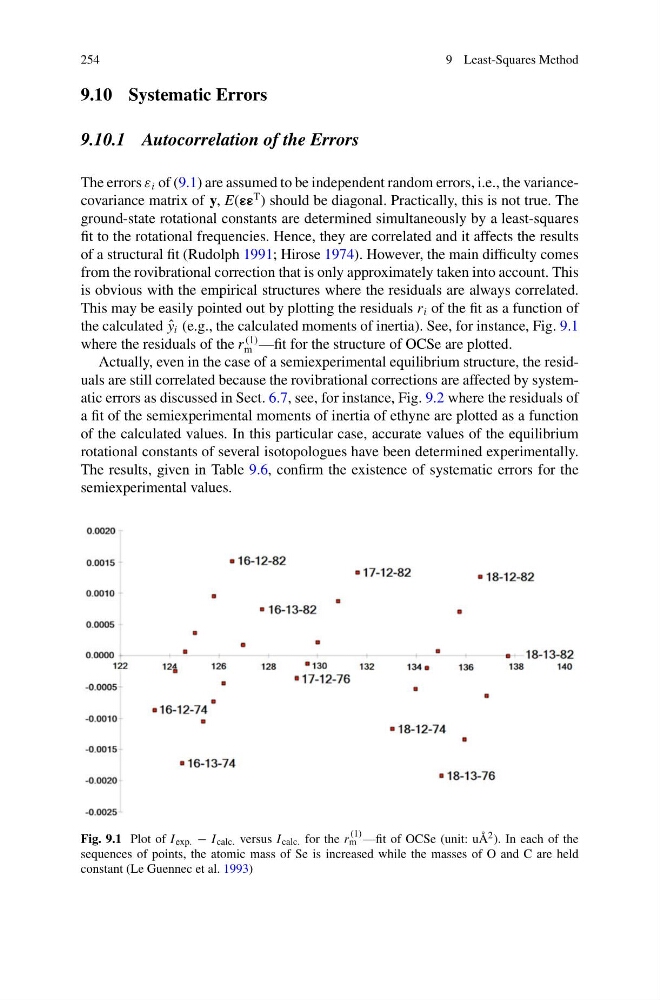
This may be easily pointed out by plotting the residuals r i of the fit as a function of
the calculated ˆ
y i (e.g., the calculated moments of inertia). See, for instance, Fig. 9.1
where the residuals of the r
(1)
m —fit for the structure of OCSe are plotted.
Actually, even in the case of a semiexperimental equilibrium structure, the residuals are still correlated because the rovibrational corrections are affected by systematic errors as discussed in Sect. 6.7, see, for instance, Fig. 9.2 where the residuals of
a fit of the semiexperimental moments of inertia of ethyne are plotted as a function
of the calculated values. In this particular case, accurate values of the equilibrium
rotational constants of several isotopologues have been determined experimentally.
The results, given in Table 9.6, confirm the existence of systematic errors for the
semiexperimental values.
Fig. 9.1 Plot of I exp. − I calc. versus I calc. for the r
(1)
m —fit of OCSe (unit: uÅ 2 ). In each of the
sequences of points, the atomic mass of Se is increased while the masses of O and C are held
constant (Le Guennec et al. 1993)
9 Least-Squares Method
9.10 Systematic Errors
9.10.1 Autocorrelation of the Errors
The errors ε i of (9.1) are assumed to be independent random errors, i.e., the variancecovariance matrix of y, E(εε
T ) should be diagonal. Practically, this is not true. The
ground-state rotational constants are determined simultaneously by a least-squares
fit to the rotational frequencies. Hence, they are correlated and it affects the results
of a structural fit (Rudolph 1991; Hirose 1974). However, the main difficulty comes
from the rovibrational correction that is only approximately taken into account. This
is obvious with the empirical structures where the residuals are always correlated.
This may be easily pointed out by plotting the residuals r i of the fit as a function of
the calculated ˆ
y i (e.g., the calculated moments of inertia). See, for instance, Fig. 9.1
where the residuals of the r
(1)
m —fit for the structure of OCSe are plotted.
Actually, even in the case of a semiexperimental equilibrium structure, the residuals are still correlated because the rovibrational corrections are affected by systematic errors as discussed in Sect. 6.7, see, for instance, Fig. 9.2 where the residuals of
a fit of the semiexperimental moments of inertia of ethyne are plotted as a function
of the calculated values. In this particular case, accurate values of the equilibrium
rotational constants of several isotopologues have been determined experimentally.
The results, given in Table 9.6, confirm the existence of systematic errors for the
semiexperimental values.
Fig. 9.1 Plot of I exp. − I calc. versus I calc. for the r
(1)
m —fit of OCSe (unit: uÅ 2 ). In each of the
sequences of points, the atomic mass of Se is increased while the masses of O and C are held
constant (Le Guennec et al. 1993)